
Loading, please wait...
LOT 0509
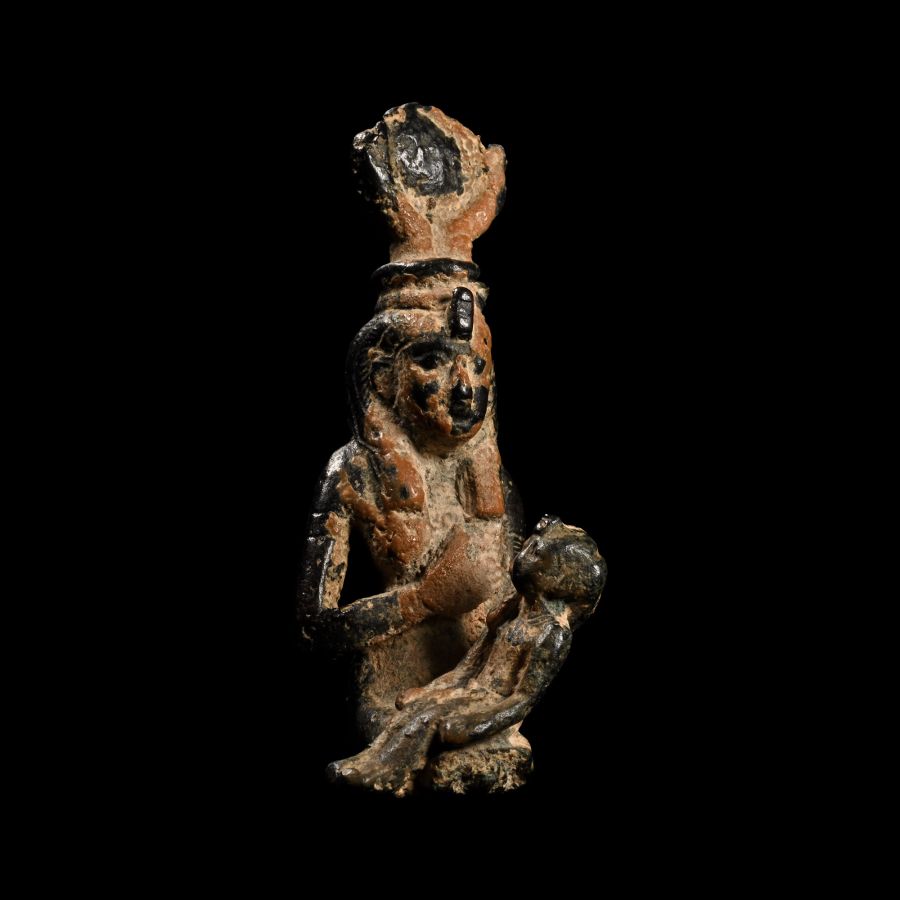
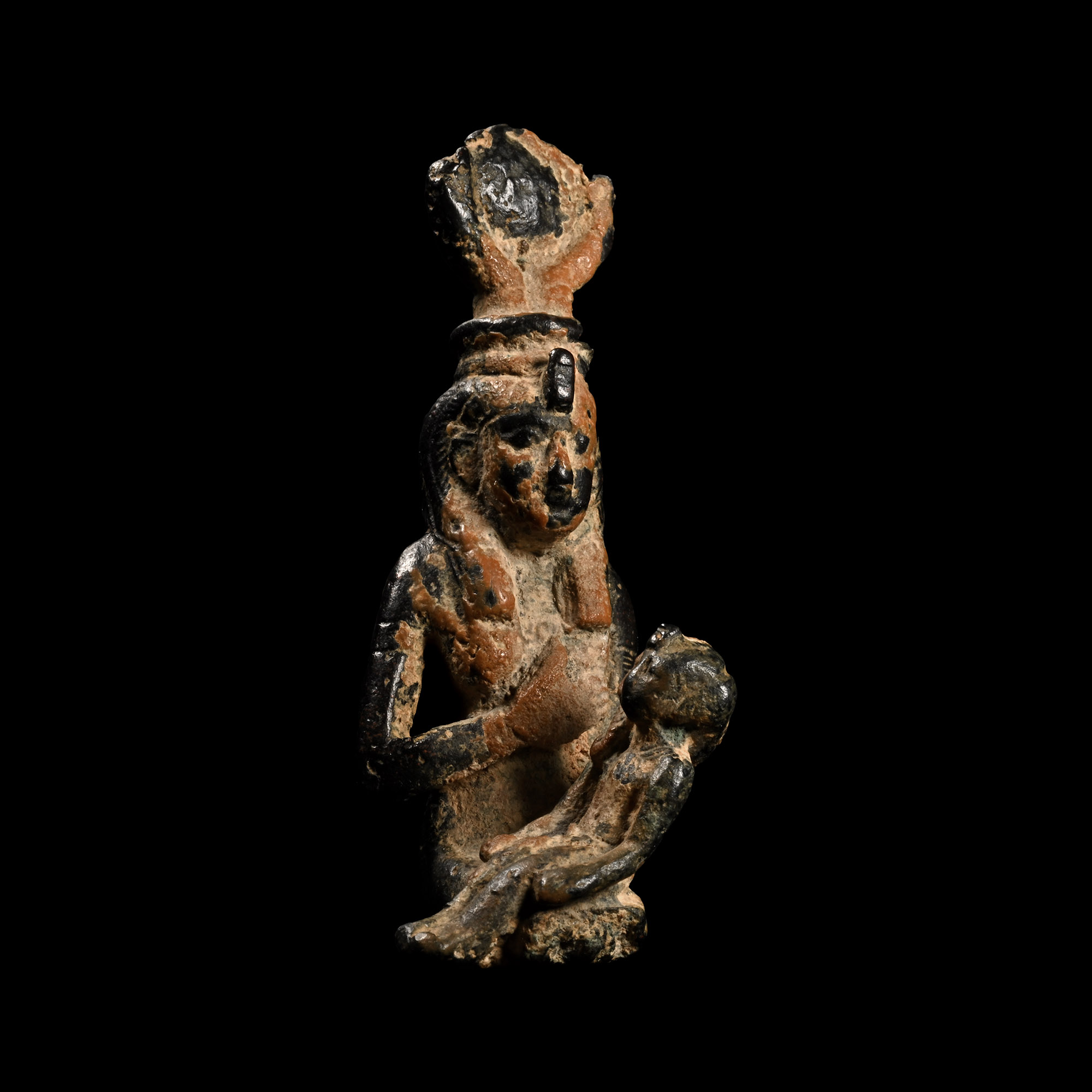
Egyptian Bronze Figure of Isis and Horus
LATE PERIOD, 664-332 B.C.
2 5/8 in. (73.4 grams, 68 mm).
Isis enthroned wearing a cow's horn headdress with a solar disc fronted by uraeus, suckling the infant Horus on her lap; Horus with a side-lock of youth.
ProvenanceAcquired in the mid 1980s-1990s.
Private collection, Switzerland, thence by descent.
Private collection, since the late 1990s.
Cf. Tiribilli, E., The bronze figurines of the Petrie Museum from 2000 BC to AD 400, GHP Egyptology 28, London, 2018, p. 242, no. 349 (UC 8064), for a similar (complete) statuette.
FootnotesIn ancient Egyptian mythology, Isis was the sister-wife of Osiris and the mother of the sky god Horus. She is associated with aspects of fertility and motherhood and is often depicted in various artworks seated in a nursing pose with her son Horus on her lap, as here.
CONDITIONTimeLine Auctions follows a vetting process to ensure the authenticity and legality of all items, reinforcing our commitment to integrity and responsible trading. Each antiquity, antique, and coin lot undergoes thorough examination by a vetting committee of at least ten external specialists, professional trade association members, scientists, and archaeologists: Our Vetting Process
AUCTIONS:
TimeLine is a leading auction house specialising in antiquities, ancient art, collectables, natural history, coins, medals, and books. Our auctions offer museums, collectors, historians, and enthusiasts the opportunity to acquire unique and historically significant pieces.
LOT 0509
Egyptian Bronze Figure of Isis and Horus
Estimate £800 - 1,000€930 - 1,160 (for guidance only)$1,080 - 1,350 (for guidance only)
-
.jpg)
Historic Collection of 591 Slides of Egyptian Archaeological and Other Subjects
1960s-1980s A.D.Sold for (Inc. bp): £910
Housed in five linen-covered boxes, covering ancient Egypt, Aswan, Karnak, Philae, Medinet, Step Pyramids, Nile birds and animals, boats, irrigation, Palestine, Damascus, Greece, Pompeii, Baalbek, Byblos, personal slides etc. 4.32 kg total, 26.5 x 16.5 x 6.5 cm each box
Property of archaeologist Stephanie Gee, N.W. London, UK, 1960s-1980s.
Stephanie Gee was a prominent archaeologist who took part in several expeditions in Egypt. She was a trusted assistant to the British-Australian archaeologist Veronica Seton-Williams, who excavated in Egypt, Britain, and the Near East. Stephanie also took part in the Tell El-Farâ'în expeditions of 1965-1968, and assisted Seton-Williams with preparing the 1966 expedition report. Their collaboration continued and Stephanie helped with the manuscript of Seton-Williams’ book ‘The Road to El-Aguzein’, a narrative account of her life that was first published in 1988. -
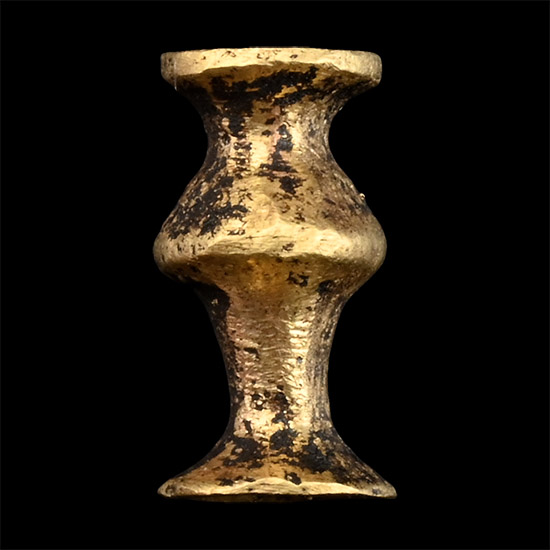
Egyptian Gold Vase-Shaped Bead
Late New Kingdom, 1279-1070 B.C.Sold for (Inc. bp): £234
With median baluster and flange to each end. 4.80 grams, 50 mm
Ex French collection, early 20th century.
This bead likely represents a hes vase, an important ritual vessel used for libations to both the living and the dead. -
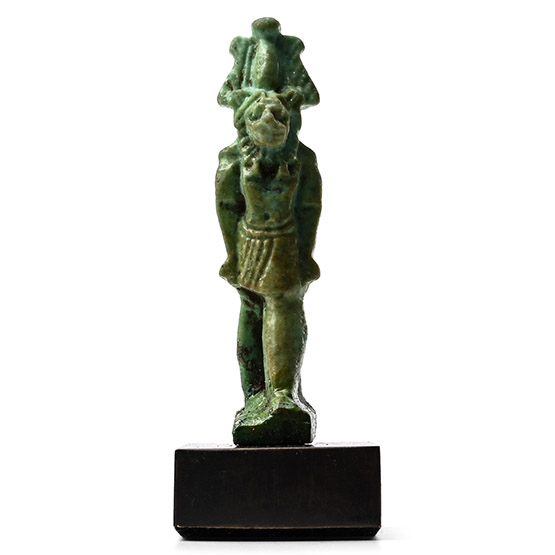
Egyptian Faience Mayhes Amulet
Late Period, 664-332 B.C.Sold for (Inc. bp): £520
Standing erect with dorsal pillar and rectangular base, arms straight and one leg advancing; lion-head wearing atef crown and a uraeus; mounted on a custom-made stand. 50.8 grams total, 84 mm including stand
Ex early 20th century London, UK, collection.
Mahes was an Egyptian lion-headed deity linked to divine protection, royal authority, and retributive justice. Considered a son of the goddess Bastet—or, in some traditions, Sekhmet—he embodied the fierce, solar power of the sun god Re and served as a fierce protector of cosmic order. Mahes was especially venerated in the Delta region, notably at Leontopolis, where his leonine form highlighted his role as a guardian and destroyer of enemies. Iconographically, he is commonly depicted as a lion or, as here, a man with a lion’s head, wearing an atef- crown.
