
Loading, please wait...
_900x900.jpg "Egyptian Bronze Figure of Horus Standing on an Oryx")
_200x200.jpg "Egyptian Bronze Figure of Horus Standing on an Oryx")
_900x900.jpg "Egyptian Bronze Figure of Horus Standing on an Oryx")
_200x200.jpg "Egyptian Bronze Figure of Horus Standing on an Oryx")
.jpg "Egyptian Bronze Figure of Horus Standing on an Oryx")
.jpg "Egyptian Bronze Figure of Horus Standing on an Oryx")
LOT 0038
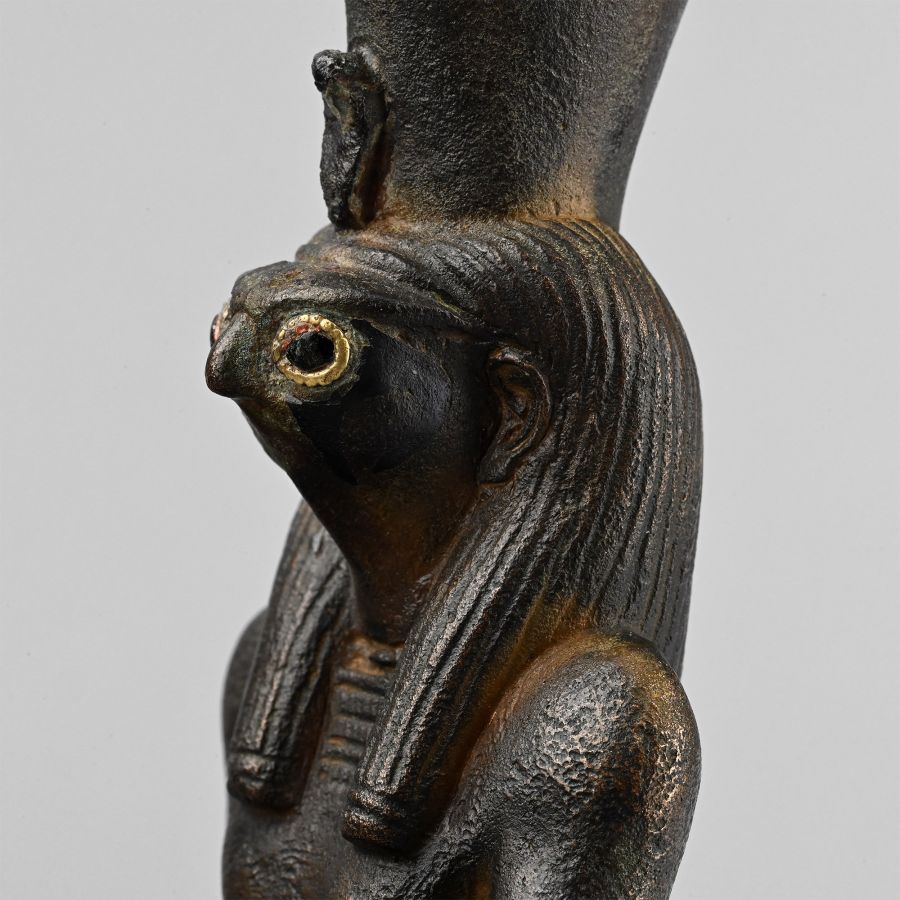
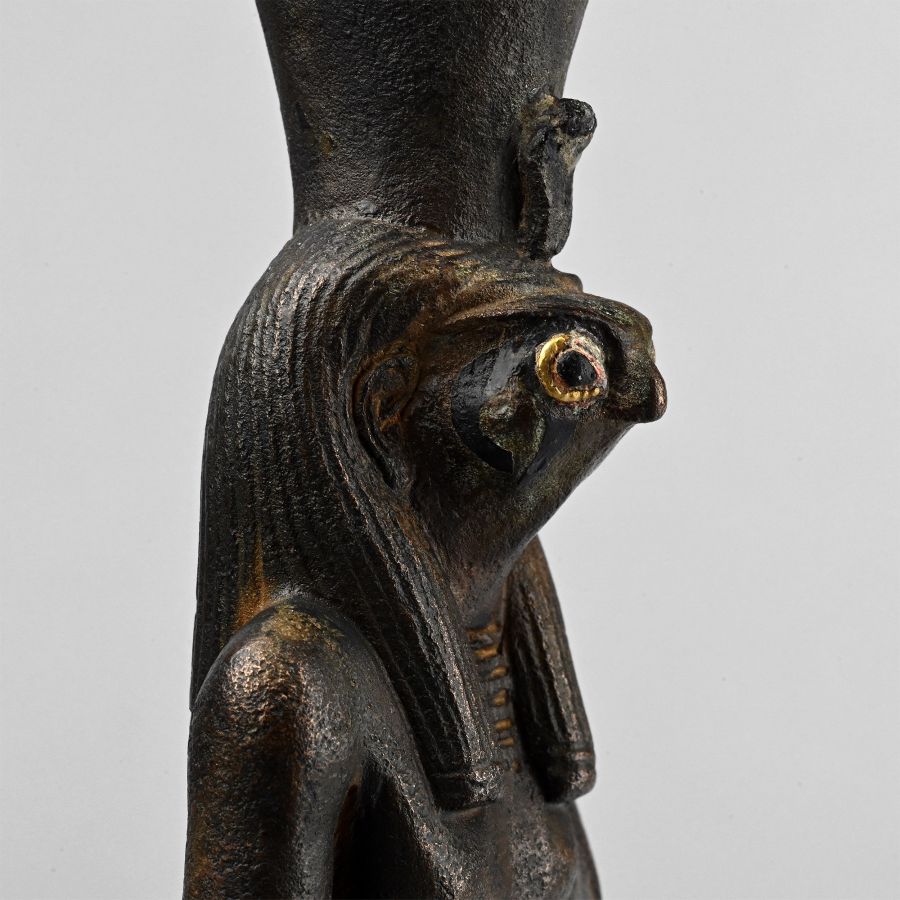
Egyptian Bronze Figure of Horus Standing on an Oryx
LATE PERIOD-PTOLEMAIC PERIOD, 664-30 B.C.
9 in. (1.1 kg total, 23 cm high including stand).
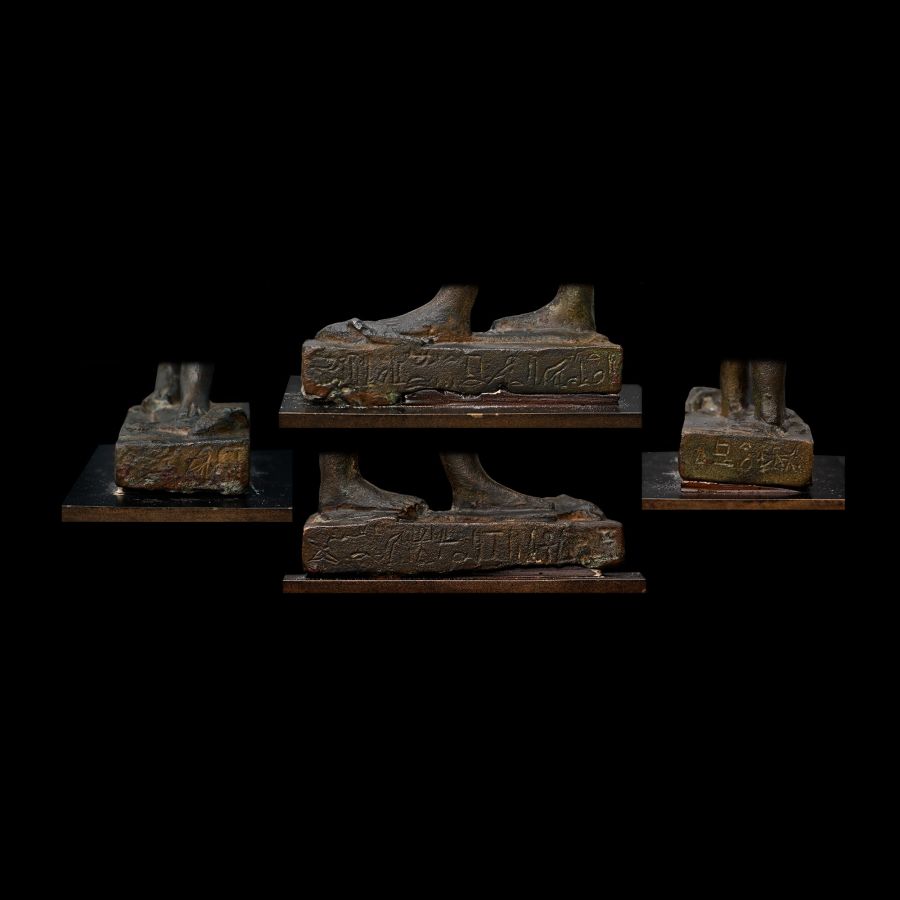
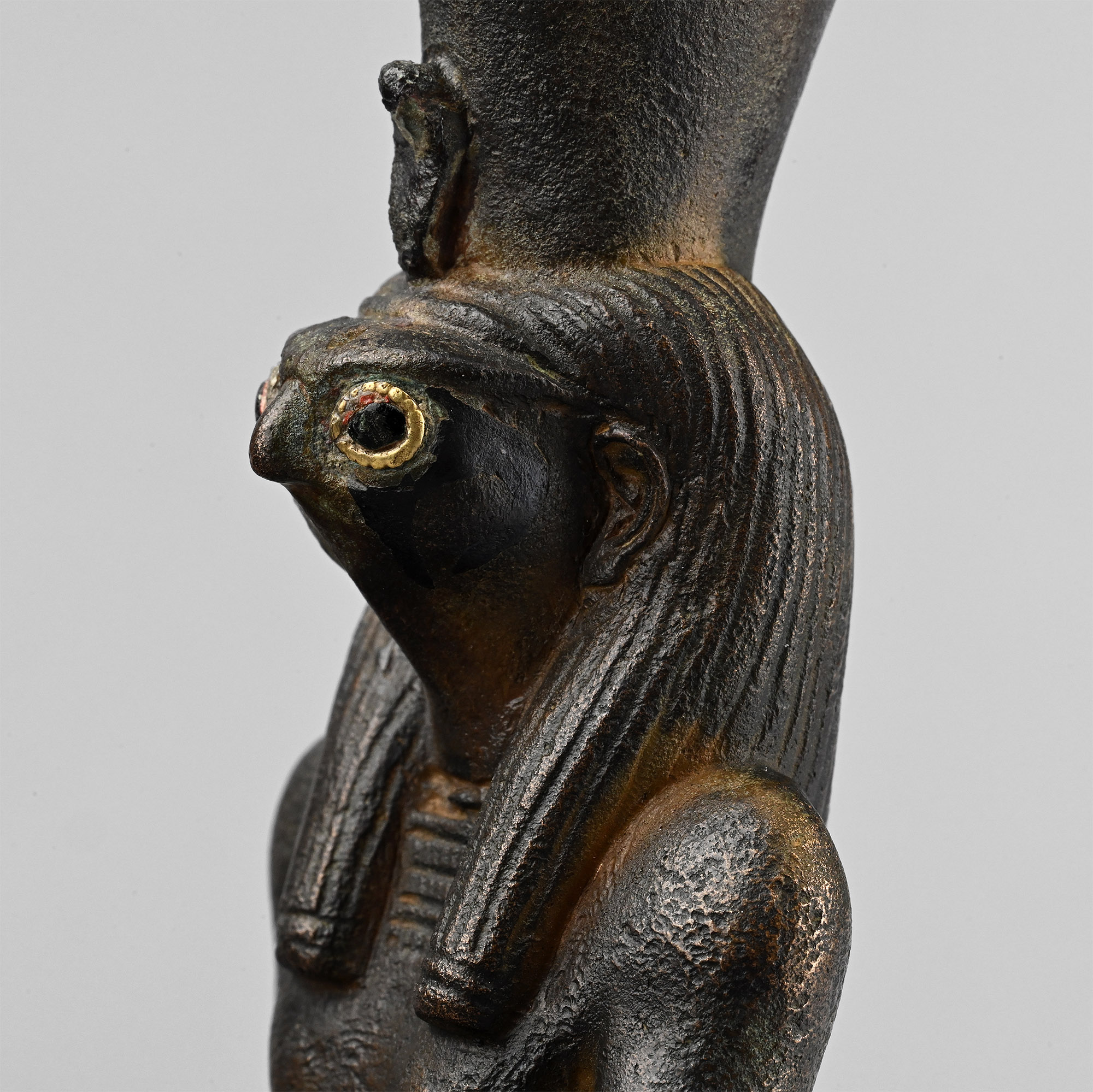
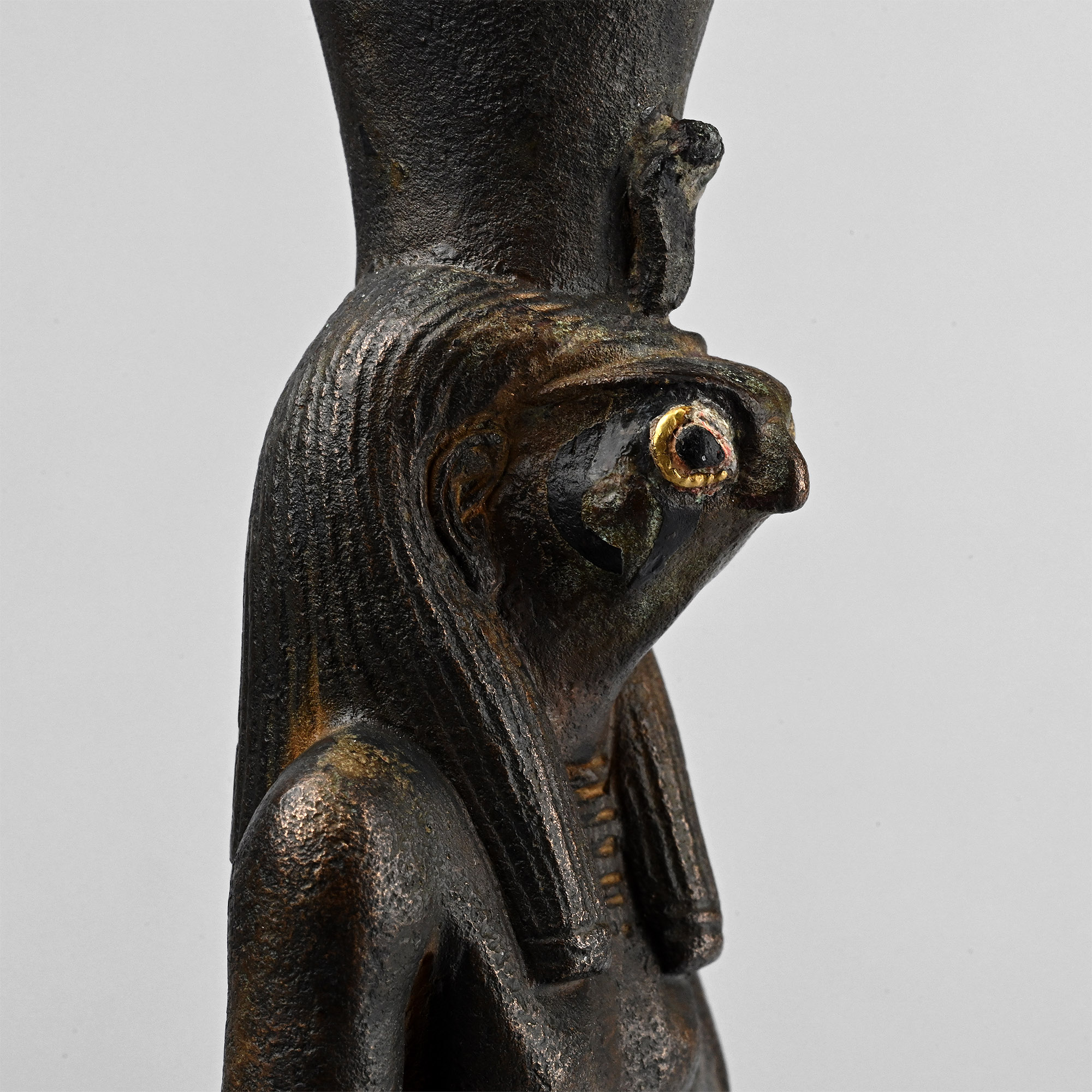
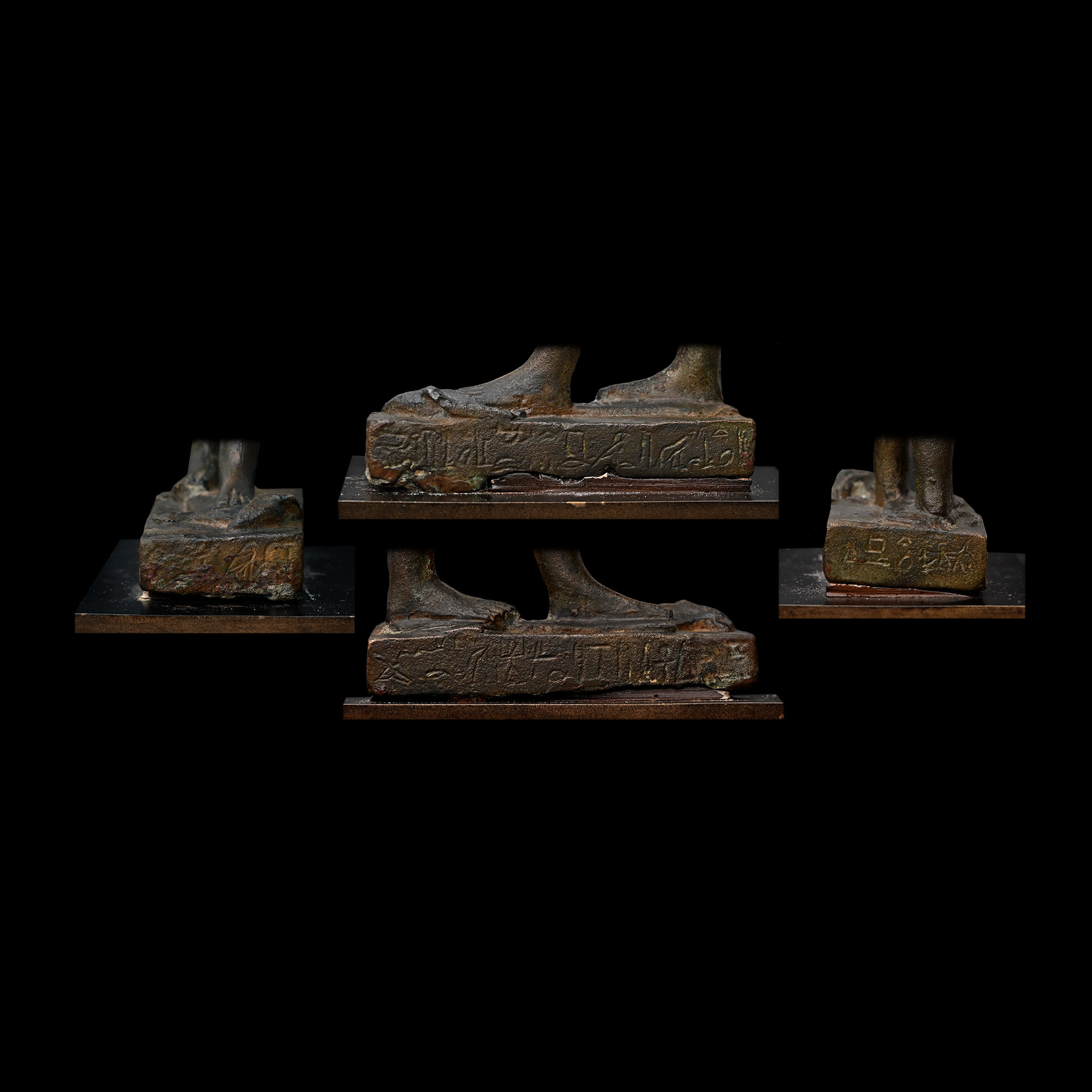
Standing falcon-headed deity with eyes inlaid in gold, wearing the traditional shendyt kilt, a tripartite wig topped by the double crown (pa-sekhemty) fronted by a uraeus, as worn by Egyptian pharaohs, and a wesekh collar; the figure depicted striding forward, with the position of the left arm and drilled hand indicating that it originally held the shaft of a sceptre or a weapon; the right hand also drilled to hold an attribute; the rectangular base featuring a low-relief depiction of an oryx beneath the god’s feet, the four sides of the base bear a line of hieroglyphic invocation giving the name of the deity represented by the statuette and those of the dedicator and his family; two tenons on underside for attachment; mounted on a custom-made display stand.
Provenancewith Sakae Art Gallery, Nagoya, Japan, 1981.
Accompanied by an academic report by Dr Alberto Pollastrini.
This lot has been checked against the Interpol Database of stolen works of art and is accompanied by a search certificate number no.13161-248074.
Small is Beautiful: The Art of Sculpture; Christie's, South Kensington, 6-20 October 2015, no.24.
LiteratureFor comparison, see an Egyptian bronze Horus of Hebenu standing atop a bound oryx from the Recanati Collection, Christie’s, New York, 26 January 2023, no.20; further parallels in New York (Metropolitan Museum of Art, 45.2.11), Baltimore (Walters Art Museum, 54.1013), and Cairo (CG 60359) are discussed by Hill, M., 'Small Divine Statuettes Outfitting Religion,' in Masson-Bergoff, A. (ed.), Statues in Context: Production, Meaning and (Re)-uses, Leuven, 2019, pp.35-49; Daressy, G., Catalogue général des antiquités égyptiennes du Musée du Caire N° 38001-39384 Statues de divinités, Cairo, 1906, p.161 (no.38618), pl. XXXIV, for a similar example.
FootnotesThe hieroglyphic inscription surrounding the base is worn and difficult to interpret. Based on the formulas preserved on similar statuettes, a tentative interpretation of its meaning can be proposed. The text begins with the customary formula ḏd mdw, meaning “words to be spoken,” followed by the hieroglyph of a falcon, indicating that the deity addressed is Horus. The following signs are unclear, making it hard to identify which specific form of Horus is meant, possibly Horus of Hebenu or Horus the Elder. The formula continues with a plea for the god to grant the dedicator life, prosperity, health, longevity, and a good old age. The inscription ends with the name of the offerer: “Pa-iu, son of Pa-di-Aset; his mother Ta-heret; and his wife Aset, justified.”
CONDITIONTimeLine Auctions follows a vetting process to ensure the authenticity and legality of all items, reinforcing our commitment to integrity and responsible trading. Each antiquity, antique, and coin lot undergoes thorough examination by a vetting committee of at least ten external specialists, professional trade association members, scientists, and archaeologists: Our Vetting Process
AUCTIONS:
TimeLine is a leading auction house specialising in antiquities, ancient art, collectables, natural history, coins, medals, and books. Our auctions offer museums, collectors, historians, and enthusiasts the opportunity to acquire unique and historically significant pieces.
LOT 0038
Egyptian Bronze Figure of Horus Standing on an Oryx
Estimate £20,000 - 30,000€23,200 - 34,800 (for guidance only)$27,000 - 40,500 (for guidance only)
-
Egyptian Black Hardstone Scarab
Late Period, 664-332 B.C.Sold for (Inc. bp): £234
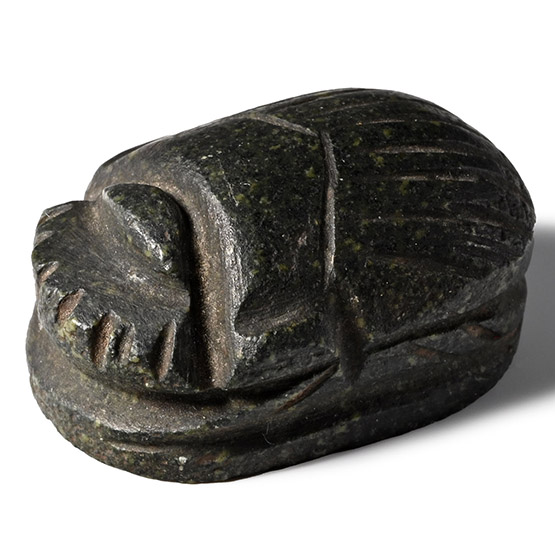
Dark green hardstone with paler speckles; with a boldly carved head, clypeus, prothorax and elytra, and legs indicated at the sides; plain underside. 17 grams, 29 mm
Ex Irene Newman, Birdham, Chichester, West Sussex, England. with Stride & Son Auctioneers, Chichester, West Sussex, England, 23 April 2015, no.1599 [Part]. Acquired by the present owner at the above sale.
The scarab, which represented the dung beetle, was the most popular amulet in ancient Egypt for approximately two thousand years until the Ptolemaic Period when it gradually fell out of favour. The popularity of scarabs extended beyond the borders of Egypt, and they were also distributed and produced in other regions, such as Phoenicia and Israel. The beetle is named khepri, derived from the verb 'to come into existence', and was considered the embodiment of the creator god Khepri, who was self-engendered. The ancient Egyptians mistakenly believed that the young beetle emerging from the dung ball was the result of an act of self-creation. -
Egyptian Silver Fly Amulet
Late Period, 664-332 B.C.Sold for (Inc. bp): £260
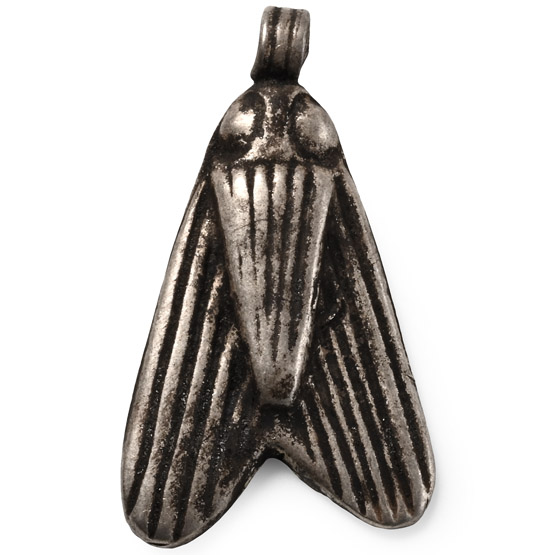
With detailing to wings and eyes, loop for suspension above the head. 2.15 grams, 24 mm
From the collection of a London, UK, gentleman, 1990s.
Considering that Egyptian artists often depicted fly whisks in the hands of pharaohs and high officials, one might assume that flies were merely a nuisance. However, the Egyptians held flies in high regard for their speed, quick reactions, and persistence. Small fly amulets first appeared in burials during the Naqada II Period, around 3200 B.C. These amulets gained popularity and were crafted from various materials such as gold, silver, lapis lazuli, carnelian, amethyst, faience, and bone. These amulets were believed to protect against insect bites and to ward off troublesome flying creatures through apotropaic magic. Some believe they may have even symbolised the fly’s fecundity. Additionally, pharaohs would bestow gold fly-shaped pendants as military awards to honour the bravery and persistence of soldiers in battle. -
Egyptian Pale Green Glazed Faience Shabti Fragment with Hieroglyphs
Late Period, 664-332 B.C.Sold for (Inc. bp): £364
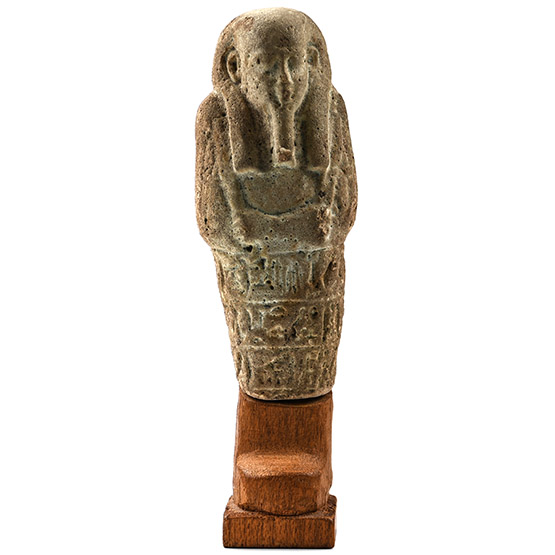
Head and torso of a mummiform figure, wearing a tripartite wig and divine beard, with arms crossed and hands holding agricultural implements and a cord for a seed bag over the left shoulder, three horizontal bands of hieroglyphic inscriptions to the lower body; mounted on a wooden display stand. 86 grams, 12.5 cm including stand
From a Scottish gentleman’s collection, Glasgow, formed from the early 2000s.
The owner's name is poorly preserved, although the filiation that follows may read: "...born (to) Djed-mut-ies-ankh" (ms ḏd mwt ı͗w s Ꜥnḫ).
