
Loading, please wait...
_900x900.jpg "Egyptian Bronze Figure of Harpocrates")
_200x200.jpg "Egyptian Bronze Figure of Harpocrates")
_900x900.jpg "Egyptian Bronze Figure of Harpocrates")
_200x200.jpg "Egyptian Bronze Figure of Harpocrates")
.jpg "Egyptian Bronze Figure of Harpocrates")
.jpg "Egyptian Bronze Figure of Harpocrates")
LOT 0028
Egyptian Bronze Figure of Harpocrates
LATE PERIOD, 664-332 B.C.
7 1/4 in. (584 grams, 18.5 cm).
Seated nude statuette of Harpocrates, with legs together and left arm by his side, right arm bent across the chest with forefinger raised to his lips, wearing a nemes headdress with uraeus on the front and a bold sidelock on the right side, surmounted by an elaborate hem-hem crown consisting of three conical atef crowns each topped with a sun disc, with an ostrich plume to the side of the outermost, and flanked by two uraei with sun discs, all supported on two horizontal ram's horns; semi-naturalistic anatomical detailing; feet resting on an integral square plinth, mounted on a wooden stand.
ProvenanceEx pre-war collection, Switzerland.
Private collection, Europe.
Accompanied by a copy of an Art Loss Register certificate no.S00075707.
This lot has been checked against the Interpol Database of stolen works of art and is accompanied by a search certificate number no.12371-226682.
Cf. Roeder, G., Ägyptische Bronzefiguren II, Berlin, 1956, pl. 21c-d, for a similar example.
FootnotesHarpocrates is the Greek rendering of the Egyptian Hor-pa-khered, which translates as 'Horus the Child'. This refers to Horus as the divine infant of Isis and Osiris. Statuettes of Harpocrates could provide the dedicator with the same protection that Isis gave her beloved son.
CONDITIONTimeLine Auctions follows a vetting process to ensure the authenticity and legality of all items, reinforcing our commitment to integrity and responsible trading. Each antiquity, antique, and coin lot undergoes thorough examination by a vetting committee of at least ten external specialists, professional trade association members, scientists, and archaeologists: Our Vetting Process
AUCTIONS:
TimeLine is a leading auction house specialising in antiquities, ancient art, collectables, natural history, coins, medals, and books. Our auctions offer museums, collectors, historians, and enthusiasts the opportunity to acquire unique and historically significant pieces.
-
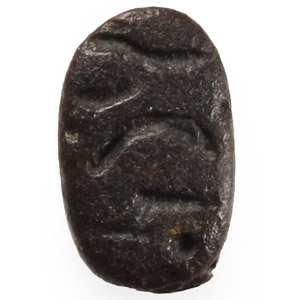
Phoenicio-Egyptian Inscribed Frog Amulet
Late 1st millennium B.C.Sold for (Inc. bp): £26
Carved in the round on an ellipsoid base with incised Phoenician characters to the underside. 1.32 grams, 10 mm
Acquired 1980-2015. Ex Abelita family collection. -
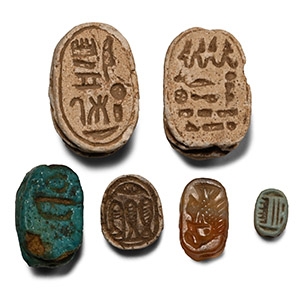
Egyptian Steatite and Faience Scarab Group
Late Period, 664-332 B.C.Sold for (Inc. bp): £208
Their bases decorated with hieroglyphs and figures, including one with the motto 'Amun lord of the Two Lands', another with the motto 'lord Ramesses beloved of Amun', and one with a detailed representation of a Nile tilapia fish. 8.68 grams total, 7-21 mm
From an early 20th century collection. -
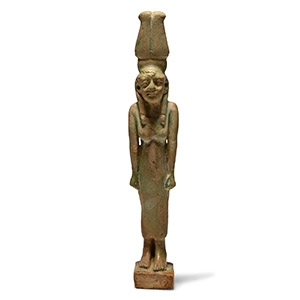
Large Egyptian Faience Amulet of the Goddess Isis
Late Period-Ptolemaic Period, 664-30 B.C.Sold for (Inc. bp): £1,170
The goddess dressed in a long tight-fitting tunic to her ankles, standing with her left leg forward, her straight arms descending to her thighs; vulture headgear surmounted two long feathers; dorsal pillar with hieroglyphic text; repaired. 50 grams, 14 cm
Private collection Mr E. Saad, Cairo, Egypt-Montreux, Switzerland, 1970s. Ex private collection of Mr S.A., acquired from Mr Saad in 1997.
In ancient Egyptian mythology, Isis was the sister-wife of Osiris and the mother of the sky god Horus. She is associated with aspects of fertility and motherhood. This amulet unusually depicts her with a two-plumed crown, which may associate her with the goddess Sothis.
