Loading, please wait...

Use mousewheel to zoom in and out, click to enlarge

Details

LOT 0012

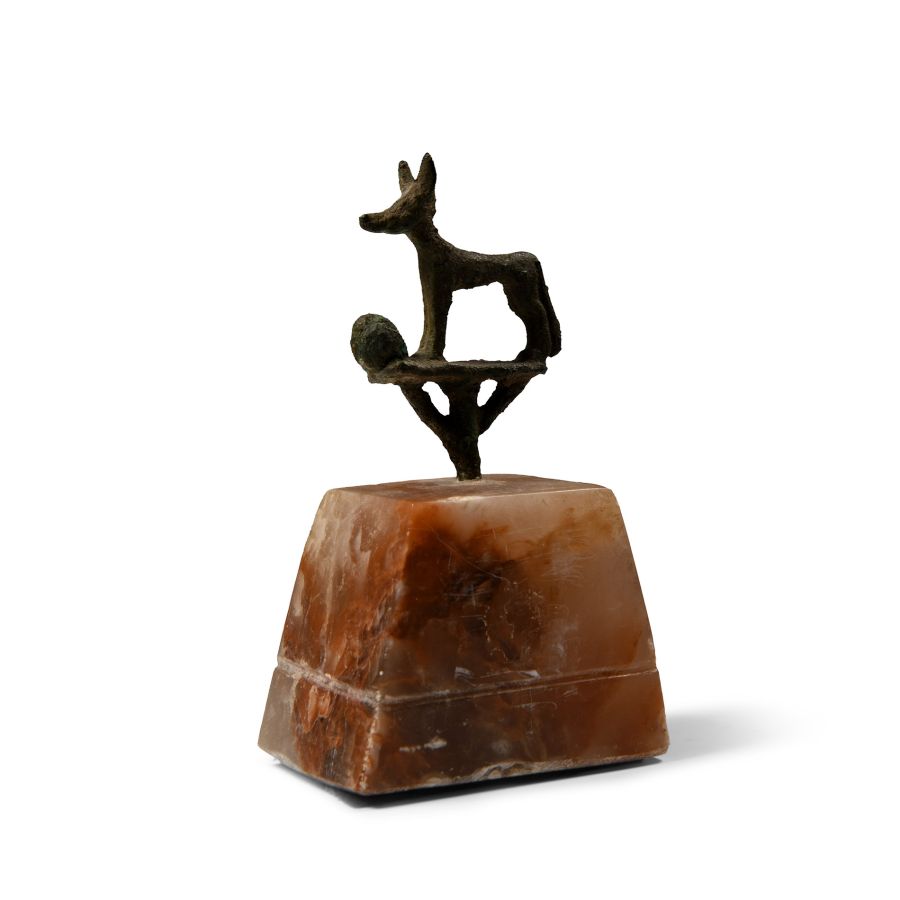
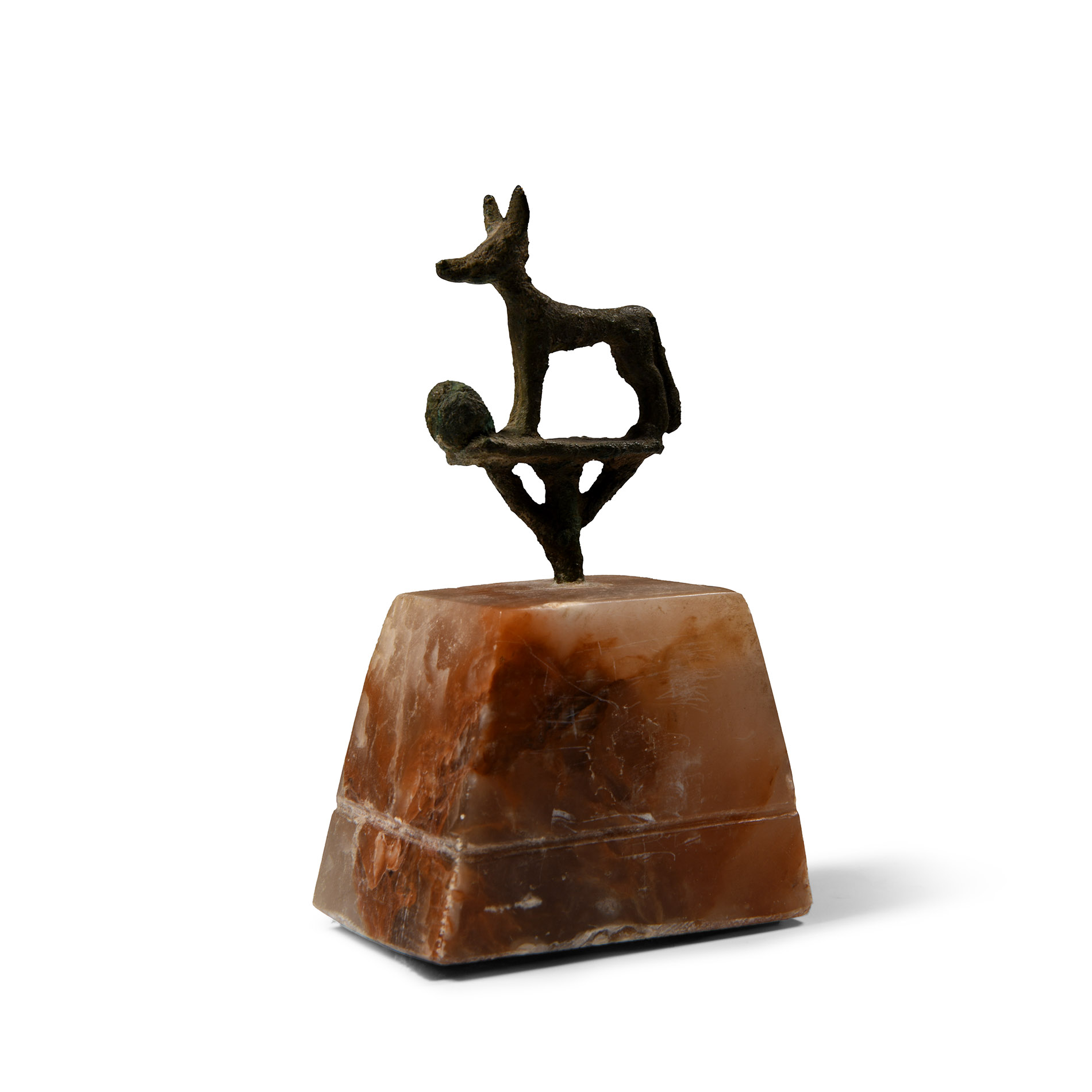
Egyptian Bronze Anubis Finial

LATE PERIOD-PTOLEMAIC PERIOD, 664-30 B.C.

5 in. (377 grams total, 12.5 cm high including stand).

Standing before an enigmatic balloon-like object on a rectangular base with two supports flanking a short shank; mounted on a custom-made stand.

Provenance

Believed to have been collected (1899-1914) and in an early 20th century collection, with some references to Psamtik I, and a German funded expedition.
Ex Ludwig Borchardt, Heliop.
Private collection of Mr T.H., Norfolk, UK.

Accompanied by a handwritten note from Ludwig Borchardt.

Literature

Cf. Tiribilli, E., The bronze figurines of the Petrie Museum from 2000 BC to AD 400, GHP Egyptology 28, London, 2018, p.184, cat.no.259, for a less elaborate Wepwawet standard terminal.

Footnotes

Wepwawet, the canine god, is strongly linked with Abydos and kingship. His name means 'Opener of the Ways' and may have had military connotations as someone who clears the path for his king. In funerary texts, Wepwawet guided the dead through the Underworld. The image of the god on a standard, as seen in this example, was carried in processions associated with Osiris and kingship. The balloon-like object, known as shed-shed, is mysterious but may have symbolised the royal placenta, which was considered the king's 'double'.

CONDITION

VETTING:

TimeLine Auctions follows a vetting process to ensure the authenticity and legality of all items, reinforcing our commitment to integrity and responsible trading. Each antiquity, antique, and coin lot undergoes thorough examination by a vetting committee of at least ten external specialists, professional trade association members, scientists, and archaeologists: Our Vetting Process


AUCTIONS:

TimeLine is a leading auction house specialising in antiquities, ancient art, collectables, natural history, coins, medals, and books. Our auctions offer museums, collectors, historians, and enthusiasts the opportunity to acquire unique and historically significant pieces.

LOT 0012

Egyptian Bronze Anubis Finial

Sold for (Inc. bp): £572

Print page

RELATED LOTS

  • Egyptian Painted Wooden Model of a Cow Giving Birth, Together with Two Figures
    Egyptian Painted Wooden Model of a Cow Giving Birth, Together with Two Figures
    Middle Kingdom, 11th-12th Dynasty, 2023-1862 B.C.

    Estimate: £4,000 - 6,000 (+bp*)

    Opening Bid: £2,000

    Composed of three figures: a standing cow or other quadruped giving birth to its young, its head, neck and forelegs emerging from the mother's rear, both with a black and white speckled coat; a standing male figure with articulated arms and pierced hands, wearing a kilt and cropped wig and with stylised facial detailing; a kneeling figure also with articulated arms, open-palm hands, wearing a kilt and cropped wig, stylised facial features; extensive remains of polychrome pigment. 111 grams total, 9.5-16 cm


    From an early 20th century Home Counties collection. This lot has been checked against the Interpol Database of stolen works of art and is accompanied by search certificate no.11597-199209.

    Such models would have been deposited in tombs; the purpose of such a scene was probably to evoke the season of spring, when calves were born, and the floodplain where farmers lived and raised their livestock.

    Lot Details

  • Egyptian Bronze Kneeling Priest Statuette
    Egyptian Bronze Kneeling Priest Statuette
    Late Period, circa 664–332 B.C.

    Estimate: £1,500 - 2,000 (‡+bp*)

    Opening Bid: £750

    The male figure of a kneeling supplicant with back pillar inscribed with hieroglyphic text: 'Neith gives life [to] ...'. 54 grams total, 76 mm including stand


    Private collection S., Freiburg im Breisgau, Germany, acquired in the first half of the 20th century. Accompanied by a copy of an Art Loss Register certificate number S00140657, dated 23 October 2018.

    This figure was likely attached to a separately cast base and positioned kneeling before a larger figure of the goddess Neith. Such objects were donated to temples to secure the god or goddess's protection for the donor, represented by the kneeling figure.

    Lot Details

  • Egyptian Blue Faience Shabti for Nesitanebisheru
    Egyptian Blue Faience Shabti for Nesitanebisheru
    Third Intermediate Period, 21st Dynasty, circa 980-935 B.C.

    Estimate: £25,000 - 35,000 (‡+bp*)

    Opening Bid: £12,500

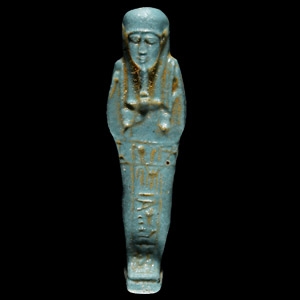
    A vibrant blue-glazed mummiform shabti of princess Nesitanebisheru, daughter of Pinudjem II, on a custom-made display stand; modelled with arms crossed over the chest, holding a hoe in each hand, wearing a tripartite wig; netted seed bag painted on the back; the bottom half of the figure bearing eight columns of hieroglyphic text in black giving a version of the shabti spell reading: (1) The illuminated one, the Osiris Nesitanebisheru, she says: (2) ‘O this shabti, if one counts, if one reckons to do (3) for the Osiris Nesitanebisheru, to cultivate the fields, (4) to irrigate the riparian lands, to transport by boat the sand of (5) the east (to) the west and vice-versa – now indeed obstacles are implanted (6) therewith – as a man at his duties (to do for ?) (7) the Osiris Nesitanebisheru, to do all the works that are to be done (8) in God’s land at any time to serve, ‘here I am,’ (you shall say). 314 grams total, 16.5 cm high including stand


    The object comes from the well known Deir el-Bahari cache (near Thebes) first discovered in 1870. Ex Zurich Antiquities Fair. Ex R. Liechti, Geneva, acquired from the above. Accompanied by an academic report by Egyptologist Paul Whelan. This lot has been checked against the Interpol Database of stolen works of art and is accompanied by search certificate no.11598-198961.

    Nesitanebisheru’s burial was discovered in the famous ‘Royal Cache I’ at Deir el-Bahari (DB 320), with many dozens of coffins and vast quantities of funerary equipment belonging to pharaohs, including Thutmose III and Ramesses II, queens, and other royals, as well as elite members of society that had been reburied by Amun priests to hide them from tomb robbers. Nesitanebisheru’s coffin and burial equipment, including her shabtis, were found at the very end of the c. 70m long tomb in a chamber which served as a family vault for her father, the High Priest of Amun, Pinudjem II, and his principal wife Neskhons. While her worker shabtis are all mostly similar in style with 6-8 text columns, the composition of their inscriptions are not consistent with different openings and variations to the content (often including several peculiarities). Curiously, her titles do not appear in her shabti inscription, unlike those for her mother.

    Lot Details

Stay up-to-date with the latest from TimeLine Auctions by joining our mailing list