
Loading, please wait...
_900x900.jpg "Egyptian Bone Cosmetic Spoon")
_200x200.jpg "Egyptian Bone Cosmetic Spoon")
.jpg "Egyptian Bone Cosmetic Spoon")
LOT 0029
Egyptian Bone Cosmetic Spoon
LATE NEW KINGDOM, 1550-664 B.C.
7 3/4 in. (32 grams, 19.5 cm).
The naked female figure standing on a lotus column and holding an elongated shallow cosmetic spoon above her head.
ProvenanceAcquired in Egypt in the early 20th century.
Private collection of Mr T.H., Norfolk, UK.
Cf. Hayes, W.C., The Scepter of Egypt. A Background for the Study of the Egyptian Antiquities in The Metropolitan Museum of Art, Vol 1, New York, 1990 (reprint), p.191, fig.106 (centre, left), for a close parallel (although only the top of papyrus handle preserved) dated to the 18th Dynasty.
CONDITIONTimeLine Auctions follows a vetting process to ensure the authenticity and legality of all items, reinforcing our commitment to integrity and responsible trading. Each antiquity, antique, and coin lot undergoes thorough examination by a vetting committee of at least ten external specialists, professional trade association members, scientists, and archaeologists: Our Vetting Process
AUCTIONS:
TimeLine is a leading auction house specialising in antiquities, ancient art, collectables, natural history, coins, medals, and books. Our auctions offer museums, collectors, historians, and enthusiasts the opportunity to acquire unique and historically significant pieces.
-
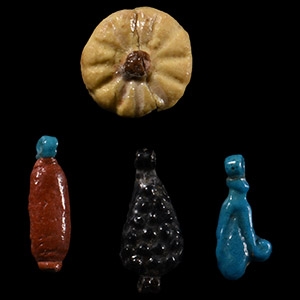
Egyptian Faience Amulet Collection
New Kingdom, 1550-1070 B.C.Sold for (Inc. bp): £182
Comprising: black bunch of grapes; red date; blue palmette frond; white daisy rosette. 1.51 grams, 12-16 mm
From the M.S. Ciappara collection, 1930s-1950s; and the flower amulet from a UK collection, 19202-1940s. Ex Den of Antiquity, Cambridgeshire, UK, and Ancient Art, London N14, UK. Private collection of Mr T.H., Norfolk, UK. Accompanied by two previous dealer's certificates of authenticity. -
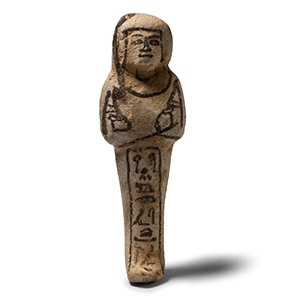
Egyptian White Faience Shabti for Khaemwaset
Ramesside Period, 19th-20th Dynasty, 1305-1080 B.C.Estimate: £1,500 - 2,000 (+bp*)
Opening Bid: £800
With black applied detailing to the face, arms, tools and block of hieroglyphic text to the lower body giving the dedication 'The illuminated one, the Osiris, Sem-(priest), Khaemwaset, true of voice.' 87 grams, 13.3 cm high
Acquired from Alex Malloy, New York, U.S.A., 1970-1980s. Ex U.S.A. collection. Accompanied by an old certificate of authenticity ($2900.00).
Although lacking the title 'King's son', this shabti is probably for Prince Khaemwaset, offspring of Ramesses II, who was Sem-priest in the temple of Ptah at Memphis. -
.jpg)
Egyptian Alabaster Hedgehog Vessel
Late Period, 664-332 B.C.Estimate: £600 - 800 (+bp*)
Opening Bid: £240
Carved in the round with four stubby feet and hatched body, broad lip and with lug on the reverse. 99 grams, 45 mm
Part of an old collection dating back to the 19th century. Ex property of a gentleman, acquired before the 1980s. Private collection of Mr T.H., Norfolk, UK.
