
Loading, please wait...
_900x900.jpg "Egyptian Bone and Glass Mummy Eye Pair")
_200x200.jpg "Egyptian Bone and Glass Mummy Eye Pair")
.jpg "Egyptian Bone and Glass Mummy Eye Pair")
LOT 0475
Egyptian Bone and Glass Mummy Eye Pair
1ST MILLENNIUM B.C. OR LATER
1 3/4 in. (5.18 grams total, 43-45 mm).
Each lentoid in plan with applied iridescent blue glass panel. [2, No Reserve]
ProvenanceAcquired in UK art market, 1977-1979.
CONDITIONTimeLine Auctions follows a vetting process to ensure the authenticity and legality of all items, reinforcing our commitment to integrity and responsible trading. Each antiquity, antique, and coin lot undergoes thorough examination by a vetting committee of at least ten external specialists, professional trade association members, scientists, and archaeologists: Our Vetting Process
AUCTIONS:
TimeLine is a leading auction house specialising in antiquities, ancient art, collectables, natural history, coins, medals, and books. Our auctions offer museums, collectors, historians, and enthusiasts the opportunity to acquire unique and historically significant pieces.
-
.jpg)
Egyptian Faience Menat Amulet
Late Period, 664-332 B.C.Sold for (Inc. bp): £286
Amuletic pendant formed as keyhole-shaped plaque with decorative column to one face, ribbed suspension loop to the top. 1.52 grams, 25 mm
Ex early 20th century collection, London, UK.
The menat was a counterpoise that hung at the back of a heavy ornamental collar and was closely associated with the goddess Hathor. Amulets representing the counterpoise were thought to bring good luck, protect against evil spirits, and safeguard the wearer in the afterlife. Their Hathoric connection symbolised fertility and good health for women while representing virility for men. -
.jpg)
Egyptian Faience Nephthys Amulet
Late Period, 664-332 B.C.Sold for (Inc. bp): £208
Standing figure of the goddess, wearing a striated lappet wig topped by her characteristic headdress, with her arms at her sides; supported by a dorsal pillar pierced once for suspension. 1.68 grams, 34 mm
Ex early 20th century collection, London, UK.
This amulet represents Nephthys (Egyptian: Nebet-Hut), a protective goddess closely associated with mourning, magic, and the afterlife. Often depicted as a woman with her name in hieroglyphs atop her head, Nephthys is Isis’s sister and, together with Isis, plays a central role in the funerary rites of Osiris. Amulets of Nephthys were often worn or placed among the deceased’s wrappings to invoke her protective role during the journey to the afterlife. As a divine mourner, Nephthys was believed to guard the dead and assist in their rebirth, making her amulet a symbol of divine protection, sacred lamentation, and renewal. -
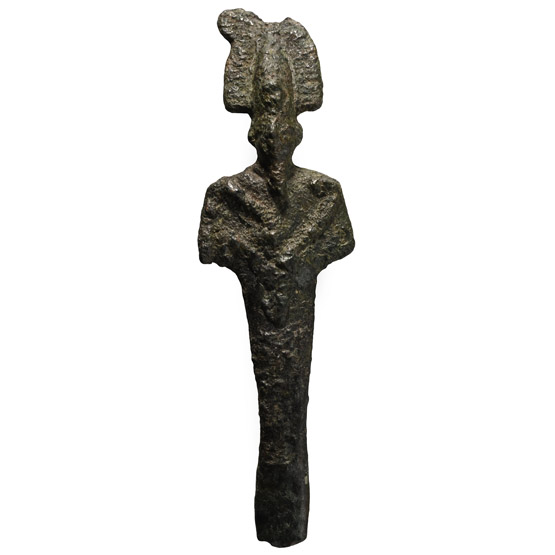
Egyptian Bronze Osiris Statuette
Late Period, 664-332 B.C.Sold for (Inc. bp): £130
Standing mummiform figure, wearing the conical Atef crown with flanking ostrich plumes and frontal uraeus, holding the crook (heka) and flail (nekhakha) regalia; minor chip to the crown. 16.5 grams, 69 mm
Ex Constable collection, 1990s. Ex P. Morris collection.
