
Loading, please wait...
LOT 0016
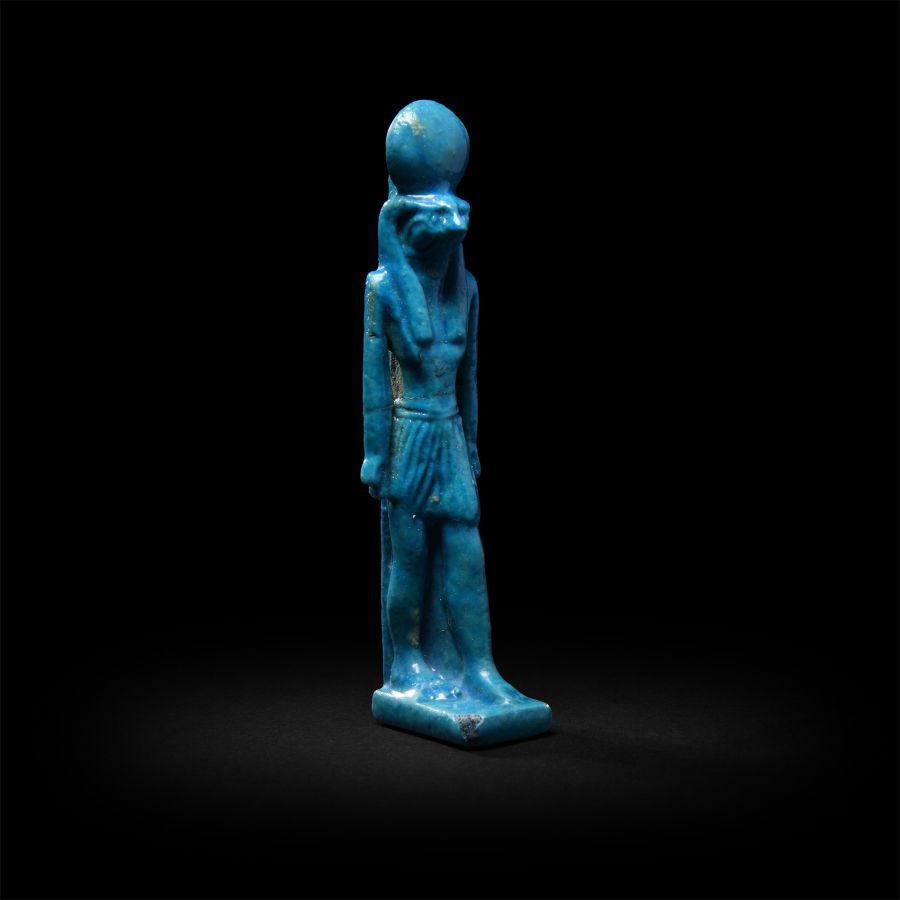
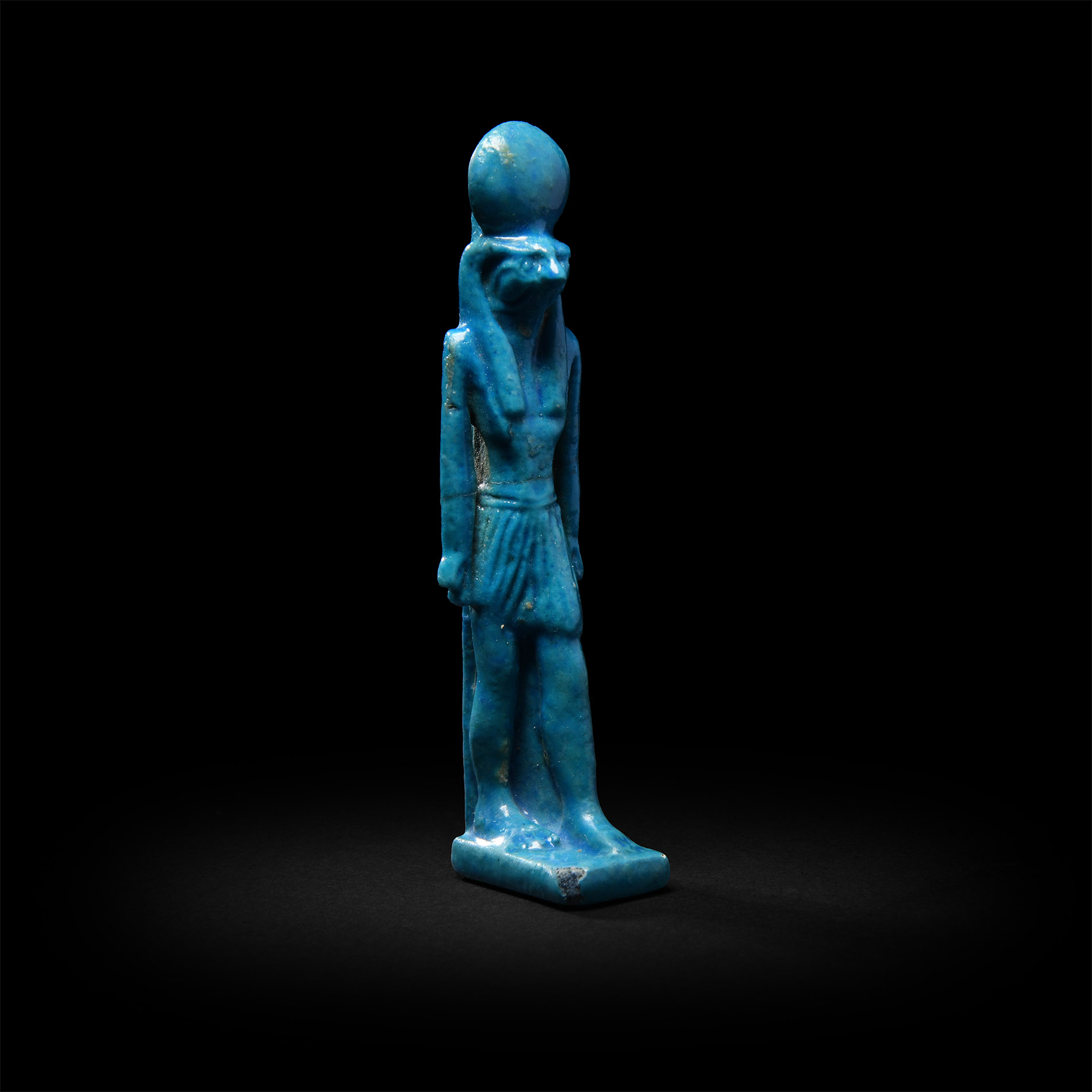
Egyptian Blue Glazed Ra Amulet
LATE NEW KINGDOM, CIRCA 1550-1070 B.C.
3 3/8 in. (18.4 grams, 87 mm high).
A blue glazed composition figure of the advancing god Ra (possibly Ra-Horakhty), falcon-headed and wearing a sun disc, set on an integral rectangular base, left leg positioned in front of the right, arms held straight by his sides, wearing a wig and kilt; tapering pillar with suspension loop behind solar disc; repaired.
ProvenanceAcquired from Dr Jan Beekmans, circa 1982.
UK private collection.
In ancient Egypt, Ra sat as the king of all the deities and the father of all creation, the god who could not only govern the sun, but who transformed himself into the sun. He was associated with the falcon, hence he is typically portrayed as a human with a falcon's head. The major cultic centre for Ra was the ancient city Iwnw, known as Heliopolis to the Greeks, which today lies under modern Cairo. The ancient Egyptians were an agricultural society inhabiting a desert; the sun (and thus Ra) was an integral component of their world view.
Placed on the chest of the deceased, this amulet offered the wearer the chance of eternal renewal each morning with the sun.
TimeLine Auctions follows a vetting process to ensure the authenticity and legality of all items, reinforcing our commitment to integrity and responsible trading. Each antiquity, antique, and coin lot undergoes thorough examination by a vetting committee of at least ten external specialists, professional trade association members, scientists, and archaeologists: Our Vetting Process
AUCTIONS:
TimeLine is a leading auction house specialising in antiquities, ancient art, collectables, natural history, coins, medals, and books. Our auctions offer museums, collectors, historians, and enthusiasts the opportunity to acquire unique and historically significant pieces.
-
.jpg)
Egyptian Marble Eye Inlay
Late Period, 664-525 B.C.Sold for (Inc. bp): £52
A carved white marble eye inlay from a statue; unfinished. 24.4 grams, 58 mm
London, UK, art market, 1980s. From the collection of G.M.R.H., London, UK. -
Large Egyptian Body of Horus-Harpocrates
Ptolemaic Period, 332-30 B.C.Estimate: £2,000 - 3,000 (+bp*)
Opening Bid: £1,000
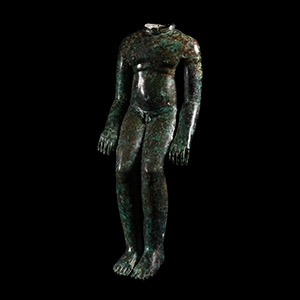
An acephalic seated bronze nude statuette of Horus-Harpocrates, legs held together and arms by his side, semi-naturalistic anatomical detailing; cleaned. 993 grams, 22.5 cm high
Collection of Brugsch Pasha (1842-1930). with Hotel Drouot, Paris, 30 September 1997, lot 643. Ex property of Mr Naudy. Property of a French collector. This lot has been checked against the Interpol Database of stolen works of art and is accompanied by search certificate no.11601-198618. Accompanied by a scholarly note by Egyptologist Paul Whelan.
Horus, son of Isis and Osiris, was considered a solar deity who overcame darkness and defeated the chaotic forces of his evil uncle, the god Seth. Egyptian Pharaohs considered themselves to be reincarnations of Horus. In his youthful form, Horus the child embodies the new sun and all associated benefits. In Graeco-Roman Egypt he became Harpocrates, son of Serapis and Isis, the deity-symbol of rebirth and fertility, perhaps the most popular deity to be represented in Ptolemaic and Roman Egypt. -
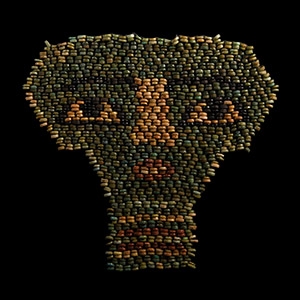
Egyptian Beaded Mummy Face Mask
Late Period, 664-332 B.C.Sold for (Inc. bp): £187
A restrung panel of small glazed composition beads in various colours representing a mummy face mask with false beard. 44 grams, 13 cm wide
Acquired 1990s. Ex Mariaud des Serres, Paris, France.
The practice of providing a bead mask as additional protection for the face of the mummy developed in the Late Period. The green beads used as the principal colour in the creation of the stylised face symbolise regeneration and re-birth. An example discovered at Esna in Upper Egypt and still attached to the face of a mummy is on display in the World Museum Liverpool (accession number 7.6.20.60).
