
Loading, please wait...
_900x900.jpg "Egyptian Blue-Glazed Faience White Lotus Chalice")
_200x200.jpg "Egyptian Blue-Glazed Faience White Lotus Chalice")
.jpg "Egyptian Blue-Glazed Faience White Lotus Chalice")
LOT 0032
Egyptian Blue-Glazed Faience White Lotus Chalice
NEW KINGDOM-THIRD INTERMEDIATE PERIOD, 1315-945 B.C.
4 3/4 in. (205 grams, 12 cm).
The lotiform cup modelled as an open lotus flower with incised petal detailing to the outer face, short stem and flared foot; some restoration.
ProvenanceAcquired 1970s-1996.
Property of a North American collector.
London collection, 2016.
This lot has been checked against the Interpol Database of stolen works of art and is accompanied by search certificate no.12100-214087.
Cf. Freed, R., et al., Egypt’s Golden Age, the Art of Living in the New Kingdom, 1558-1085 B.C, Boston, 1982, p.147, no.147, for a similar pale blue faience white lotus chalice; S., Reeves, N., and Quirke, S., Egyptian Art at Eton College: Selections from the Myers Museum, Windsor/New York, 1999, p.39, no.56, for a squatter version of this chalice style in deep blue faience.
FootnotesFaience chalices shaped like the flowers of the white lotus (Nymphaea albicans) first appeared in the 18th Dynasty, and are thought to be drinking vessels.
CONDITIONTimeLine Auctions follows a vetting process to ensure the authenticity and legality of all items, reinforcing our commitment to integrity and responsible trading. Each antiquity, antique, and coin lot undergoes thorough examination by a vetting committee of at least ten external specialists, professional trade association members, scientists, and archaeologists: Our Vetting Process
AUCTIONS:
TimeLine is a leading auction house specialising in antiquities, ancient art, collectables, natural history, coins, medals, and books. Our auctions offer museums, collectors, historians, and enthusiasts the opportunity to acquire unique and historically significant pieces.
LOT 0032
Egyptian Blue-Glazed Faience White Lotus Chalice
Estimate £5,000 - 7,000€5,800 - 8,120 (for guidance only)$6,750 - 9,450 (for guidance only)
-
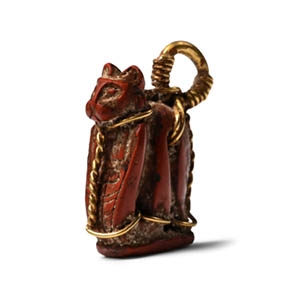
Egyptian Jasper Lion-Headed Cobra Amulet in Gold Frame
6th century B.C.Estimate: £2,000 - 3,000 (‡+bp*)
Opening Bid: £1,000
The S-curved body resting on a tongue-shaped based, detailed hood, and delicate details to the head of a lioness; wrapped in a gold frame with suspension loop. 2 grams, 18 mm
Private collection of Mr K.A. Private collection, Europe, 26 June 2009.
This amulet likely represents a goddess, either Sekhmet or Wadjet. Sekhmet is typically depicted as a lioness or lion-headed woman, while Wadjet appears in the form of a cobra. The lion-headed cobra form can be an allusion to the uraeus, worn on the crowns of royalty and deities for protection. -
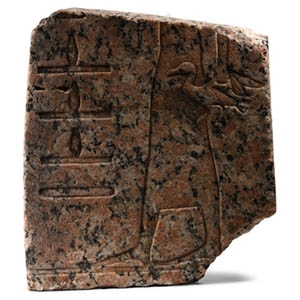
Egyptian Granite Relief
New Kingdom, 1550-1292 B.C.Sold for (Inc. bp): £1,560
Relief fragment with dressed face and three edges; the feet and lower body of a human figure in profile wearing a tight-fitting calf-length garment on a baseline; the left forearm behind with hand holding a goose by its pinions; to the left a series of ḥtp hieroglyphs. 3.57 kg, 18.7 cm
Acquired in the mid 1980s-1990s. Private collection, Switzerland, thence by descent. Private collection, since the late 1990s. This lot has been checked against the Interpol Database of stolen works of art and is accompanied by search certificate number no.12366-226937.
This likely represents part of an offering scene, showing the individual bringing a goose and the hieroglyphs writing ḥtpt, probably part of a phrase referring to 'offerings'. -
.jpg)
Egyptian Limestone False Door Relief Panel
Middle Kingdom, circa 1900-1750 B.C.Sold for (Inc. bp): £1,105
Rectangular panel from a false door stela carved in sunk relief with raised vertical borders framing a scene with a male figure wearing a knee-length kilt, collar and short wig, seated on a stool with lion-claw feet, holding a bolt of cloth in his left hand; before him, a pedestal table with splayed feet, the top laden with vertical loaves; traces of pigment to the collar, kilt and table; rear face dressed but plain. 4.12 kg, 28.7 cm
Acquired in the mid 1980s-1990s. Private collection, Switzerland, thence by descent. Private collection, since the late 1990s.
The ancient Egyptians believed the soul of the departed could move in and out of the tomb using a ‘false door.’ This door was identified by a recessed surface with a symbolic entrance at its centre. In the Middle Kingdom, the false door design was combined with other elements or represented by a raised border and cornice above on rectangular stelae.
