
Loading, please wait...


LOT 0486
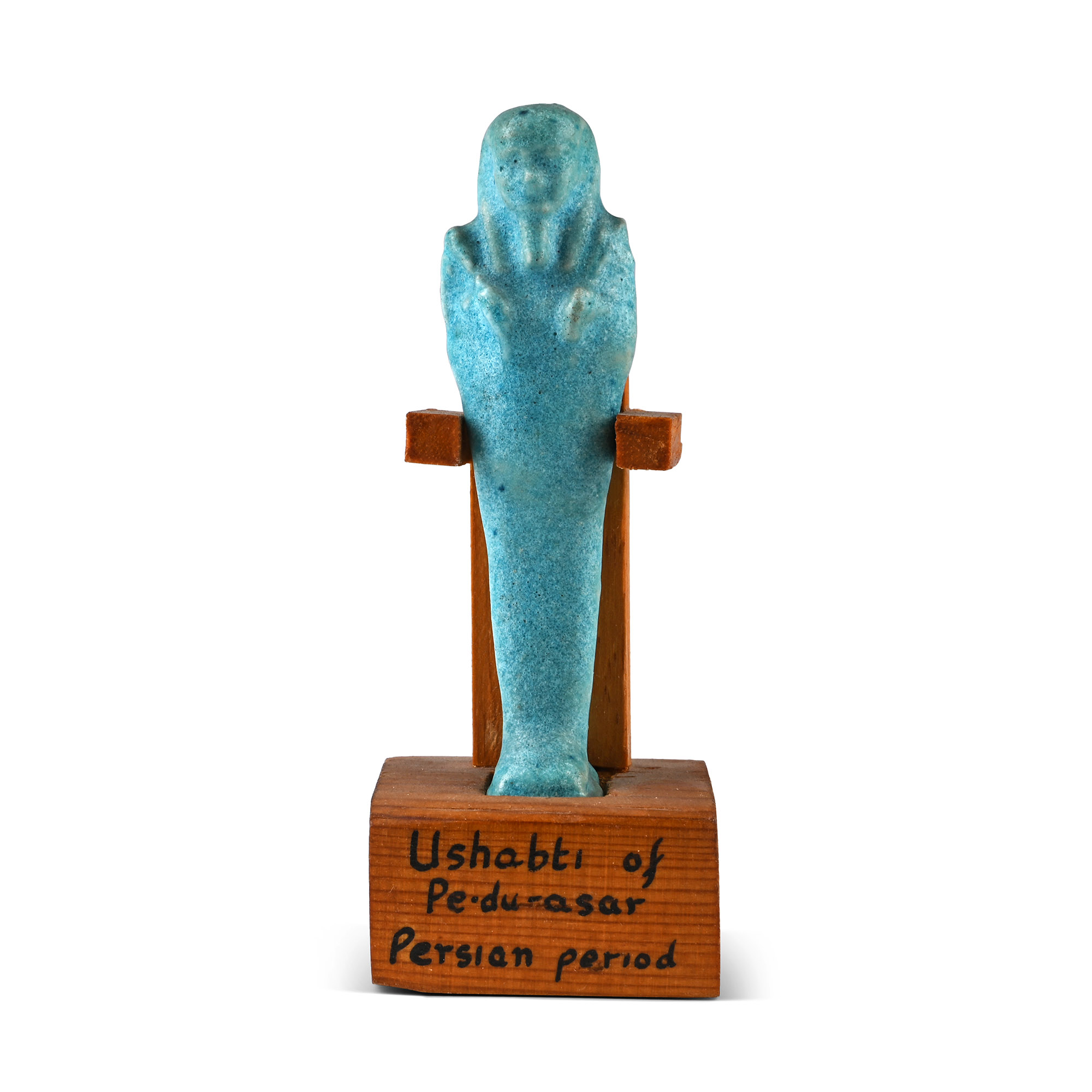
Egyptian Blue Glazed Faience Shabti
PTOLEMAIC PERIOD, 323-30 B.C.
3 7/8 in. (41.3 grams total, 99 mm).
Typical mummiform type wearing a lappet wig, with arms crossed and hands holding agricultural implements; uninscribed; mounted on a custom-made stand marked 'Ushabti of Pe-du-asar Persian period'. [No Reserve]
ProvenanceAcquired Church Street, 14th December 1957, for 10 shillings.
From the private collection of Peter Clayton, FCILIP, Dip, Arch, FSA, FRNS, Hemel Hempstead, Hertfordshire, UK; formed since the late 1950s.
Accompanied by an old handwritten information card by Peter Clayton, collection no.6.
Cf. Schlögl, H.A., and Brodbeck, A., Ägyptische Totenfiguren aus öffentlichen und privaten Sammlungen der Schweiz, Göttingen, 1990, p. 314, no. 227, for a similar uninscribed type.
FootnotesThe 'Pe-du-asar' on the label likely refers to the individual whose burial Flinders Petrie discovered at Abydos in 1902, which contained many blue-glazed, uninscribed shabtis. However, his shabtis have different hand positions and a glassier, often bichrome, glaze, suggesting that this example comes from a different burial.
CONDITIONTimeLine Auctions follows a vetting process to ensure the authenticity and legality of all items, reinforcing our commitment to integrity and responsible trading. Each antiquity, antique, and coin lot undergoes thorough examination by a vetting committee of at least ten external specialists, professional trade association members, scientists, and archaeologists: Our Vetting Process
AUCTIONS:
TimeLine is a leading auction house specialising in antiquities, ancient art, collectables, natural history, coins, medals, and books. Our auctions offer museums, collectors, historians, and enthusiasts the opportunity to acquire unique and historically significant pieces.
LOT 0486
Egyptian Blue Glazed Faience Shabti
Estimate £200 - 300€230 - 350 (for guidance only)$270 - 410 (for guidance only)
-
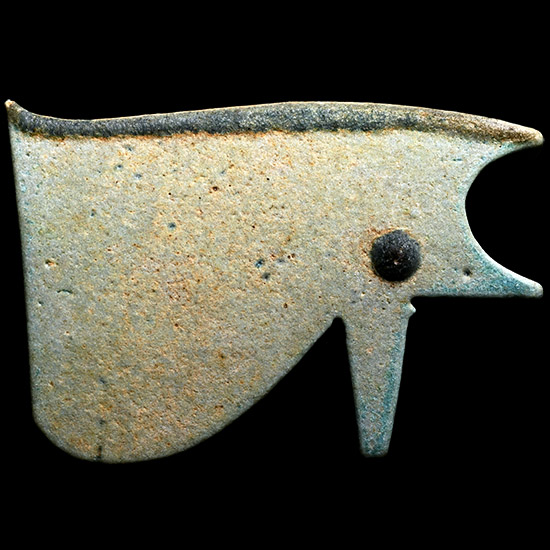
Large Egyptian Faience Eye of Horus Amulet
Third Intermediate Period, circa 1069-664 B.C.Estimate: £300 - 400 (+bp*)
Opening Bid: £150
The outline displays the characteristic wedjat-eye motif: a fusion of a human eye and eyebrow, combined with specific falcon markings: a tear-like drop extending down from the front of the lower lid and a stylised curl trailing from the base; longitudinally pierced for suspension. 7.15 grams, 41 mm
From a mid 20th century collection.
The wedjat-eye amulet depicts Horus’s healed eye, blending human and falconine features. Its ancient Egyptian name means ‘the one that is sound’. Myth holds that Seth wounded or took the eye, and Thoth later restored it. Believed to offer protection, healing, and regeneration, the popular amulet was worn by the living and the dead. -
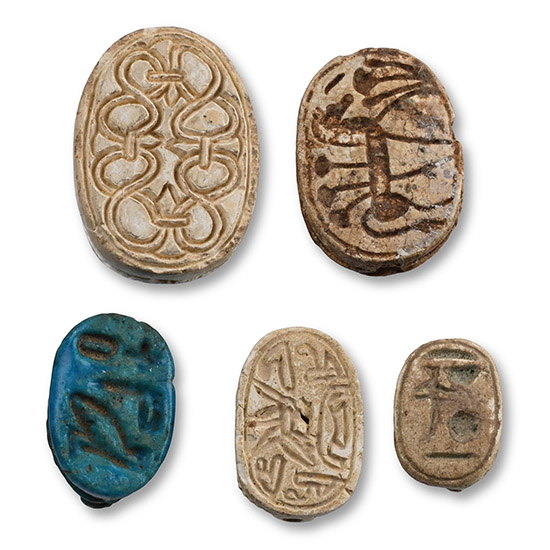
Egyptian Steatite and Other Scarab Group
Mainly Second Intermediate Period, circa 1660-1500 B.C.Estimate: £150 - 200 (‡+bp*)
Opening Bid: £75
Designs include: a line border enclosing a decorative symmetrical scroll-work pattern; a line border enclosing a horse with papyrus clumps above and in front; deeply impressed bird and other signs behind; a line border enclosing a nwb (gold) sign flanked by Red Crowns, with a bee above flanked by coiled cobras; a line border enclosing a djed, neb, and sun disc, with narrow neb(?) signs above and below. 8.76 grams total, 12-21 mm
Acquired on the European art market in the early 2000s. with Galerie Rhéa, Zurich, Switzerland. This lot is accompanied by an illustrated lot declaration signed by the Head of the Antiquities Department, Dr Raffaele D'Amato. -
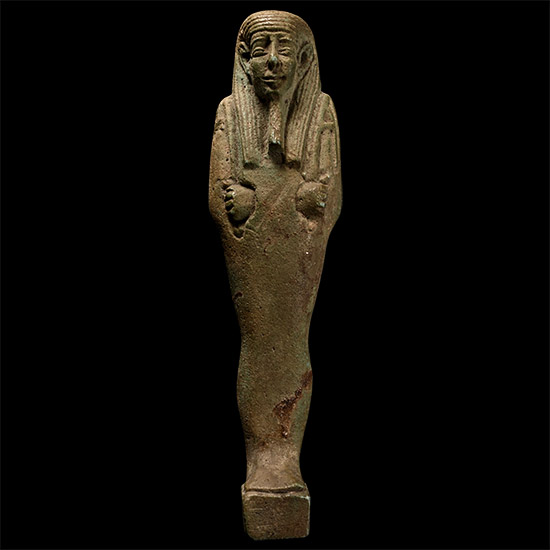
Egyptian Green Glazed Faience Shabti
Late Period, 664-332 B.C.Estimate: £1,000 - 1,400 (‡+bp*)
Opening Bid: £550
Modelled with a slender mummiform body on a small rectangular base; the long face framed by a striated tripartite wig and false beard; the hands of the imperceptibly crossed arms hold a hoe and a pick; the right hand also holds a cord from which a seed bag hangs over the figure's back; a dorsal pillar on the reverse; uninscribed. 102 grams, 14 cm
Ex Ms.E.C.(1923-2014), Israel. Inherited by his son D.L., Switzerland.
Although uninscribed, the distinctive long face, manner of hand styling and long striated wig lappets suggest that it may come from the same mould as another shabti in the World Museum, Liverpool (Janes, G., The Shabti Collections 6: A Selection from the World Museum, Liverpool, Lymm, 2016, p. 501, no. 264b).
