
Loading, please wait...
LOT 0031
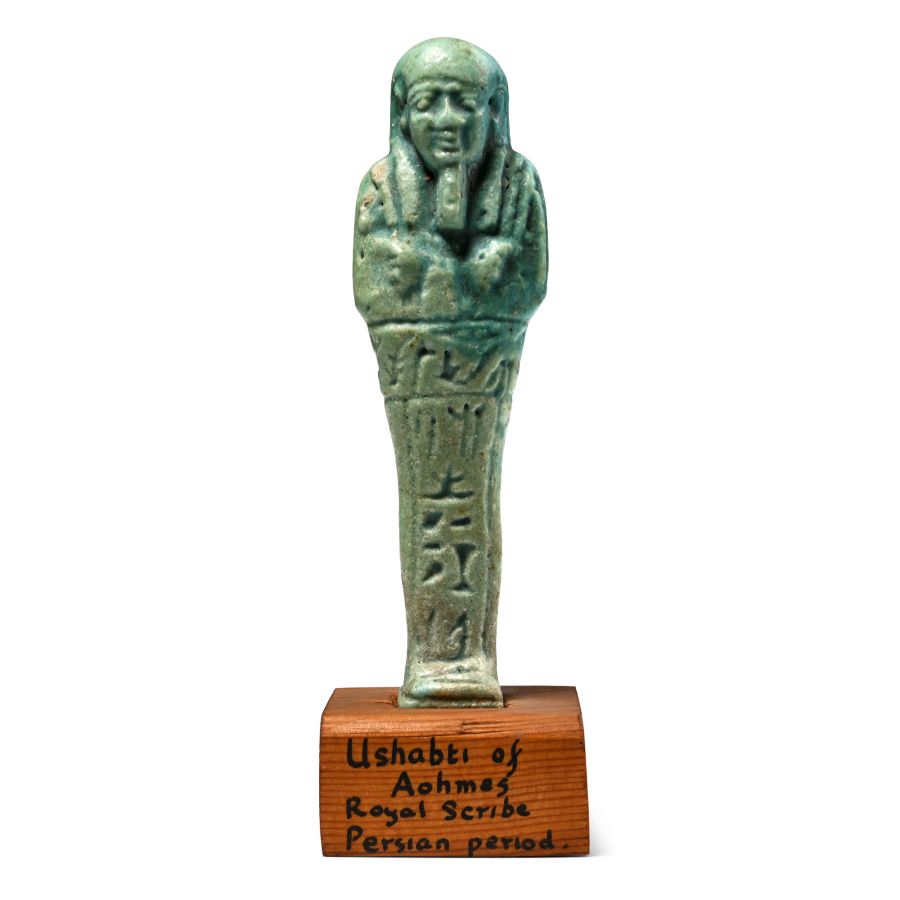
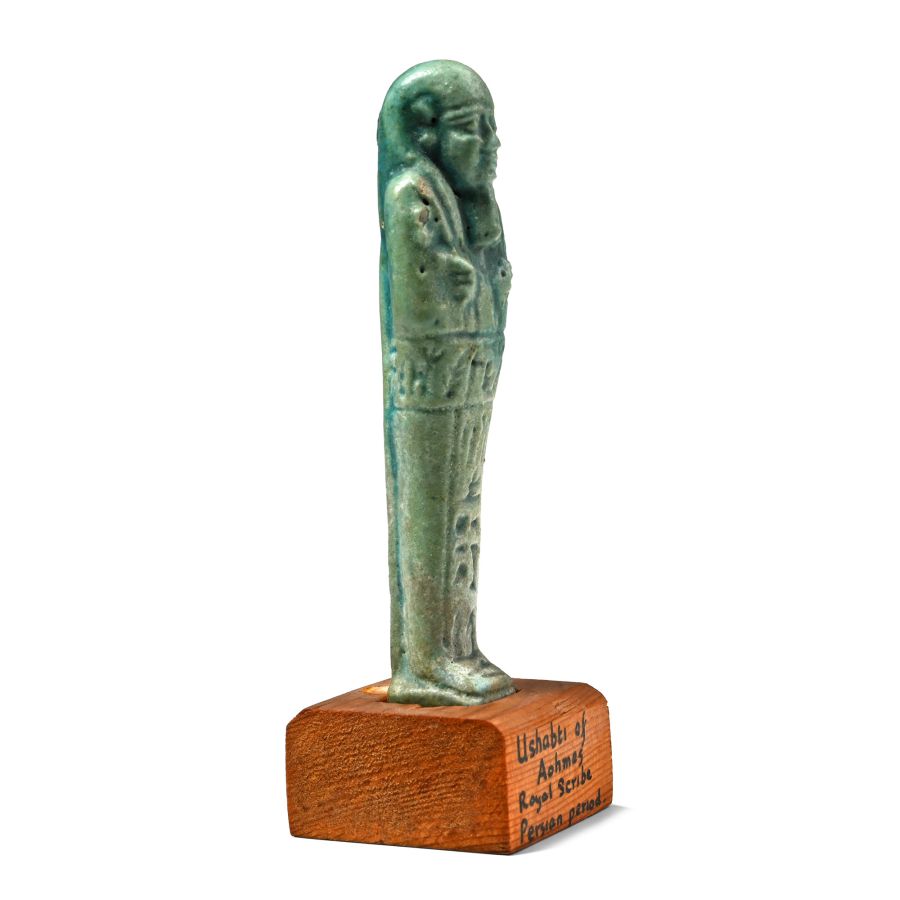
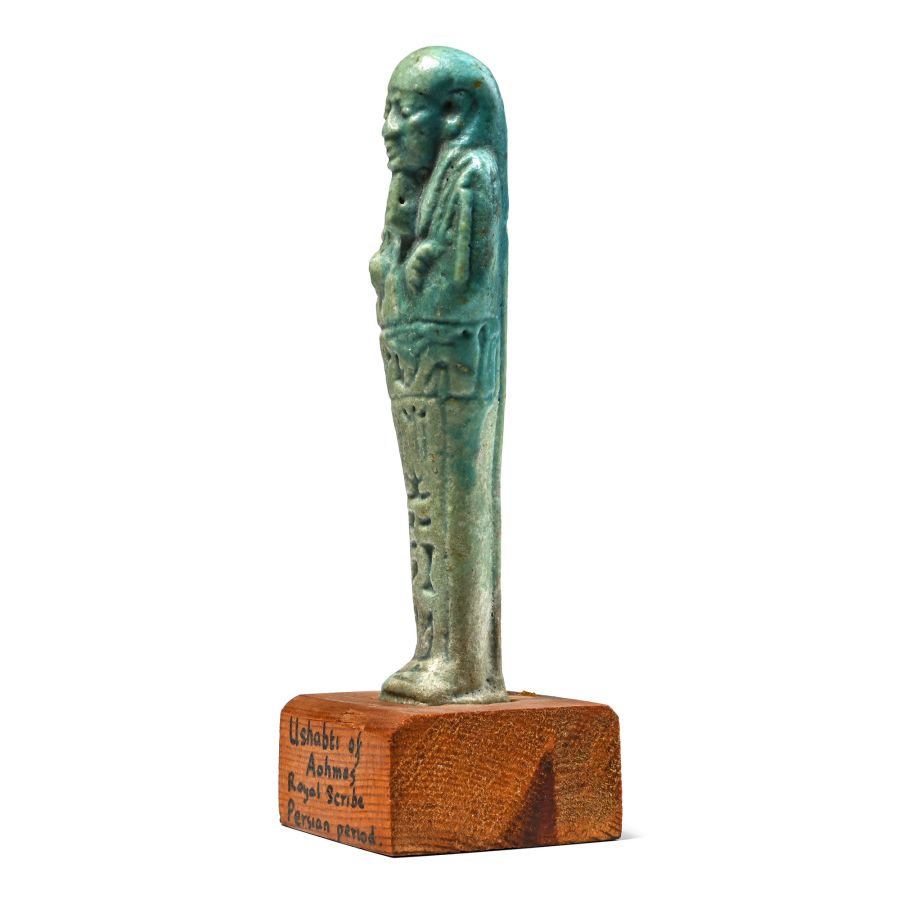
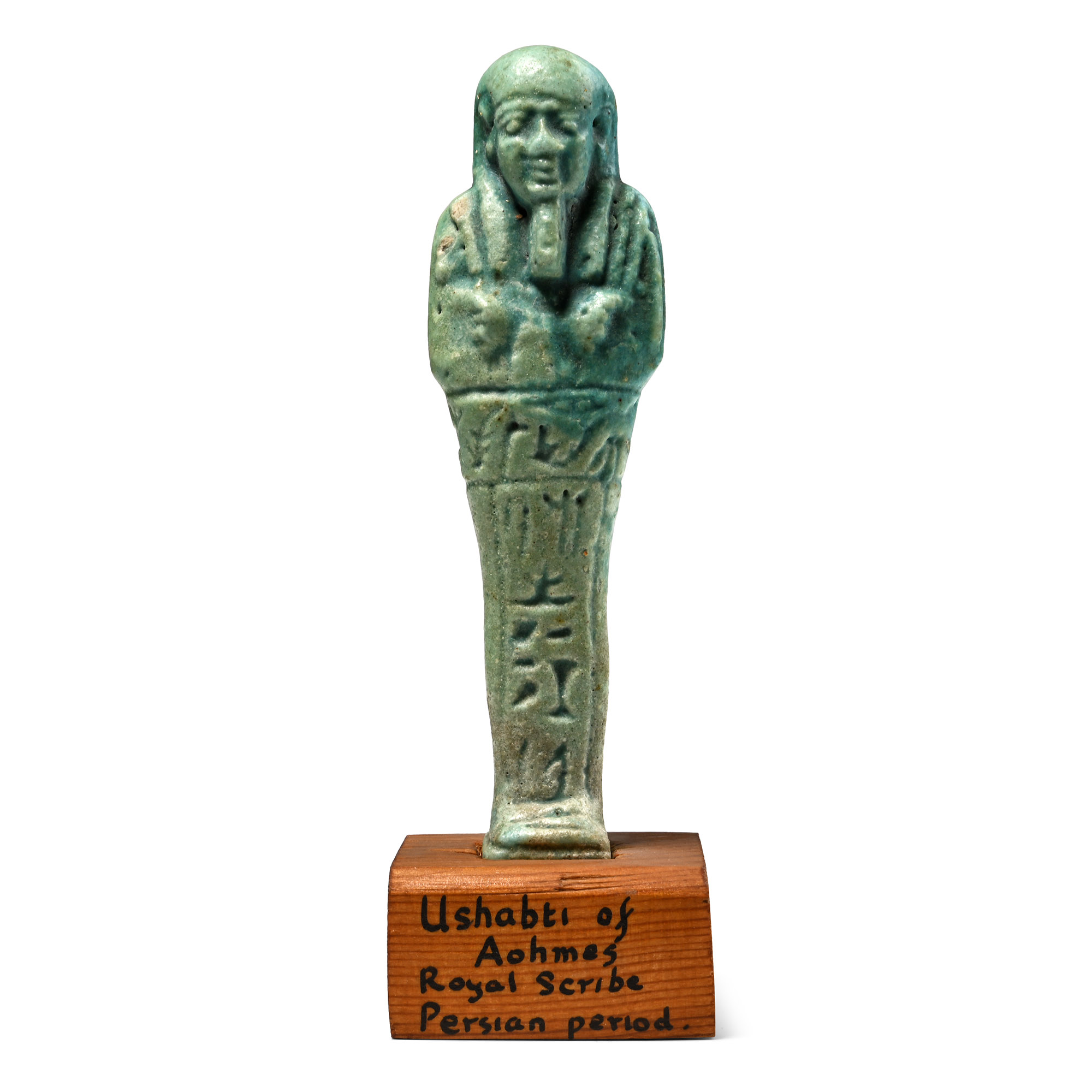
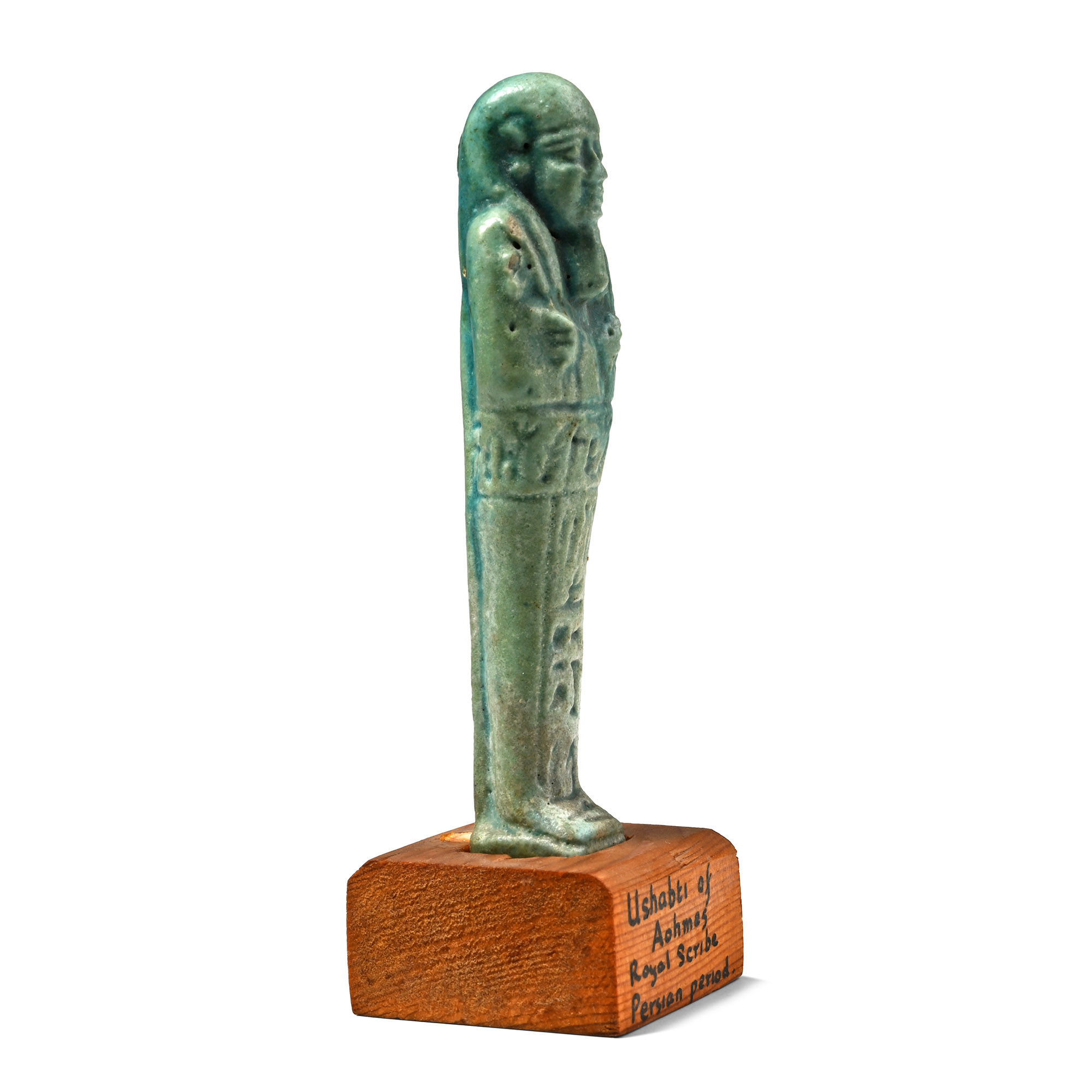
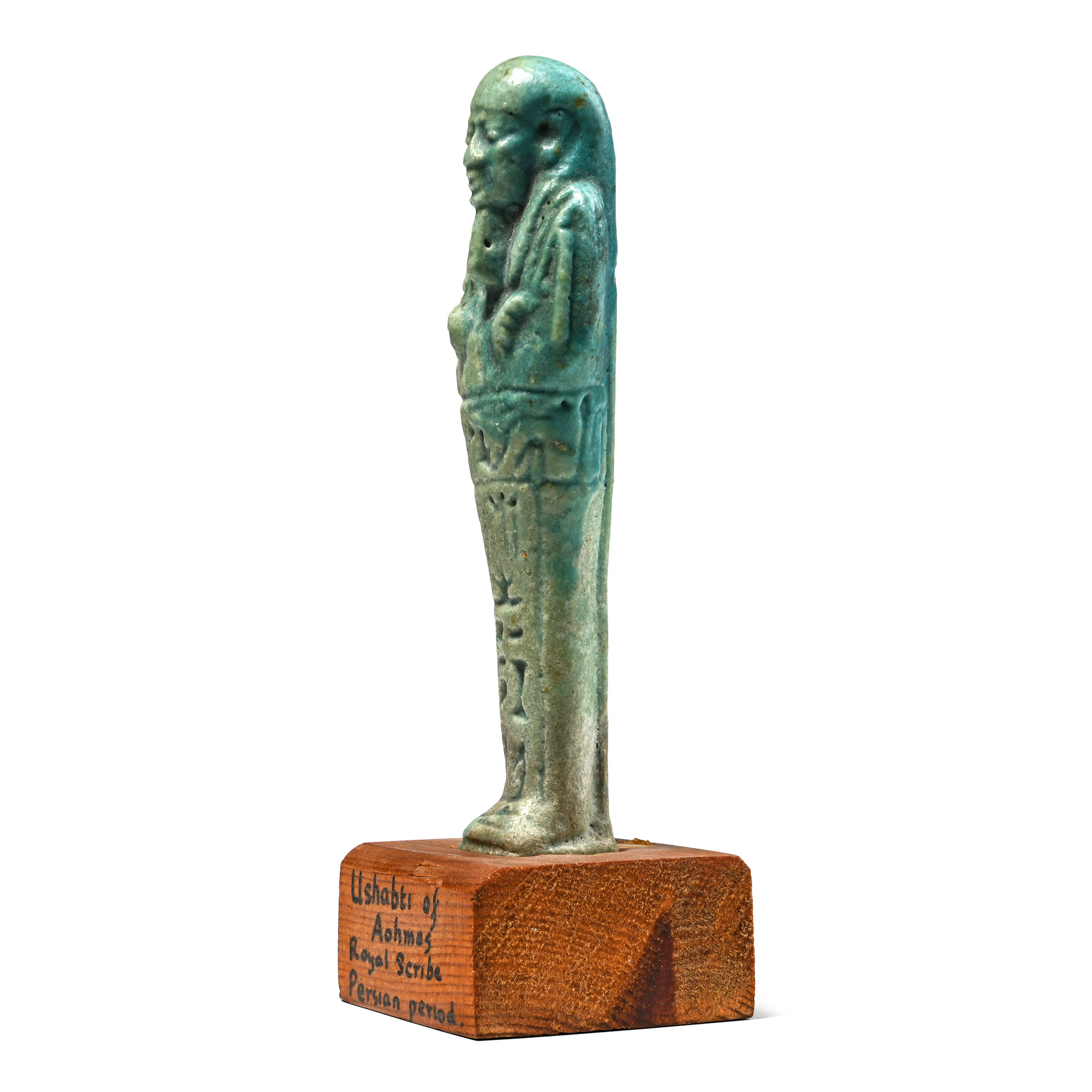
Egyptian Blue Glazed Faience Shabti of the Royal Scribe Aahmes
PERSIAN PERIOD, CIRCA 6TH CENTURY B.C.
4 1/4 in. (4 3/4 in.) (44.7 grams, 10.7 cm (62.2 grams total, 12.2 cm including stand)).
Mummiform figure wearing a lappet wig and long false beard, arms crossed over the chest; the left hand holds a pick, the right a hoe, and a cord from a small seed bag hangs over the shoulder; plain dorsal pillar; a T-form hieroglyphic text arrangement on the lower body, with the horizontal line reading: 'The illuminated one, the Osiris, the royal scribe Aahmes,' and the central column 'born to Hotep-Bastet, true of voice'; with a wooden display stand bearing the legend 'Ushabi of Aahmes, Royal Scribe, Persian period'. [No Reserve]
ProvenanceAcquired Herne Bay High Street, circa February 1957, for 2 shillings and sixpence.
From the private collection of Peter Clayton, FCILIP, Dip, Arch, FSA, FRNS, Hemel Hempstead, Hertfordshire, UK; formed since the late 1950s.
Accompanied by an old handwritten information card by Peter Clayton, collection no.4.
Cf. Petrie, W.M.F., Shabtis, London, 1935, pl. XLIV, no. 602, for a shabti of the same individual.
CONDITIONTimeLine Auctions follows a vetting process to ensure the authenticity and legality of all items, reinforcing our commitment to integrity and responsible trading. Each antiquity, antique, and coin lot undergoes thorough examination by a vetting committee of at least ten external specialists, professional trade association members, scientists, and archaeologists: Our Vetting Process
AUCTIONS:
TimeLine is a leading auction house specialising in antiquities, ancient art, collectables, natural history, coins, medals, and books. Our auctions offer museums, collectors, historians, and enthusiasts the opportunity to acquire unique and historically significant pieces.
LOT 0031
Egyptian Blue Glazed Faience Shabti of the Royal Scribe Aahmes
Estimate £500 - 700€580 - 810 (for guidance only)$680 - 950 (for guidance only)
Opening Bid
£5 (EUR 6; USD 7) +BP*
-
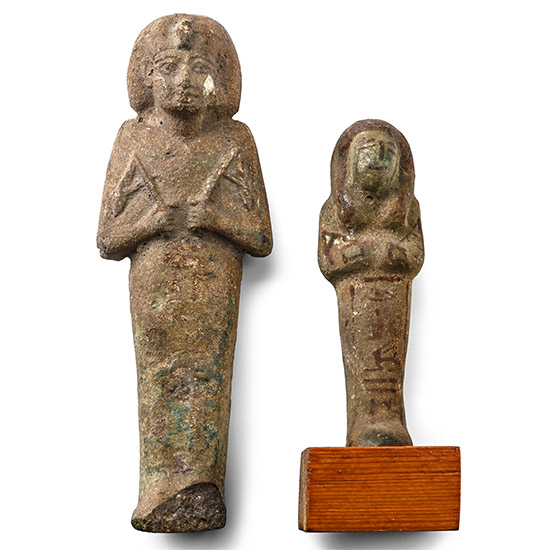
Egyptian Green Glazed Faience Ushabti of Karomama Meritmut
Third Intermediate Period, 22nd Dynasty, circa 900 B.C.Estimate: £500 - 700 (+bp*)
Opening Bid: £5
Characteristic mummiform figure for the Divine Adoratrice Karomama Meritmut G, wearing a bag-like khat headcloth fronted by a uraeus, and a trailing flap at the back, with opposed hands each holding a hoe; faint traces of an inscription on the lower front are illegible; and another small blue-olive-green mummiform shabti of late New Kingdom date wearing a lappet wig with opposed (not crossed) hands holding agricultural implements, details in black; a partially preserved column of hieroglyphic text on the lower body, reading: 'The Osiris, Wenis...'; on a wooden display stand. 167 grams total, 10.9-13.7 cm
The smaller one acquired Caledonian Market, 16th March 1962 for 5 shillings. From the private collection of Peter Clayton, FCILIP, Dip, Arch, FSA, FRNS, Hemel Hempstead, Hertfordshire, UK; formed since the late 1950s. Accompanied by an old handwritten information card by Peter Clayton, collection no.94.
The tomb of Karomama Meritmut G was discovered in the 19th century within the mortuary temple complex of Ramesses II, known as the Ramesseum, at Thebes. She was buried with kilted overseer ushabtis and mummiform worker figurines such as this one. Although its inscription is illegible, other preserved examples (such as British Museum EA74324) suggest it almost certainly read: 'The Osiris, the Divine Adoratrice of Amun, Karomama, beloved of Mut'. -
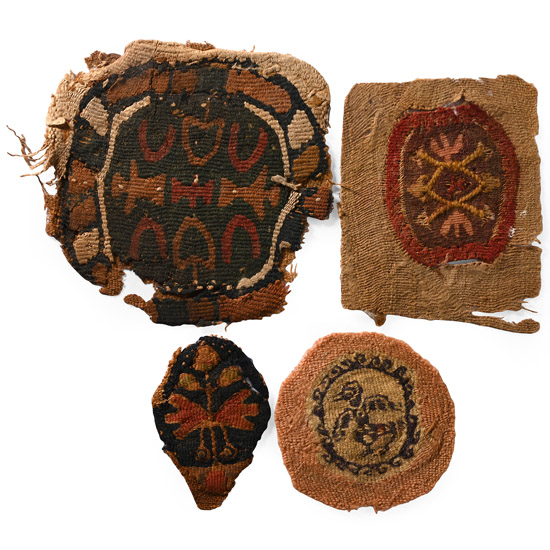
Egyptian Coptic Tunic Textile Fragments of Orbiculi with Vegetation, Animals and Geometric Ornament
Circa 6th-7th century A.D.Estimate: £80 - 100 (+bp*)
Opening Bid: £5
Featuring four medallions (orbiculi) in red, green, yellow, and dark blue wool, three decorated with floral and geometric motifs, the fourth featuring an eaglet figure with a meander border; tapestry weave, S-twist. 11.07 grams total, 6.3-10.7 cm
Acquired 1970s-1996. Property of a North American collector. London collection, 2016.
The orbiculi are realised in the tapestry technique. They were part of the decoration of a tunic, and the presence of the Imperial eagle, which is not a common pattern, could be related to a military tunic or to a tunic of an Imperial functionary. -
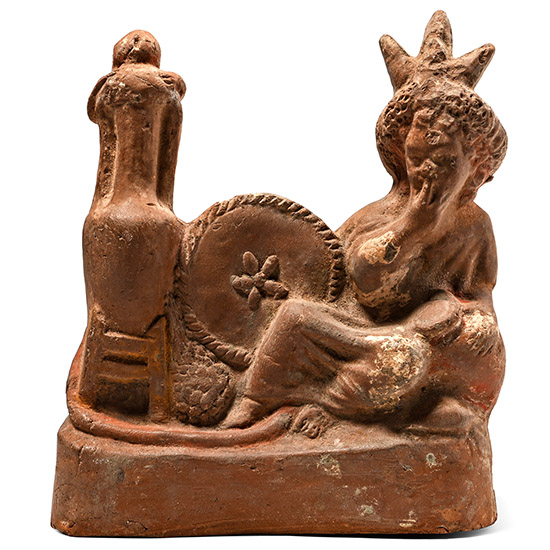
Romano-Egyptian Terracotta Figure of Seated Harpocrates
Alexandria, 1st century A.D.Estimate: £500 - 700 (‡+bp*)
Opening Bid: £275
Hollow-formed and moulded in the half-round, reclining figure with wreath and diadem, amphora and other items; hollow to the underside. 236 grams, 12.4 cm
The Erotica Collection of Christian von Faber-Castell, Küsnacht ZH, Switzerland; acquired in November 1997 or 1998 from Galerie Puhze, TEFAF Basel, no.137. with Jean-David Cahn Auktionen AG, Basel, 9 November 2013, no.66.
