
Loading, please wait...
LOT 0022
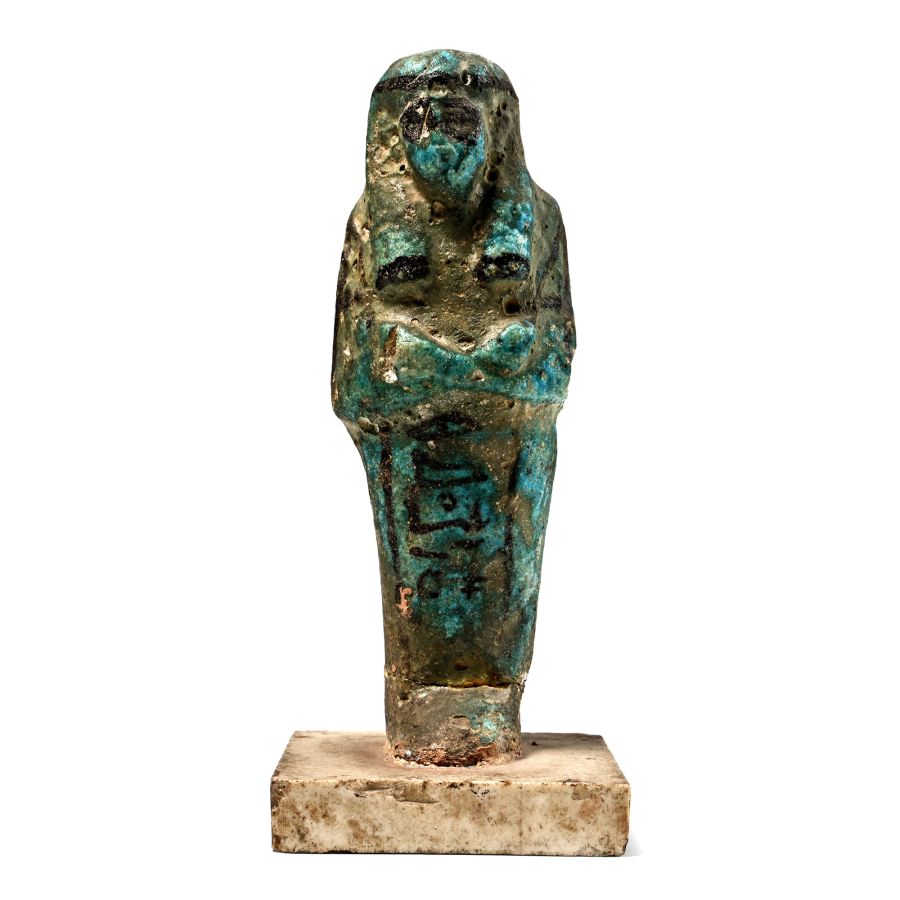
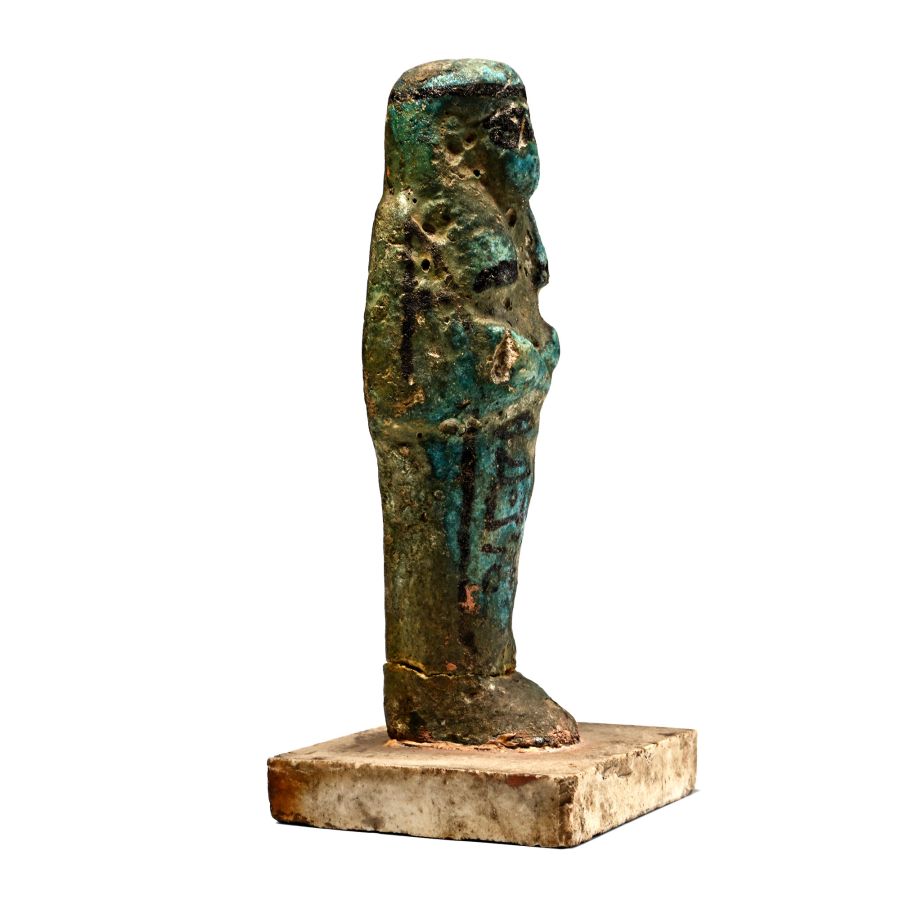
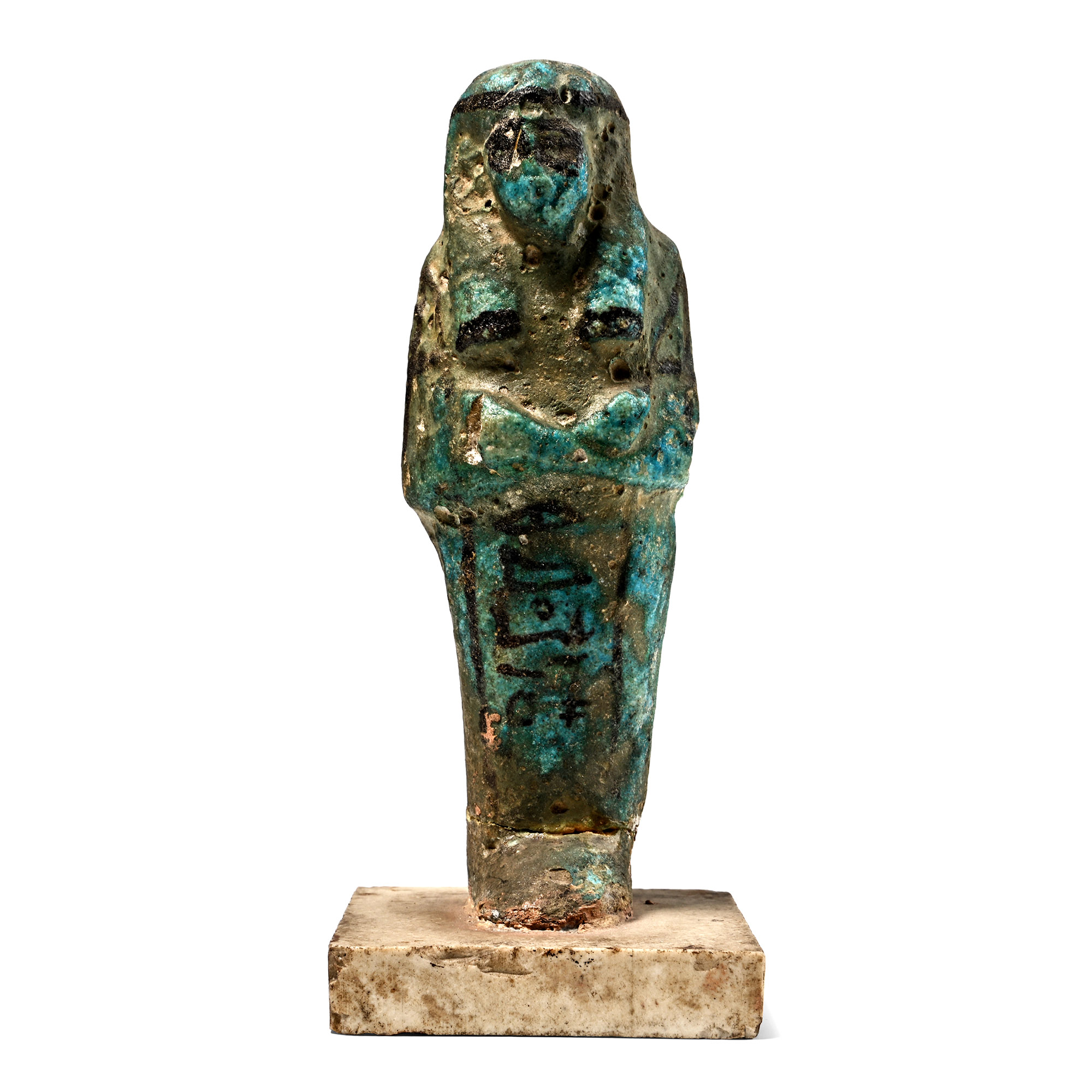
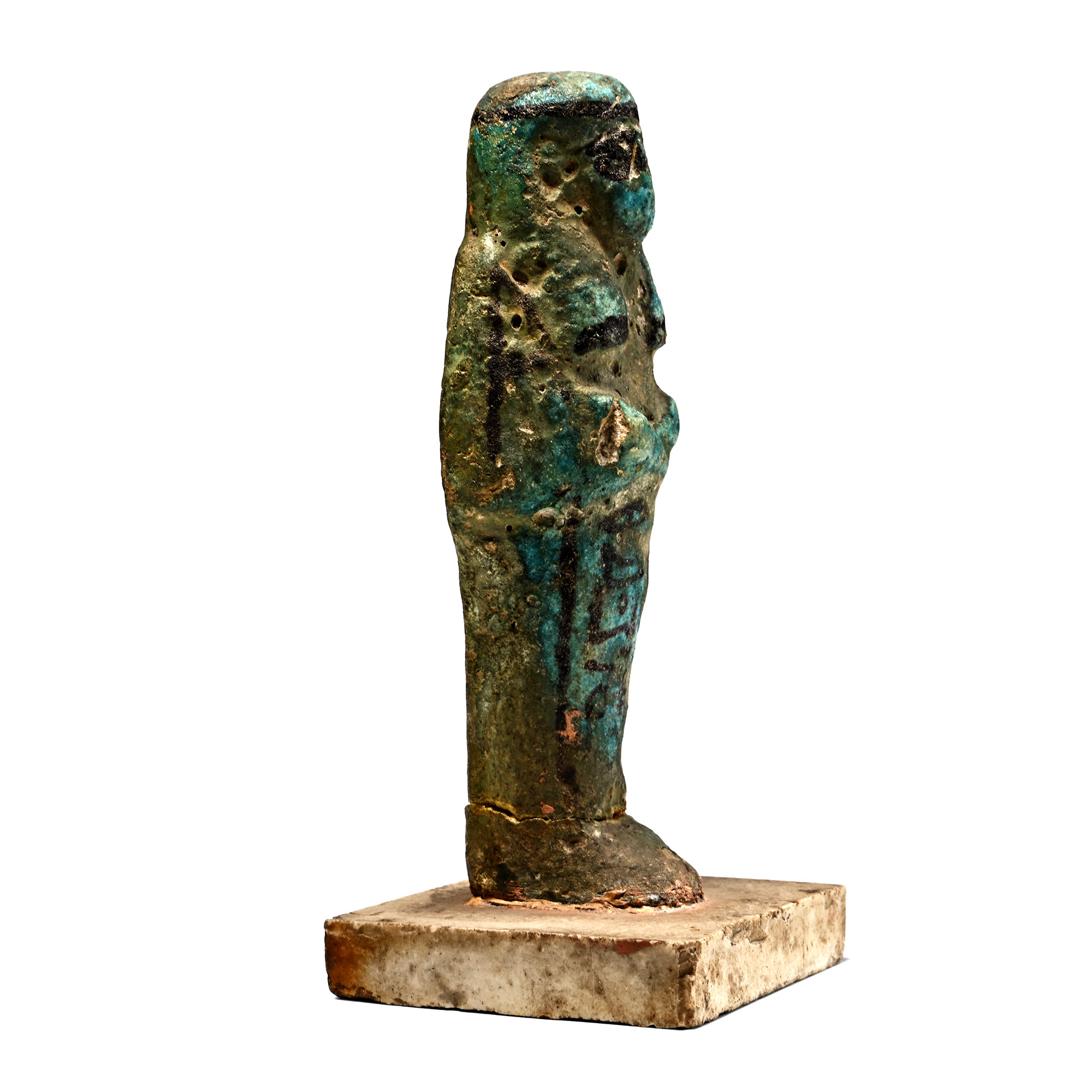
Egyptian Blue Glazed Faience Shabti of the Osiris Pedi-Khonsu
THIRD INTERMEDIATE PERIOD, 21ST DYNASTY, CIRCA 980-935 B.C.
5 1/8 in. (183 grams total, 12.9 cm including stand).
Mummiform type wearing a lappet wig, with arms crossed and hands holding hoes, black-painted detailing on the face, lappet ends, sash tie encircling the wig, seed bag across the back, and a column of hieroglyphic text on the lower body; mounted on a display stand, repaired. [No Reserve]
ProvenanceEx E.B.W.Chappelors collection, July 1958.
From the private collection of Peter Clayton, FCILIP, Dip, Arch, FSA, FRNS, Hemel Hempstead, Hertfordshire, UK; formed since the late 1950s.
Accompanied by an old handwritten information card by Peter Clayton, collection no.41.
The writing of Khonsu on this shabti is reversed from the usual spelling and matches another example in the Musée d'ethnographie de Neuchâtel, Switzerland, for the same individual (Schlögl, H.A., and Brodbeck, A., Ägyptische Totenfiguren aus öffentlichen und privaten Sammlungen der Schweiz, Göttingen, 1990, p. 213, no. 135).
CONDITIONTimeLine Auctions follows a vetting process to ensure the authenticity and legality of all items, reinforcing our commitment to integrity and responsible trading. Each antiquity, antique, and coin lot undergoes thorough examination by a vetting committee of at least ten external specialists, professional trade association members, scientists, and archaeologists: Our Vetting Process
AUCTIONS:
TimeLine is a leading auction house specialising in antiquities, ancient art, collectables, natural history, coins, medals, and books. Our auctions offer museums, collectors, historians, and enthusiasts the opportunity to acquire unique and historically significant pieces.
LOT 0022
Egyptian Blue Glazed Faience Shabti of the Osiris Pedi-Khonsu
Estimate £500 - 700€580 - 810 (for guidance only)$680 - 950 (for guidance only)
-
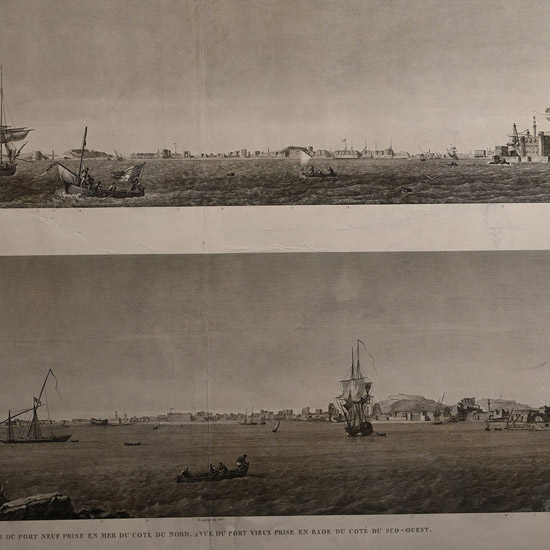
Very Large Egyptian Expedition Lithograph of Views of Alexandria
Early 19th century A.D.Estimate: £80 - 100 (+bp*)
Opening Bid: £40
Proof etching on laid paper of plate 88 from Description de l'Égypte : ou, Recueil des observations et des recherches qui ont été faites en Égypte pendant l'expédition de l'armée française. entitled 1. Vue du port neuf en mer du cote du nord. 2. Vue du port vieux prise en rade du cote du sud-ouest. 259 grams, 104.5 x 69 cm
From the collection of a North American priest. Acquired between 1981-1996. Property of a North American collector.
Produced between February 1802 and 1830 on the orders of Napoleon Bonaparte; published between 1809 and 1828. Just 1,000 copies were distributed to various institutions, printed on laid paper with an 'Égypte ancienne et moderne' watermark. The book is subtitled Recueil des observations et des recherches qui ont été faites en Égypte pendant l’expédition de l’Armée française, publié par les ordres de Sa Majesté l’Empereur Napoléon le Grand (Gathering of observations and discoveries which were made in Egypt during the expedition of the French army, published on the orders of His Majesty the Emperor Napoleon the Great). It was the world's first encyclopedia devoted exclusively to the remains of ancient Egypt. The plates of this book are the first to present the archaeological sites of Thebes (Luxor). -
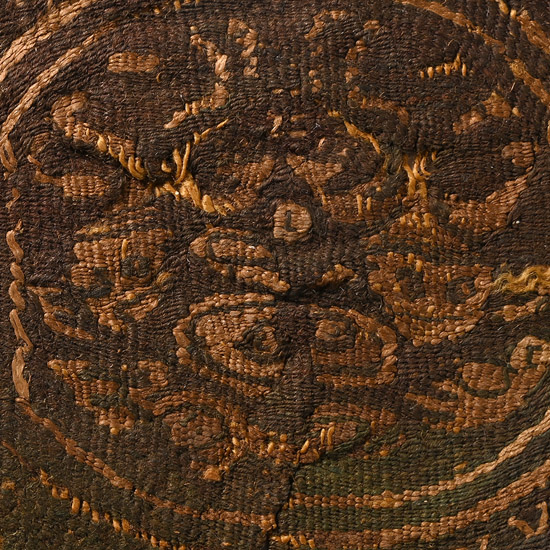
Egyptian Coptic Tunic Textile Fragment of an Orbiculus with Facing Military Horsemen
Circa 7th century A.D.Estimate: £70 - 90 (+bp*)
Bids: 1 | Current Bid: £5
Featuring a large central floral motif, divided into sections containing rhomboid patterns and bordered by meander designs, executed in a tapestry weave using raw wool in reddish-purple, yellow, and dark brown, with an S-twist. 4.15 grams, 10.7 cm
Acquired 1970s-1996. Property of a North American collector. London collection, 2016.
In the Late Roman Period, round orbiculi decorated the shoulders and the lower part of tunics and inner tunics. These fabrics were of great decorative finesse, displaying an unusual and extremely well-preserved colour palette. When the tunic came to the end of its life, these embroideries could be recycled and patched onto another garment. The motif of the opposed horsemen could be related to a military tunic. -
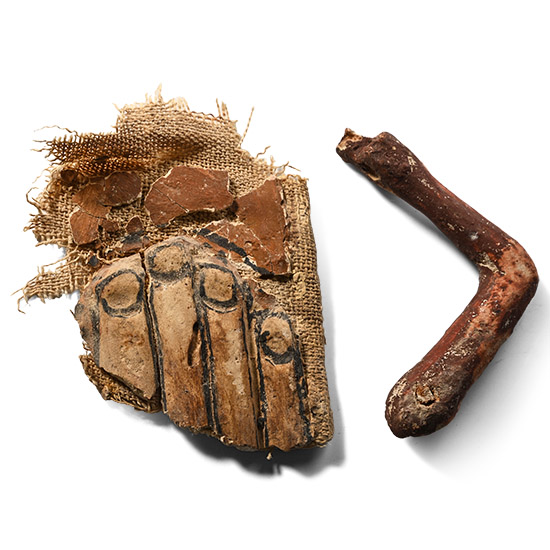
Egyptian Cartonnage Hand Fragment and Wooden Model Arm
Late Period-Ptolemaic Period, circa 664-30 B.C.Estimate: £30 - 40 (+bp*)
Opening Bid: £5
The arm modelled in bent pose with hand pierced to accept the handle of a tool; cartonnage fragment with finger detailing. 18 grams total, 73-82 mm
with a privately curated collection, 1980s-early 2000s. From the private collection and estate of Christine Simons (1943-2025), West Midlands, UK.
