
Loading, please wait...


LOT 0470
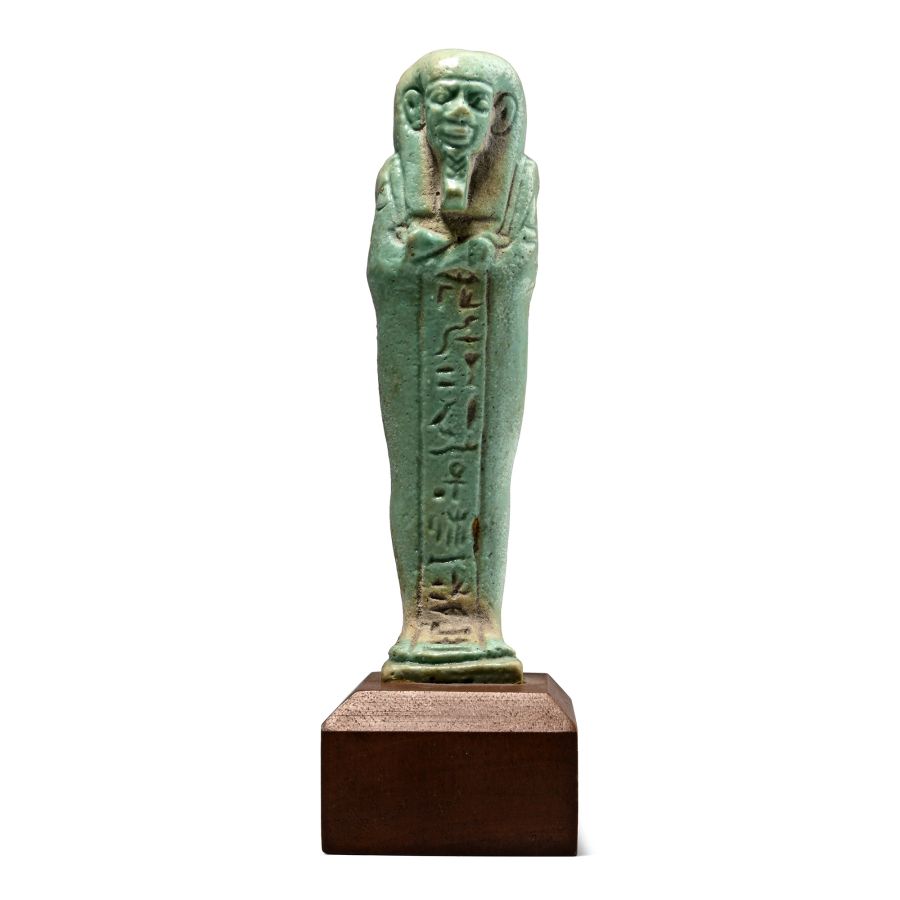
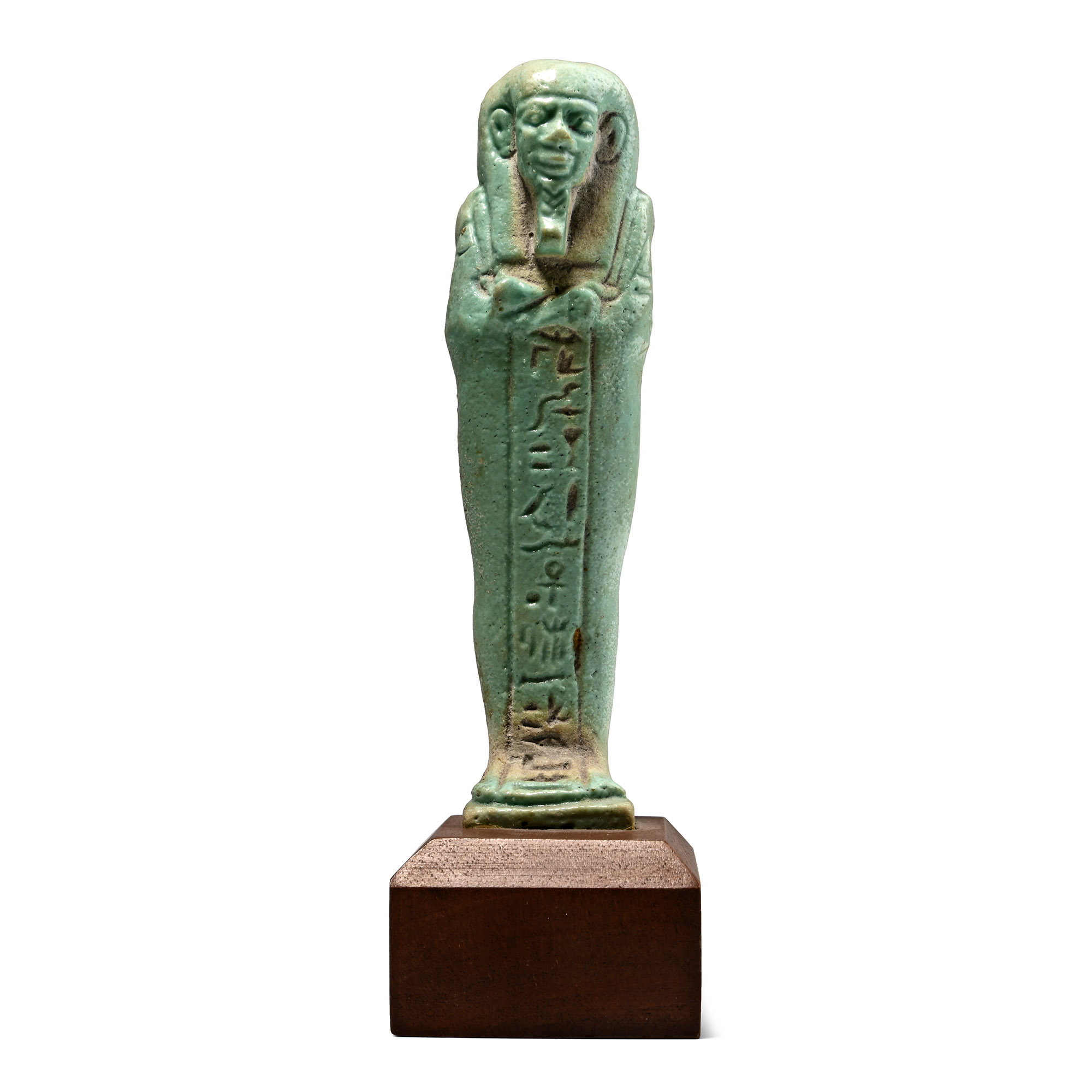
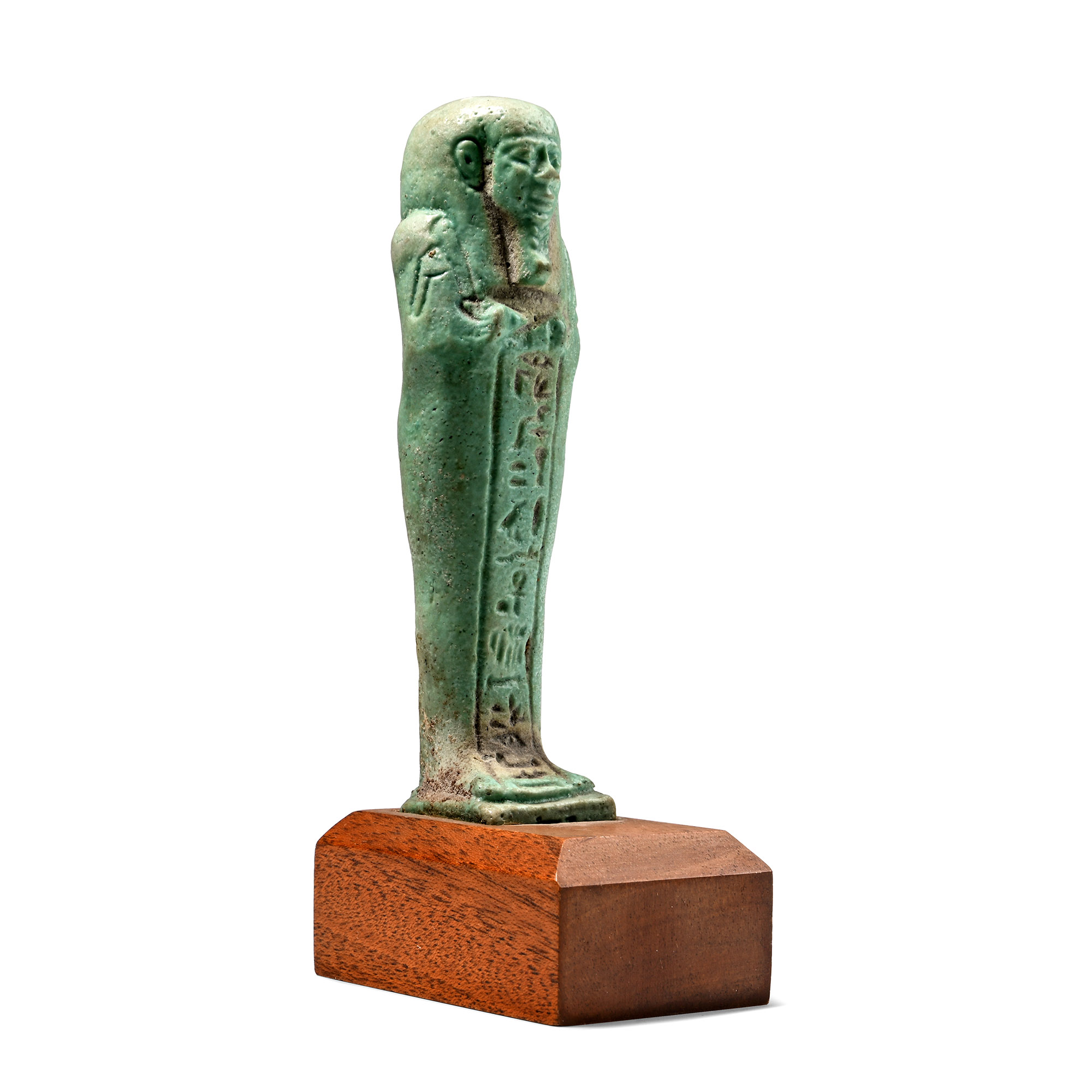
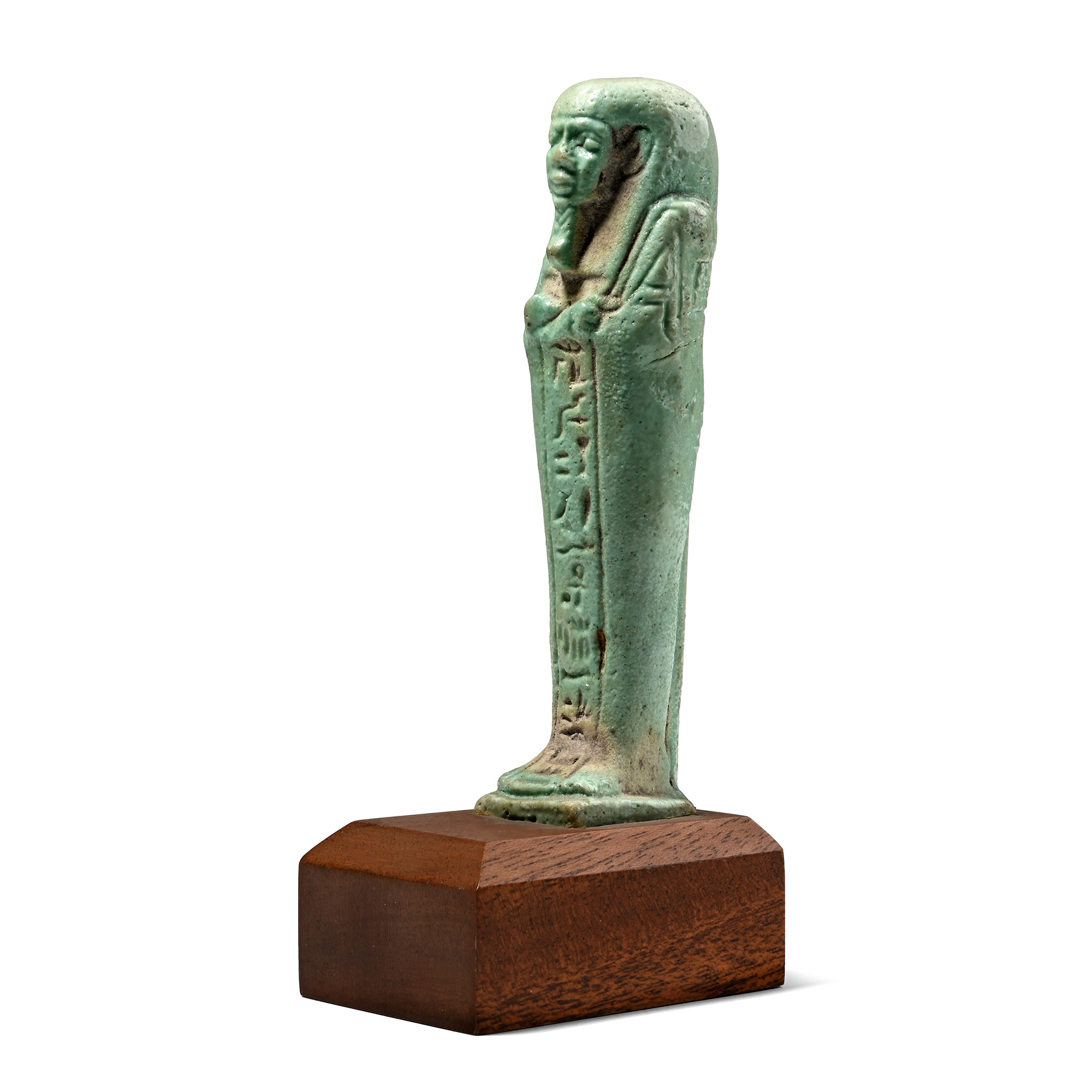
Egyptian Blue Glazed Faience Shabti of Djed-Bastet-Iuef-Ankh
LATE PERIOD, 664-332 B.C.
5 1/8 in. (99 grams total, 13.1 cm including stand).
Mummiform figure standing on a square plinth, wearing a long lappet wig, a false beard, and fine facial detailing, with crossed arms, the left hand holding a pick and the right a hoe, with the cord of a seed bag suspended from the bag; a plain dorsal pillar; the lower front bearing a vertical panel containing an impressed hieroglyphic text reading: 'The Osiris, Djed-Bastet-iuef-ankh, born to Iset-ir-dis'; mounted on a display stand. [No Reserve]
ProvenanceAcquired from Richardson, February 1965, for £2.00.
From the private collection of Peter Clayton, FCILIP, Dip, Arch, FSA, FRNS, Hemel Hempstead, Hertfordshire, UK; formed since the late 1950s.
Accompanied by an old handwritten information card by Peter Clayton, collection no.112.
TimeLine Auctions follows a vetting process to ensure the authenticity and legality of all items, reinforcing our commitment to integrity and responsible trading. Each antiquity, antique, and coin lot undergoes thorough examination by a vetting committee of at least ten external specialists, professional trade association members, scientists, and archaeologists: Our Vetting Process
AUCTIONS:
TimeLine is a leading auction house specialising in antiquities, ancient art, collectables, natural history, coins, medals, and books. Our auctions offer museums, collectors, historians, and enthusiasts the opportunity to acquire unique and historically significant pieces.
LOT 0470
Egyptian Blue Glazed Faience Shabti of Djed-Bastet-Iuef-Ankh
Estimate £400 - 600€460 - 700 (for guidance only)$540 - 810 (for guidance only)
-
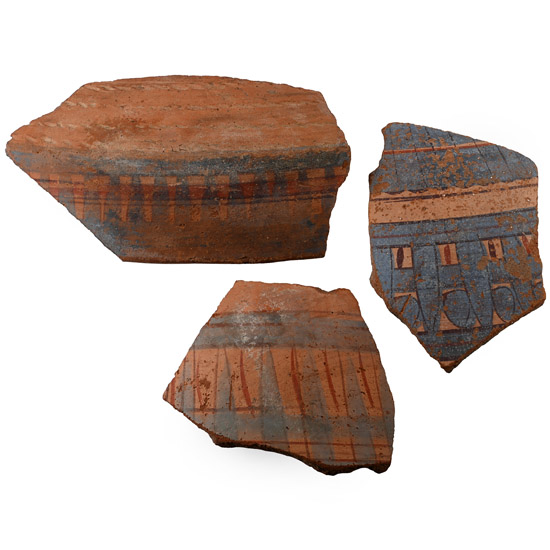
Large Egyptian Painted Bowl Fragments
New Kingdom, 18th Dynasty, Amarna Period, 1379-1362 B.C.Estimate: £80 - 100 (+bp*)
Bids: 1 | Current Bid: £5
Three fragments from three highly decorated blue-painted vessels. 545 grams total, 11.5-18 cm
Acquired in February 1978. From the private collection of Peter Clayton, FCILIP, Dip, Arch, FSA, FRNS, Hemel Hempstead, Hertfordshire, UK; formed since the late 1950s. Accompanied by an old handwritten information card by Peter Clayton, collection no.140.
The distinctive blue colour on these pottery fragments came from a cobalt-and-aluminium slip that reacted during firing. -
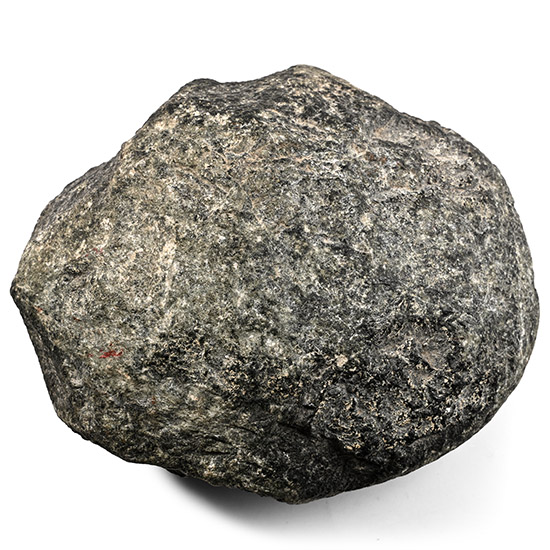
Egyptian Dolerite Pounder Tool
3rd-late 1st millennium B.C.Estimate: £50 - 70 (+bp*)
Opening Bid: £5
Plano-convex in section with smoothed upper face; collector's findspot note to underside 'Dolorite pounder. Unfinished obelisk quarry at Aswan. 1976, February'. 660 grams, 10.9 cm
Found at the unfinished obelisk quarry at Aswan, 1976. From the private collection of Peter Clayton, FCILIP, Dip, Arch, FSA, FRNS, Hemel Hempstead, Hertfordshire, UK; formed since the late 1950s.
Dolerite pounders are hand-held stone tools, widely used in Egypt for quarrying and dressing granite and other hard rocks. -
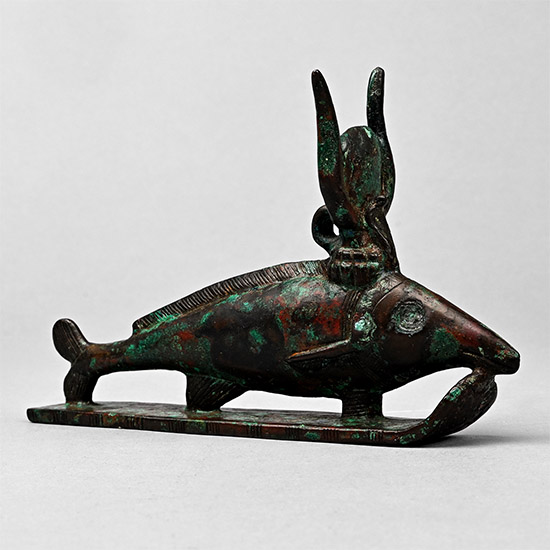
Large Egyptian Bronze Oxyrhynchus Fish of Per-Medjed with Hieroglyphic Inscription
Late Period-Ptolemaic Period, 664-30 B.C.Estimate: £4,000 - 6,000 (‡+bp*)
Opening Bid: £2,100
Modelled in the round on a sledge attached by ventral and pectoral fins, a forked tail, a dorsal ridge, and a tapering nose, featuring recessed circular eyes filled with enamel, a horned sun disc headdress fronted by a uraeus, and a suspension loop behind; a few hieroglyphs of a dedication remain visible on the underside of the sledge, which may be interpreted as part of a name ‘….Ta-ir-di-ankhet…’ (…tꜢ di͗ Ꜥnḫ t….). 585 grams, 17 cm
Acquired from Gallery Reiner, Paris, France, 1981. Private collection, Europe. Accompanied by a copy of French passport no.150583 dated 29 November 2013. This lot has been checked against the Interpol Database of stolen works of art and is accompanied by a search certificate no.12375-226676.
The Medjed, a type of elephant-snout fish (Mormyrus kannume), was revered in ancient Egyptian religion, particularly in Per-Medjed, better known by its Greek name, Oxyrhynchus Polis. This version of the name, meaning "city of the sharp-nosed," reflects the fish's distinctive appearance as depicted in Egyptian art. These fish were believed to have consumed the penis of Osiris, the god who was dismembered and scattered by his brother Seth. As sacred creatures, figurines of the Medjed were often adorned with a horned sun-disc headdress worn by the goddesses Hathor and Isis, suggesting a close association with both. Some figurines, like this example, featured suspension loops, allowing them to be worn as pendant amulets.
