
Loading, please wait...
_900x900.jpg "Egyptian Blue Glazed Faience Figure of Pataikos")
_200x200.jpg "Egyptian Blue Glazed Faience Figure of Pataikos")
.jpg "Egyptian Blue Glazed Faience Figure of Pataikos")
LOT 0026
Egyptian Blue Glazed Faience Figure of Pataikos
SAITE PERIOD, 26TH DYNASTY, 664-545 B.C.
1 3/4 in. (10.8 grams, 43 mm).
Wearing a broad collar and a stylised scarab on top of the head, elongated arms resting on the lower part of his protruding abdomen.
ProvenanceAcquired in the mid 1980s-1990s.
Private collection, Switzerland, thence by descent.
Private collection, since the late 1990s.
Cf. Andrews, C., Amulets of Ancient Egypt, London, 1994, p.39, pl.36b, for a similar example.
FootnotesHerodotus mentions Pataikos as a dwarf-like representation of Ptah, although the ancient Egyptian name of the god remains unclear. These diminutive amulets symbolise Ptah’s immense magical power, which served to protect the wearer from dangerous creatures such as snakes and crocodiles. The role of the deity in the funerary sphere is explained in Spell 164 of the Book of the Dead, where a Pataikos is used to protect the deceased's heart from enemy attacks and the putrefaction of the body.
CONDITIONTimeLine Auctions follows a vetting process to ensure the authenticity and legality of all items, reinforcing our commitment to integrity and responsible trading. Each antiquity, antique, and coin lot undergoes thorough examination by a vetting committee of at least ten external specialists, professional trade association members, scientists, and archaeologists: Our Vetting Process
AUCTIONS:
TimeLine is a leading auction house specialising in antiquities, ancient art, collectables, natural history, coins, medals, and books. Our auctions offer museums, collectors, historians, and enthusiasts the opportunity to acquire unique and historically significant pieces.
LOT 0026
Egyptian Blue Glazed Faience Figure of Pataikos
Estimate £500 - 700€580 - 810 (for guidance only)$680 - 950 (for guidance only)
-
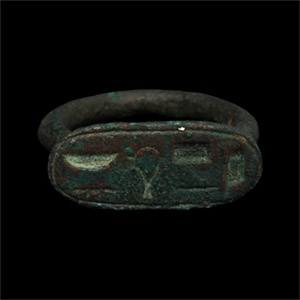
Egyptian Bronze Ring with Hieroglyphic Motto
Late Period, 664-332 B.C.Sold for (Inc. bp): £468
With slim loop and cartouche-shaped bezel inscribed with hieroglyphs ı͗mn-sꜢ-nb.s, 'Amun lord (of) her protection'. 4.30 grams, 21.48 mm overall, 14.60 mm internal diameter (approximate size British G, USA 3 1/4, Europe 4.92, Japan 4)
From an early 20th century collection. -
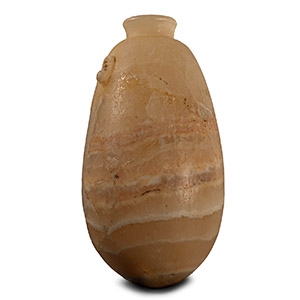
Egyptian Alabaster Alabastron
Third Intermediate Period, circa 8th-7th century B.C.Estimate: £1,000 - 1,400 (‡+bp*)
Opening Bid: £500
Ovoid jar with a rounded base, concave shoulders and flared neck/rim; remains of lug handles. 332 grams, 14 cm
Acquired in the mid 1980s-1990s. Private collection, Switzerland, thence by descent. Private collection, since the late 1990s. -
.jpg)
Large Egyptian Bronze Figure of Osiris
Late Period-Ptolemaic Period, 664-30 B.C.Sold for (Inc. bp): £7,150
Bust of Osiris modelled in the round, wearing the white crown with uraeus to the brow, plaited false beard, tiered collar with counterweight to rear; the hands opposed at the chest, holding the nekhakha flail and the heka crook; the eyes with glass inserts; mounted on a custom-made stand. 850 grams total, 35 cm high including stand
Ex R. Liechti (1934-2010) collection, Geneva, Switzerland. Private collection, Europe. This lot has been checked against the Interpol Database of stolen works of art and is accompanied by search certificate number no.12365-226680.
Osiris is a deity who represents death and fertility and is commonly regarded as the quintessential god of rebirth. Though he was once a mortal ruler, as a deceased entity, his domain was the Underworld. Abydos was the primary centre of Osiris’ cult, where a renowned yearly celebration of the god was held. The proliferation of bronze statues of the god indicates his widespread popularity. R. Liechti was a distinguished collector of Egyptian antiquities, known for his discerning eye and passion for ancient artefacts. Active during the mid-20th century, Liechti's collection featured a wide range of objects that showcased the rich cultural heritage of ancient Egypt, from intricately carved statuettes to rare amulets and jewellery. His dedication to preserving and studying these relics earned him a respected reputation among scholars and collectors alike. Many pieces from his collection have since found their way into prominent museum collections and auction houses, further solidifying his legacy in the world of antiquities.
