
Loading, please wait...
LOT 0501
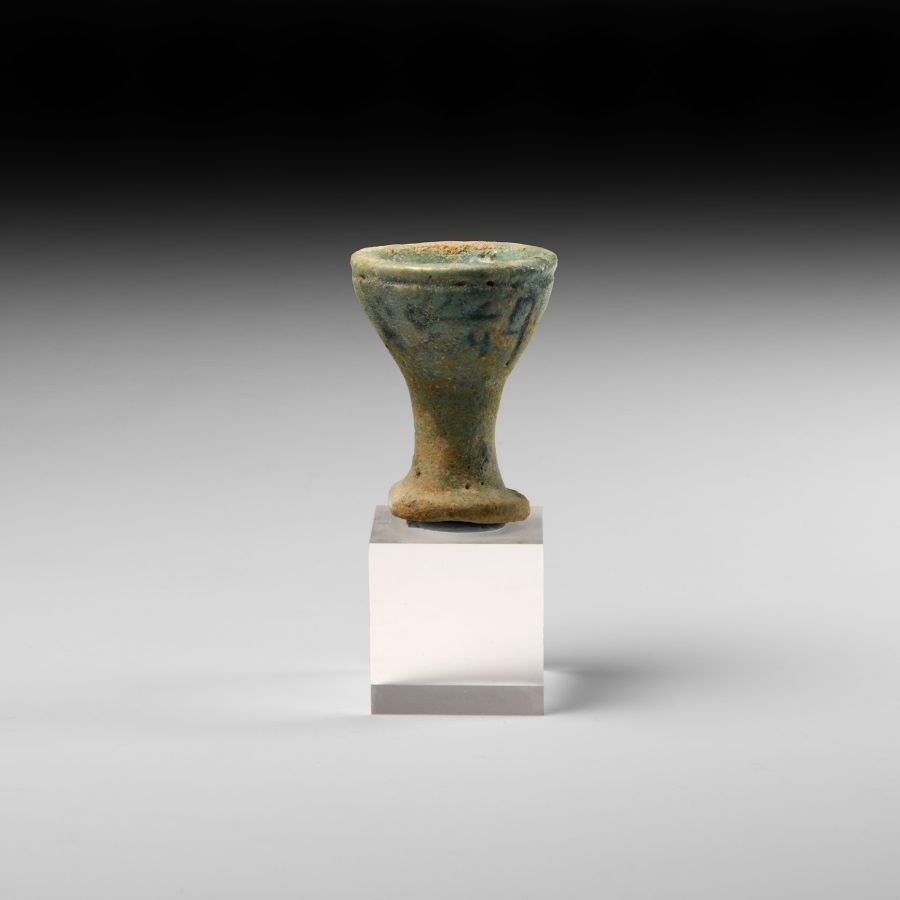
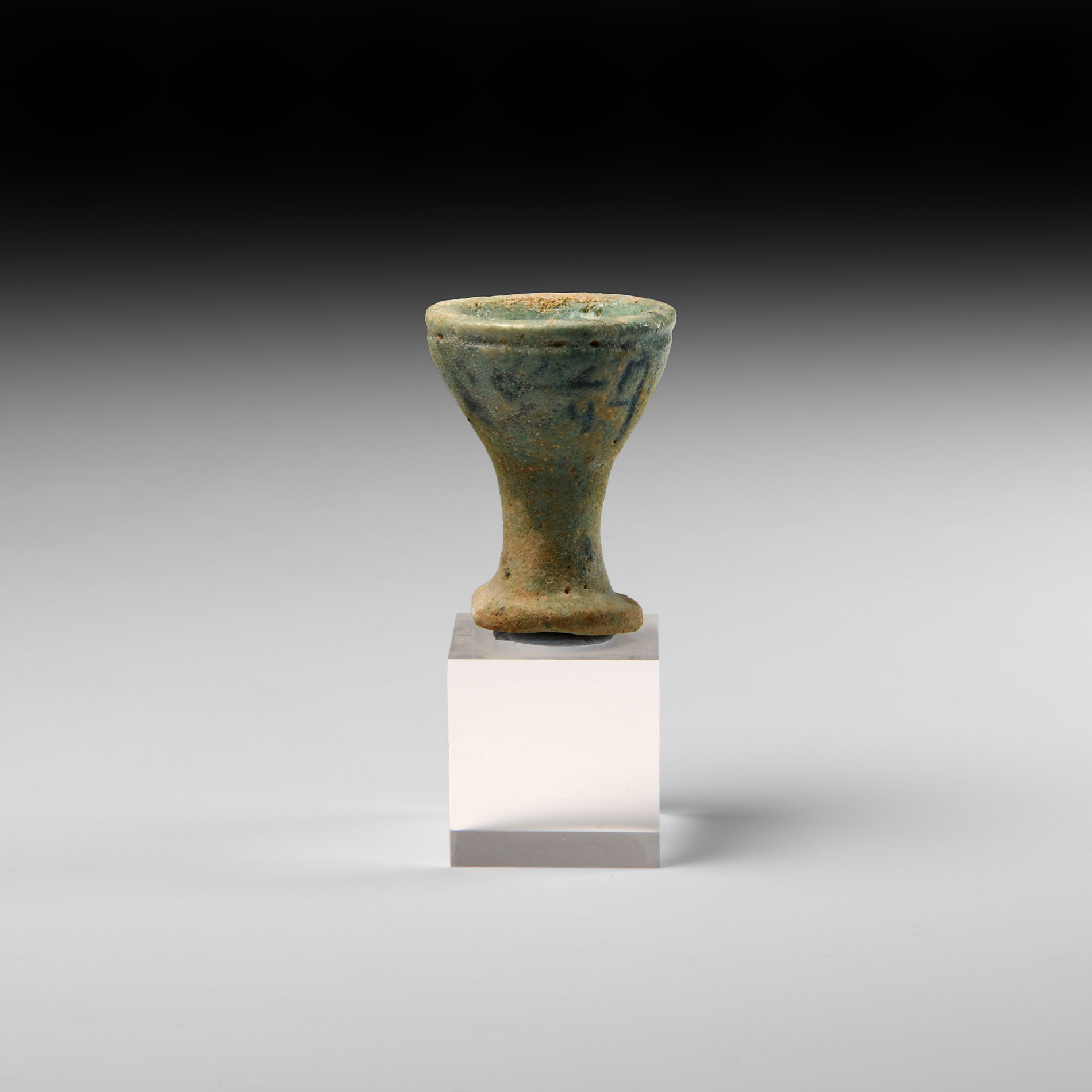
Egyptian Blue glazed Faience Cup with Hieroglyphs
LATE PERIOD-PTOLEMAIC PERIOD, CIRCA 664-30 B.C.
2 1/2 in. (36 grams total, 65 mm high including stand).
A blue glazed composition chalice, with enigmatic hieroglyphs on the body in darker blue; mounted on an acrylic base. [No Reserve]
ProvenanceFrom an old UK collection.
From the private collection of Alf Baxendale (1941-2016) part 2, keen Egyptologist, member of the Egyptology Society, trustee of the Amarna Trust; thence by descent.
Accompanied by an identification display card.
Accompanied by a copy of his obituary published in Horizon, The Amarna Project and Amarna Trust newsletter, Issue 18, 2017, p.21, by Barry John Kemp, CBE, FBA, Professor Emeritus of Egyptology at the University of Cambridge and directing excavations at Amarna in Egypt.
Probably a foundation deposit.
CONDITIONTimeLine Auctions follows a vetting process to ensure the authenticity and legality of all items, reinforcing our commitment to integrity and responsible trading. Each antiquity, antique, and coin lot undergoes thorough examination by a vetting committee of at least ten external specialists, professional trade association members, scientists, and archaeologists: Our Vetting Process
AUCTIONS:
TimeLine is a leading auction house specialising in antiquities, ancient art, collectables, natural history, coins, medals, and books. Our auctions offer museums, collectors, historians, and enthusiasts the opportunity to acquire unique and historically significant pieces.
-
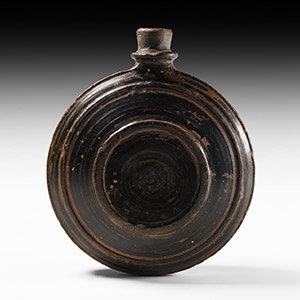
Egyptian Black Burnished Ware Pilgrim's Flask
Graeco-Roman Period, 332-30 B.C.Sold for (Inc. bp): £130
A ceramic black burnished ware pilgrim's flask of discoid form, short neck with collar, body with raised concentric roundels to both faces. 296 grams, 15.8 cm high
Acquired in Egypt in 1960 whilst working at the British Council. Ex Andrews collection.
This resembles an Etruscan style bucchero impasto flask of circa 700-600 B.C., suggesting that this was an import into Egypt; a comparable example is in the Penn Museum (inventory no. MS 3431). -
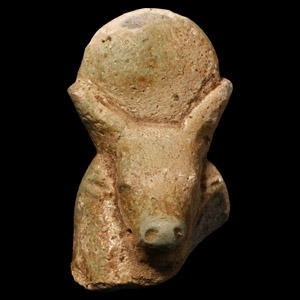
Egyptian Bull-Headed Apis Shabti Head
New Kingdom, Ramesside Period, 1295-1069 B.C.Sold for (Inc. bp): £1,690
A glazed composition shabti fragment representing the head of a bull surmounted by a sun-disc between its horns, wearing a lappet wig and with human arms crossed over the chest; the missing lower portion continued the shape of a mummiform human body; the back of the figure flat and bearing faint traces of inscription, the opening begins with a common shabti introduction which appears to be followed (as would be expected) by the name of syncretic deity Osiris Apis. 34 grams, 60 mm
Acquired early 1990s. Ex private American collection; thence by descent. Private collection since 1998. Accompanied by a scholarly note by Egyptologist Paul Whelan.
The figure comes from the catacombs at Saqqara where the sacred Apis bulls were buried, known today as the Serapeum. The Apis bull was associated principally with the gods Ptah, patron deity of Memphis, and Osiris, and when one died it was afforded the kind of lavish burial befitting a pharaoh. All bull-headed shabtis date to the 19th and 20th Dynasties and were left as offerings beside the huge granite sarcophagi of the deified bulls. These shabtis were among hundreds of objects recovered from the catacombs by Auguste Mariette during his excavations there between 1850-1853. The Musée du Louvre in Paris holds the largest collection of artefacts from the Serapeum outside Egypt, including around 120 Apis shabtis. They reveal that the this fragment with its sun-disc is from a rare variant of this shabti type; just 5 of the Louvre examples have sun-discs (S 1823, N 5234 51-54), the remaining shabtis have a bull’s head with short stubby horns and no sun-disc. -
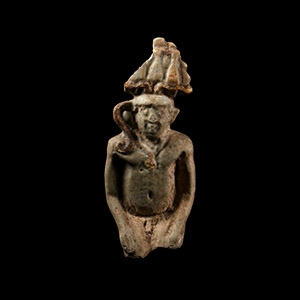
Egyptian Harpocrates Amulet
Late Period, 664-332 B.C.Estimate: £300 - 400 (+bp*)
Opening Bid: £150
A composition amulet fragment of the god Harpocrates, modelled nude, with stylised facial features and the Sidelock of Youth; light blue-green glaze with darker glaze to his hair and the lower part of the hem-hemet crown; pierced lug to reverse of crown for suspension. 6.72 grams, 51 mm high
Acquired 1980s-1990s. H.N. collection, Milton Keynes, Bedfordshire, UK.
