
Loading, please wait...

LOT 0565
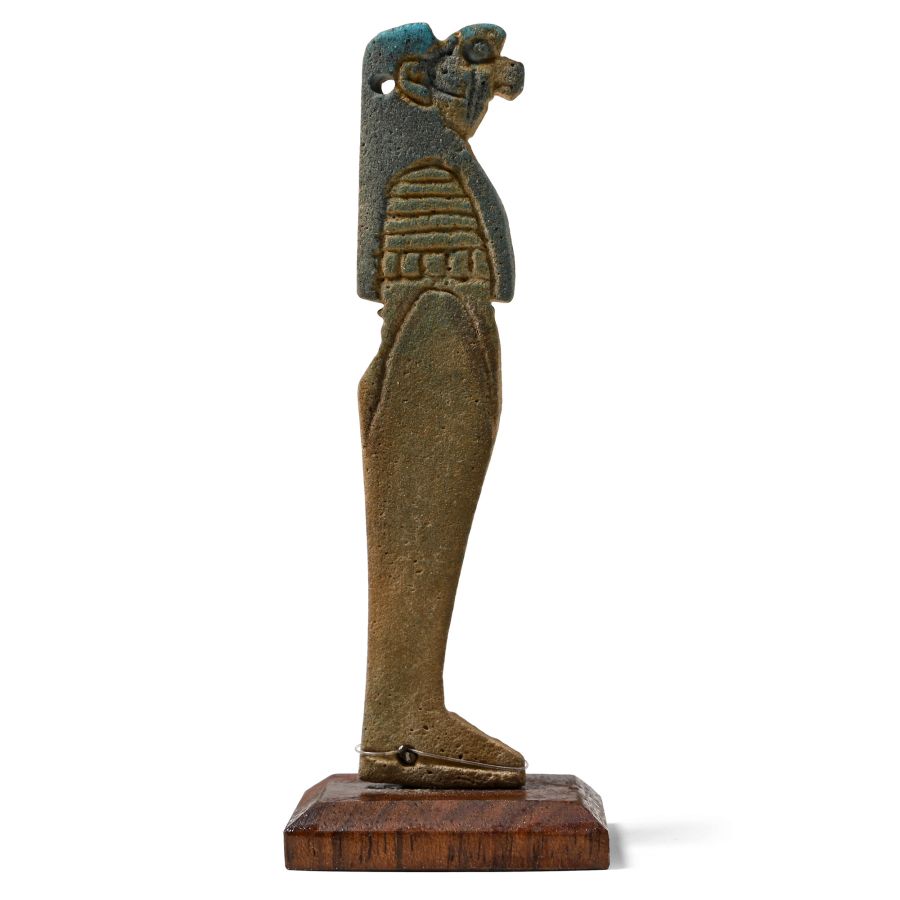
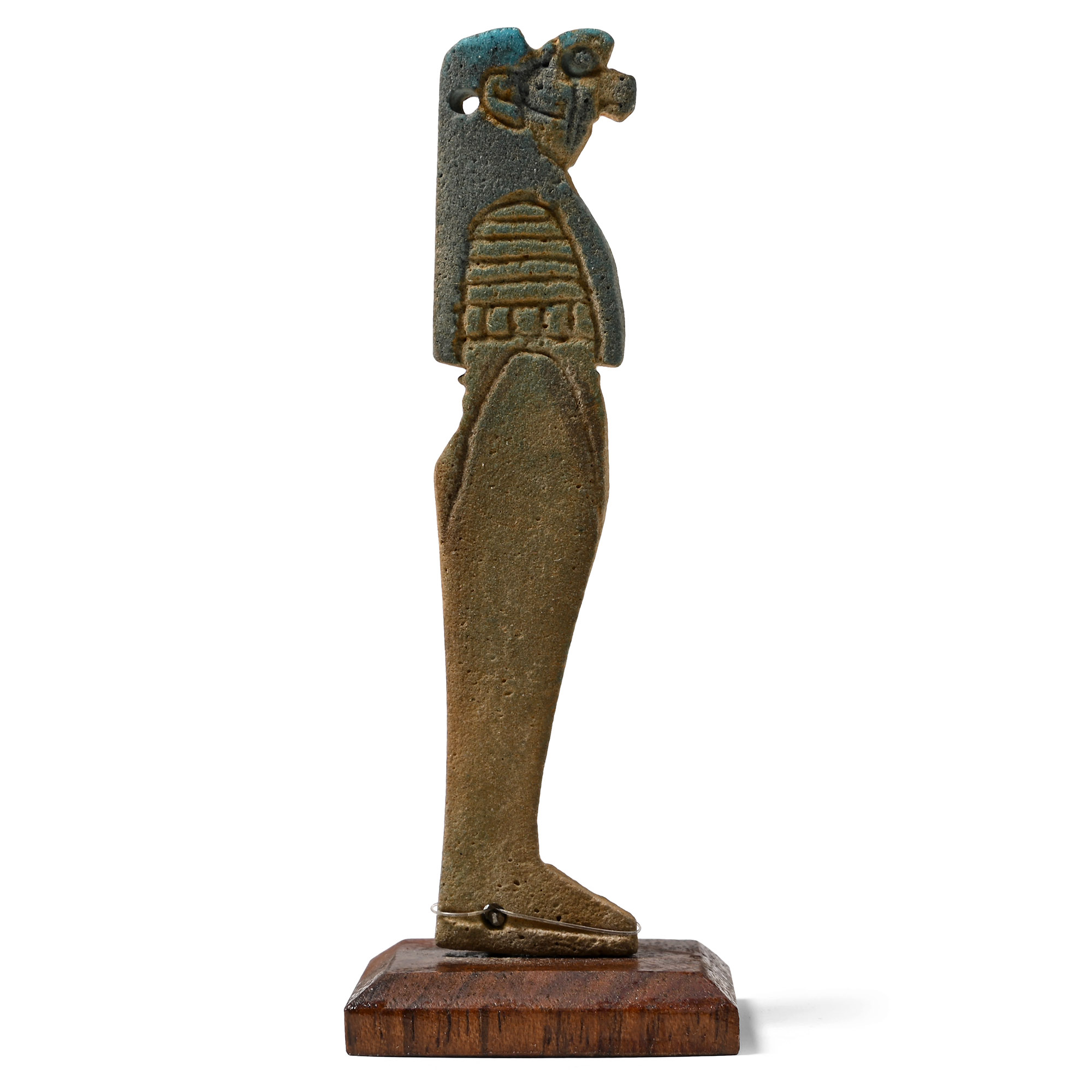
Egyptian Blue Glazed Faiance Qebehsenuef Appliqué
LATE PERIOD, 664-332 B.C.
3 1/8 in. (6.91 grams total, 80 mm high including stand).
Flat appliqué of the mummiform, falcon-headed Qebehsenuef, one of the Four Sons of Horus in profile, with a human ear, wearing a tripartite wig and multi-row collar around the shoulders, and hanging straps on lower body; face, decorative collar and belt indicated by fine incisions; mounted on a stand.
ProvenanceEx Roger Liechti (1934-2010), Petit-Lancy, Switzerland (inv. no.E.494, written on the underside of the wooden mount); acquired in 1973 from the art dealer Mr. Wagner Terrassière, Geneva.
Thence by descent in the family, Switzerland.
The applique belonged to a set of four depicting the Four Sons of Horus with their differently shaped heads (human, baboon, jackal and falcon). These four gods, Imsety, Hapy, Duamutef, and Qebehsenuef, were already mentioned in the Pyramid Texts of the Old Kingdom and were believed to accompany and protect the deceased from the time he or she was embalmed and buried up to the judgment of the dead. Their main function was to guard the viscera during and after mummification. The group of four objects was part of a mummy's elaborate jewellery, which also included a mummy net, a winged scarab and a broad shoulder collar. Two small holes through the back of the head and feet, which were used to sew the figure onto a textile base. Traces of yellow and blue paint. Intact.
CONDITIONTimeLine Auctions follows a vetting process to ensure the authenticity and legality of all items, reinforcing our commitment to integrity and responsible trading. Each antiquity, antique, and coin lot undergoes thorough examination by a vetting committee of at least ten external specialists, professional trade association members, scientists, and archaeologists: Our Vetting Process
AUCTIONS:
TimeLine is a leading auction house specialising in antiquities, ancient art, collectables, natural history, coins, medals, and books. Our auctions offer museums, collectors, historians, and enthusiasts the opportunity to acquire unique and historically significant pieces.
LOT 0565
Egyptian Blue Glazed Faiance Qebehsenuef Appliqué
Estimate £500 - 700€580 - 810 (for guidance only)$680 - 950 (for guidance only)
Opening Bid
£275 (EUR 319; USD 371) ‡+BP*
-

Egyptian Steatite and Other Scarab Group
Mainly Second Intermediate Period, circa 1660-1500 B.C.Estimate: £150 - 200 (‡+bp*)
Opening Bid: £75
Designs include: a line border enclosing a decorative symmetrical scroll-work pattern; a line border enclosing a horse with papyrus clumps above and in front; deeply impressed bird and other signs behind; a line border enclosing a nwb (gold) sign flanked by Red Crowns, with a bee above flanked by coiled cobras; a line border enclosing a djed, neb, and sun disc, with narrow neb(?) signs above and below. 8.76 grams total, 12-21 mm
Acquired on the European art market in the early 2000s. with Galerie Rhéa, Zurich, Switzerland. This lot is accompanied by an illustrated lot declaration signed by the Head of the Antiquities Department, Dr Raffaele D'Amato. -
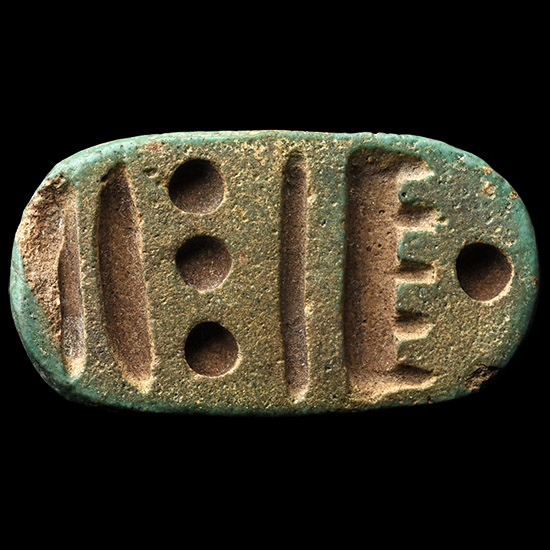
Large Egyptian Amuletic Cartouche-shaped Stamp Naming Amun-Re
Third Intermediate Period-Late Period, circa 1069-332 B.C.Estimate: £300 - 400 (+bp*)
Opening Bid: £150
Large oval stamp with plano-convex profile, plumed motif to the top, pierced for suspension; underside with hieroglyphic legend, possibly a garbled version of (A)mun-Re, lord of the thrones (of the two lands). 13.2 grams, 49 mm
Excavated from Egypt in 1914. From the private collection of Mr David Sams and his wife Elizabeth Kate Sams, gentry and amateur archaeologists who travelled to Egypt in 1914 with their daughter Ethel. Mr Sams and his wife led digging expeditions from which these items come from the family estate of Mr and Mrs Sams, by direct descent to their granddaughter. -
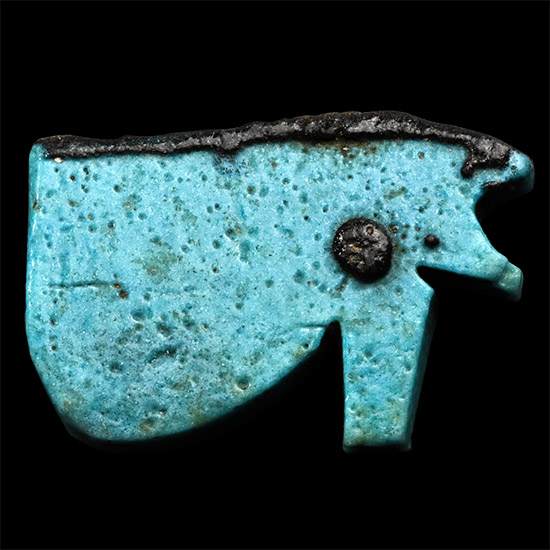
Large Egyptian Blue Glazed Faience Eye of Horus Amulet
New Kingdom-Late Period, circa 1550-332 B.C.Estimate: £500 - 700 (+bp*)
Opening Bid: £250
The body displaying the characteristic shape combining human and falcon ocular imagery, the brow and pupil detailed in black faience, pierced longitudinally for suspension. 8.34 grams, 41 mm
Early 20th century UK collection. Accompanied by a previous catalogue information page.
The wedjat-eye amulet depicts Horus’s healed eye, blending human and falconine features. Its ancient Egyptian name means ‘the one that is sound’. According to myth, Seth wounded or took the eye, and Thoth later restored it. Believed to offer protection, healing, and regeneration, the popular amulet was worn by the living and the dead.
