
Loading, please wait...
LOT 0023
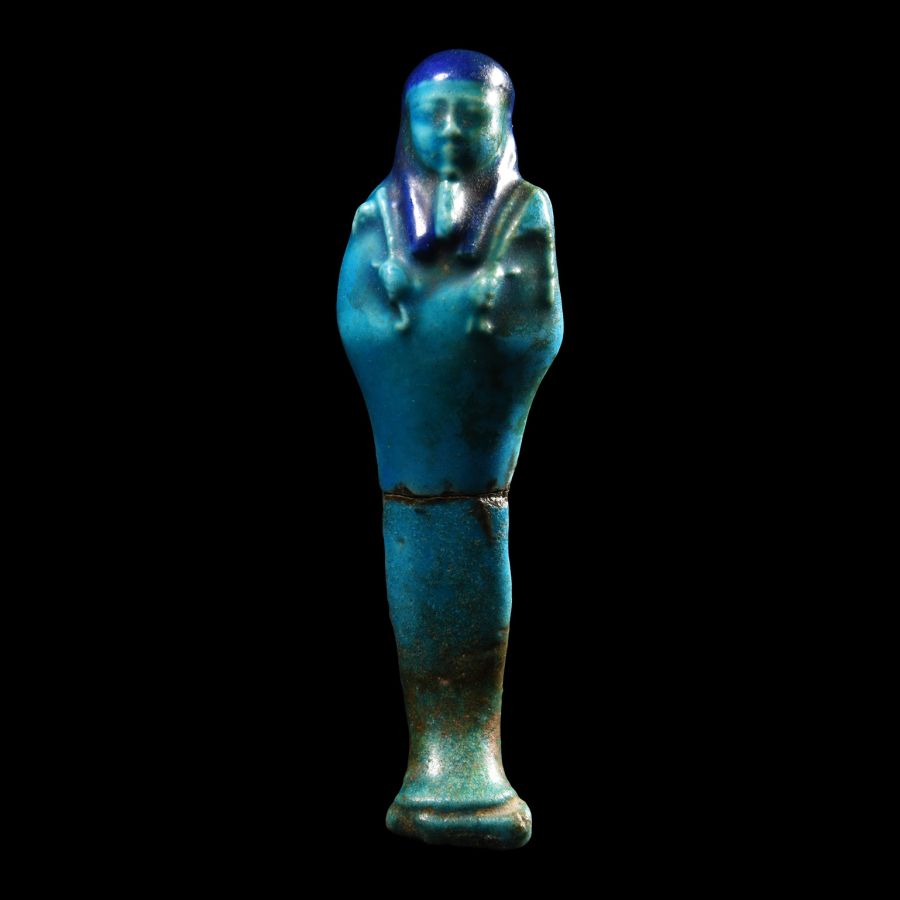
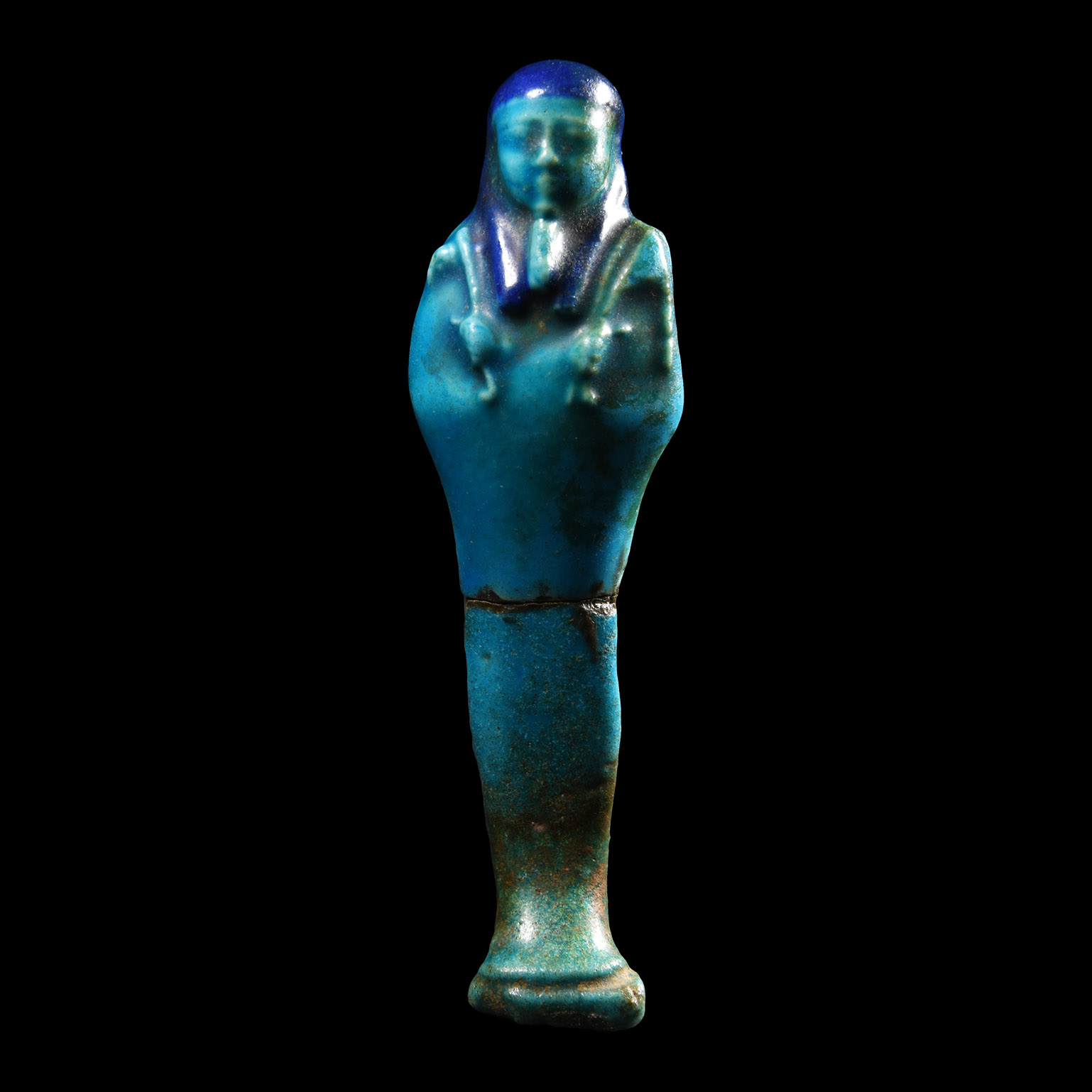
Egyptian Blue Faience Shabti
EARLY PTOLEMAIC PERIOD, CIRCA 3RD CENTURY B.C.
4 1/2 in. (44 grams, 11.5 cm high).
A mummiform shabti with a thick and lustrous turquoise glaze, sporting a tripartite wig highlighted in darker blue glaze, and a long beard; holding a pick, hoe and a cord for a seed bag hanging over the left shoulder; raised dorsal pillar and an integral plinth; repaired.
ProvenanceEx collection of Jacques René Fiechter, Switzerland (1920-1950).
with Auction Martin, Egyptian Collection André Bircher, 1949.
Accompanied by an academic report by Egyptologist Paul Whelan.
Cf. Janes, G., The Shabti Collections 6: A Selection from World Museum, Liverpool, Cheshire, 2016, p.518, nos.272a-b, p.521, no.275; Fitzwilliam Museum, no. E.GA.2636.1943, for similar.
FootnotesThe lack of inscription hinders positive identification, but the shabti’s proportions, elegant modelling, and lustrous glaze closely match others considered to have come from an area of the extensive necropolis at Abydos, labelled “Cemetery G” by its excavator Flinders Petrie, where hundreds of blue lustrous-glazed shabtis of varying qualities were recovered. This figure is closest in style to those belonging to Petosiris, son of Djed-hor. Both were buried with similarly blue lustrous-glazed shabtis that were mostly plain although a few were inscribed with an inscription.
CONDITIONTimeLine Auctions follows a vetting process to ensure the authenticity and legality of all items, reinforcing our commitment to integrity and responsible trading. Each antiquity, antique, and coin lot undergoes thorough examination by a vetting committee of at least ten external specialists, professional trade association members, scientists, and archaeologists: Our Vetting Process
AUCTIONS:
TimeLine is a leading auction house specialising in antiquities, ancient art, collectables, natural history, coins, medals, and books. Our auctions offer museums, collectors, historians, and enthusiasts the opportunity to acquire unique and historically significant pieces.
LOT 0023
Egyptian Blue Faience Shabti
Estimate £1,000 - 1,400€1,160 - 1,620 (for guidance only)$1,350 - 1,890 (for guidance only)
-
.jpg)
Egyptian Faience Scaraboid of Seti I and Thutmose III
New Kingdom, 19th Dynasty, 1314-1304 B.C.Sold for (Inc. bp): £1,040
A blue glazed bifacial scaraboid; one side bearing the cartouche of Thutmose III and the legend “Enduring image of Re” and the other side Seti I’s throne name Men-Maat-Re (meaning “Eternal is the Justice of Re”) with other signs for an epithet that perhaps reads as “truly praised (of Re)”; pierced for suspension. 4.11 grams, 23 mm
From an old UK collection. From the private collection of Alf Baxendale (1941-2016) part 2, keen Egyptologist, member of the Egyptology Society, trustee of the Amarna Trust; thence by descent. Accompanied by an identification display card. Accompanied by a copy of his obituary published in Horizon, The Amarna Project and Amarna Trust newsletter, Issue 18, 2017, p.21, by Barry John Kemp, CBE, FBA, Professor Emeritus of Egyptology at the University of Cambridge and directing excavations at Amarna in Egypt.
Seti I's reign saw the production of many scarabs, scaraboids and plaques bearing his name as well as that of Thutmose III - who was considered a great warrior king. -
.jpg)
Egyptian Limestone Fragment with Hieroglyphs
Old Kingdom, 2700-2200 B.C.Sold for (Inc. bp): £780
A limestone fragment of provincial workmanship, displaying a partial column of titular naming hieroglyphs, possibly royal; repaired. 1.5 kg, 19 cm
London collection, acquired on the art market in the 1980s. From the collection of a West London, UK, gentleman. -
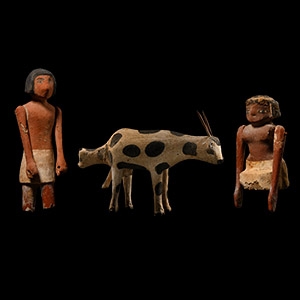
Egyptian Animal Birthing Diorama
Middle Kingdom, 11th-12th Dynasty, 2023-1862 B.C.Estimate: £5,000 - 7,000 (+bp*)
Opening Bid: £2,500
A wooden animal birthing scene composed of three figures: a standing cow or other quadruped giving birth to its young, its head, neck and forelegs emerging from the mother's rear, both with a black and white speckled coat; a standing male figure with articulated arms and pierced hands, wearing a kilt and cropped wig and with stylised facial detailing; a kneeling figure also with articulated arms, open-palm hands, wearing a kilt and cropped wig, stylised facial features; extensive remains of polychrome pigment. 111 grams total, 9.5-16 cm
From an early 20th century Home Counties collection. This lot has been checked against the Interpol Database of stolen works of art and is accompanied by search certificate no.11597-199209.
Such models would have been deposited in tombs; the purpose of such a scene was probably to evoke the season of spring, when calves were born, and the floodplain where farmers lived and raised their livestock.
