
Loading, please wait...
_900x900.jpg "Egyptian Blue Faience Shabti Group")
_200x200.jpg "Egyptian Blue Faience Shabti Group")
.jpg "Egyptian Blue Faience Shabti Group")
LOT 0487
Egyptian Blue Faience Shabti Group
LATE PERIOD-PTOLEMAIC PERIOD, 664-30 B.C.
1 5/8 in. (18.2 grams total, 43-46 mm).
A group of four blue-glazed faience shabtis. [4, No Reserve]
ProvenanceAcquired 1930s-1950s.
Ex Ciapara collection.
TimeLine Auctions follows a vetting process to ensure the authenticity and legality of all items, reinforcing our commitment to integrity and responsible trading. Each antiquity, antique, and coin lot undergoes thorough examination by a vetting committee of at least ten external specialists, professional trade association members, scientists, and archaeologists: Our Vetting Process
AUCTIONS:
TimeLine is a leading auction house specialising in antiquities, ancient art, collectables, natural history, coins, medals, and books. Our auctions offer museums, collectors, historians, and enthusiasts the opportunity to acquire unique and historically significant pieces.
-
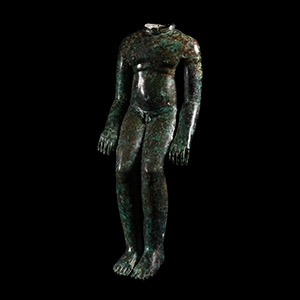
Large Egyptian Body of Horus-Harpocrates
Ptolemaic Period, 332-30 B.C.Estimate: £2,000 - 3,000 (+bp*)
Opening Bid: £1,000
An acephalic seated bronze nude statuette of Horus-Harpocrates, legs held together and arms by his side, semi-naturalistic anatomical detailing; cleaned. 993 grams, 22.5 cm high
Collection of Brugsch Pasha (1842-1930). with Hotel Drouot, Paris, 30 September 1997, lot 643. Ex property of Mr Naudy. Property of a French collector. This lot has been checked against the Interpol Database of stolen works of art and is accompanied by search certificate no.11601-198618. Accompanied by a scholarly note by Egyptologist Paul Whelan.
Horus, son of Isis and Osiris, was considered a solar deity who overcame darkness and defeated the chaotic forces of his evil uncle, the god Seth. Egyptian Pharaohs considered themselves to be reincarnations of Horus. In his youthful form, Horus the child embodies the new sun and all associated benefits. In Graeco-Roman Egypt he became Harpocrates, son of Serapis and Isis, the deity-symbol of rebirth and fertility, perhaps the most popular deity to be represented in Ptolemaic and Roman Egypt. -
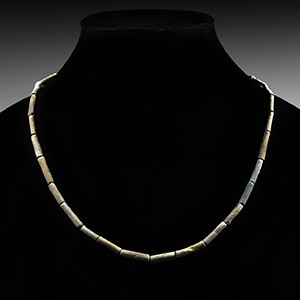
Egyptian Faience Bead Necklace
Late Period, 664-525 B.C.Sold for (Inc. bp): £46
A restrung group of tubular faience beads with a modern clasp. 8.3 grams, 48 cm long
From an early 20th century UK collection. -
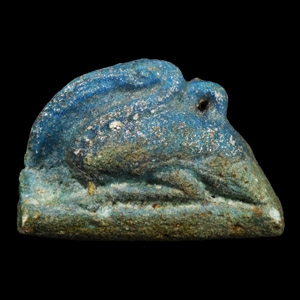
Egyptian Blue Faience Ibis Amulet
Ptolemaic Period, 1550-1070 B.C.Sold for (Inc. bp): £156
A glazed composition amuletic pendant of an ibis standing on a rectangular base, its curved beak resting on its chest. 4.25 grams, 28 mm
From a UK private collection, 1975-1978.
