
Loading, please wait...
LOT 0554
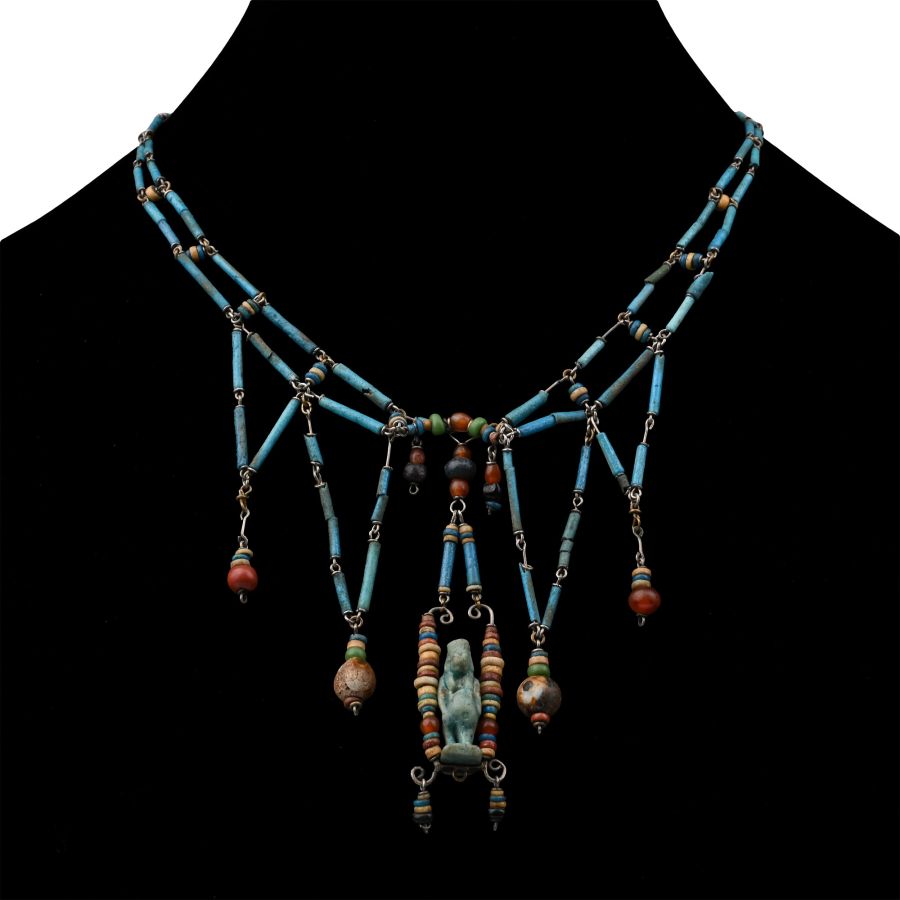
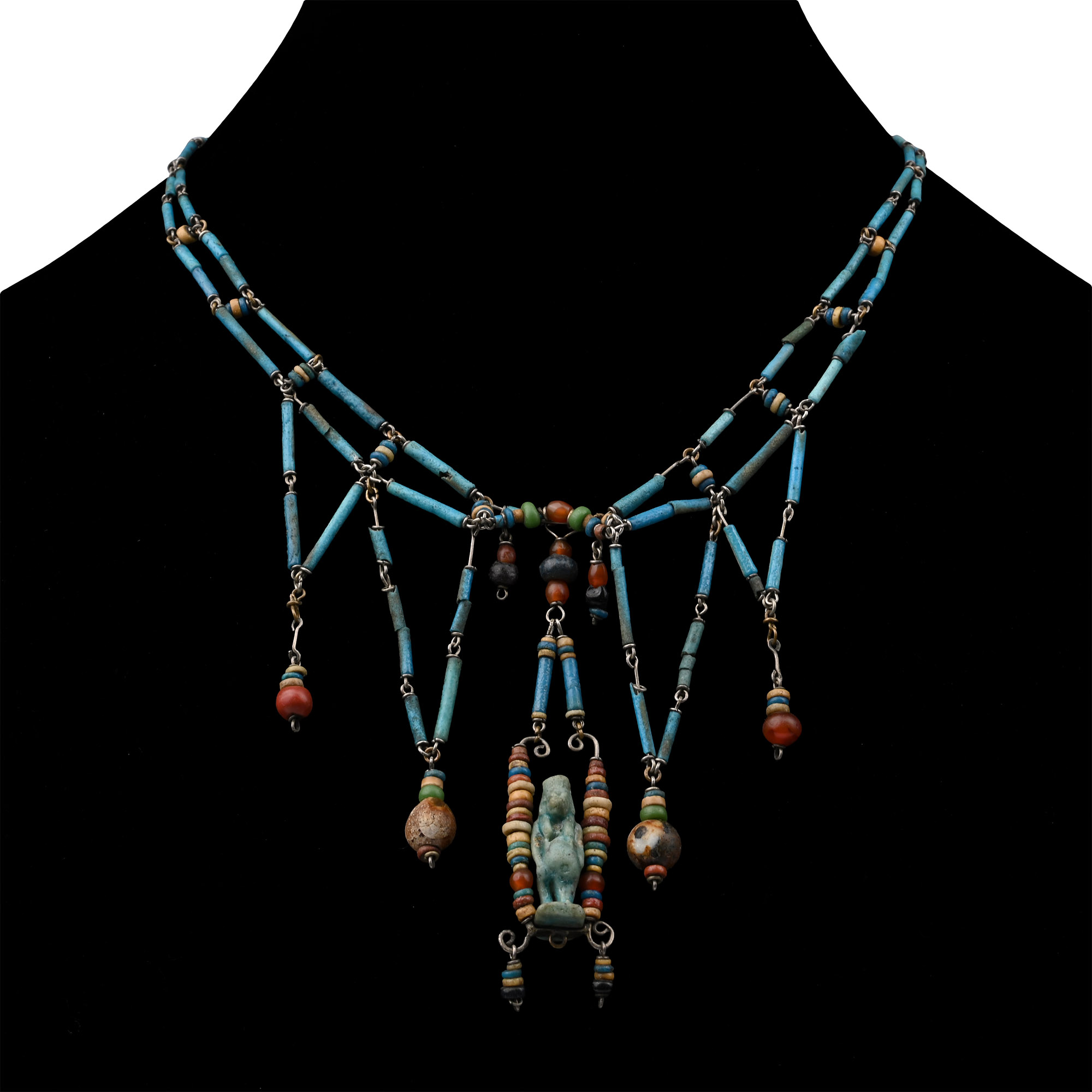
Egyptian Blue Faiance Bead Necklace with Taweret
LATE PERIOD, 664-332 B.C.
14 3/4 in. (21.2 grams, 37.5 cm).
A restrung designer necklace composed of cylindrical and spherical beads; centrpiece composed of polychrome annular beads flanking a Taweret amulet; modern clasp.
ProvenanceFrench private collection, formed in the early 20th century.
Private collection, London, UK.
TimeLine Auctions follows a vetting process to ensure the authenticity and legality of all items, reinforcing our commitment to integrity and responsible trading. Each antiquity, antique, and coin lot undergoes thorough examination by a vetting committee of at least ten external specialists, professional trade association members, scientists, and archaeologists: Our Vetting Process
AUCTIONS:
TimeLine is a leading auction house specialising in antiquities, ancient art, collectables, natural history, coins, medals, and books. Our auctions offer museums, collectors, historians, and enthusiasts the opportunity to acquire unique and historically significant pieces.
-
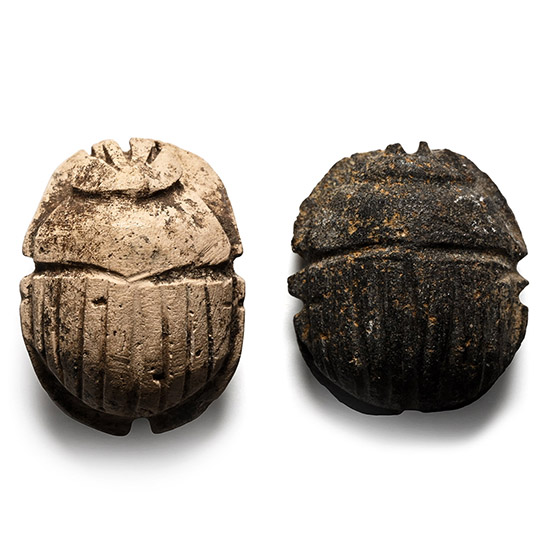
Egyptian Heart Scarab Group
Late Period, 664-332 B.C.Estimate: £140 - 180 (+bp*)
Opening Bid: £70
Comprising two scarabs with striated wing cases and ribbed underside. 7.5 grams total, 18-20 mm
From the collection of a gentleman, acquired on the London art market in the 1990s.
The scarab amulet was a powerful symbol of rebirth, transformation, and protection in ancient Egypt. Modelled after the beetle linked to the sun god Khepri, it represented the cycle of life and regeneration. Used from the Middle Kingdom (c. 2050 BCE) onwards, scarabs served as funerary amulets, personal charms, and seals—often inscribed with prayers or names—reflecting both spiritual beliefs and daily life. -
.jpg)
Large Egyptian Blue Faience Roundel for Ramesses II
New Kingdom, 19th Dynasty, 1295-1186 B.C.Estimate: £10,000 - 14,000 (+bp*)
Opening Bid: £5,000
A fitting or pommel made for King Ramesses II, his throne name (User-Maat-Re Setep-en-Re) inscribed within a cartouche topped by two ostrich feathers framing a solar disc; the cartouche positioned above the hieroglyphic sign nbw, which signifying 'gold' and alluded to the luminous radiance of the royal name; two uraei flanking the cartouche, wearing the White Crown of Upper Egypt and the Red Crown of Lower Egypt, respectively; the throne name roughly translating as 'The justice of Re is powerful, chosen of Re'; a square-shaped socket located at the back for attachment; mounted on a custom-made display stand. 475 grams total, 14 cm including stand
Formerly with G. Janes, Manchester, UK and collection Galerie Nefer. Previously with Cybele Galerie Librairie Egyptologie, Paris, France. From an important English collection. Accompanied by an academic report by Dr Alberto Maria Pollastrini. Accompanied by a copy of the Cybele invoice. This lot has been checked against the Interpol Database of stolen works of art and is accompanied by search certificate number no.10740-177442.
The epithet part of the throne name Setep en Re appears in Ramesses II's royal titulary from Year 2 of his reign. The two rearing cobras, which symbolise the goddesses Nekhbet and Wadjet, also represent the unity of the Two Lands under Ramesses II's rule. A similar green faience fitting bearing Ramesses II's throne name is kept in the Archaeological Collection of Zürich (inv. no. 3702). Similar objects linked to the 18th Dynasty kings Akhenaten and Ay show that such fittings were not limited to the 19th Dynasty. They may even have influenced later designs, as the fitting of King Ay, possibly from a piece of heirloom furniture, was found among the tomb goods of Nefertari, Ramesses II’s “Chief Queen”. -
.jpg)
Egyptian Pale Blue Steatite Scarab with Hieroglyphs
Late Period, 664-332 B.C. or laterSold for (Inc. bp): £104
Plano-convex in section with scarab detailing to the upper face; underside with hieroglyphic inscription; pierced longitudinally. 2.22 grams, 17 mm
Ex Constable collection, 1990s. Ex P. Morris collection.
