Loading, please wait...

Egyptian Black Steatite Eye of Horus Amulet Egyptian Black Steatite Eye of Horus Amulet Egyptian Black Steatite Eye of Horus Amulet Egyptian Black Steatite Eye of Horus Amulet Egyptian Black Steatite Eye of Horus Amulet Egyptian Black Steatite Eye of Horus Amulet
Use mousewheel to zoom in and out, click to enlarge
Details

LOT 0009

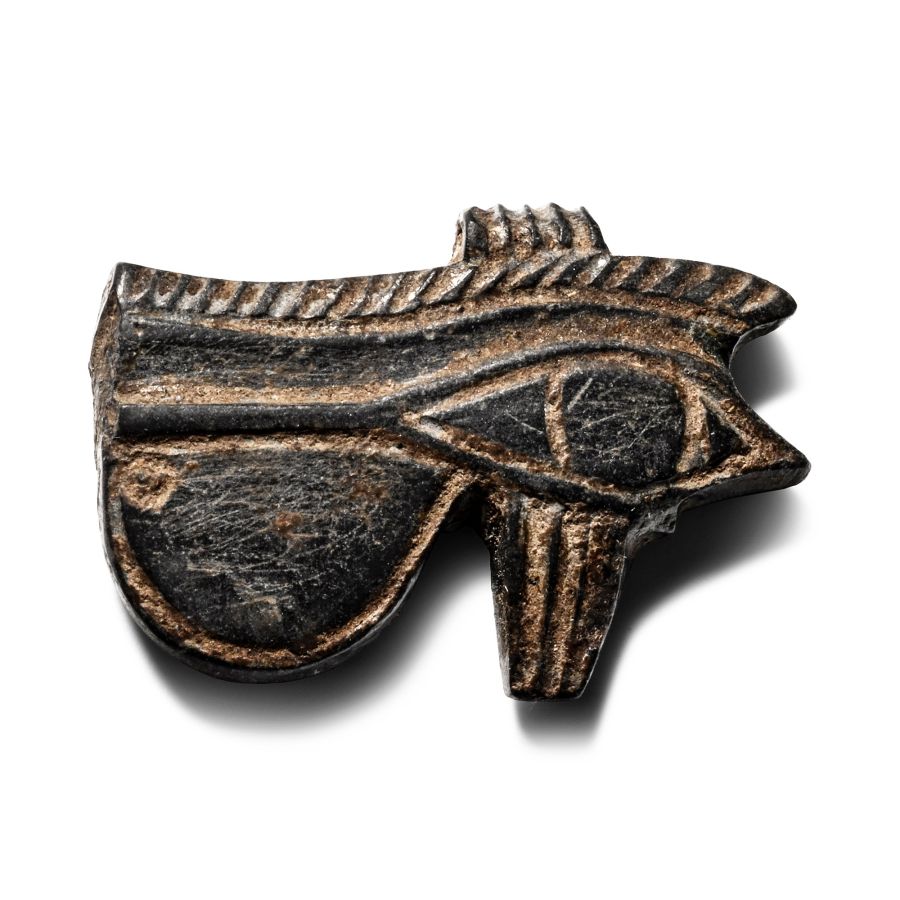
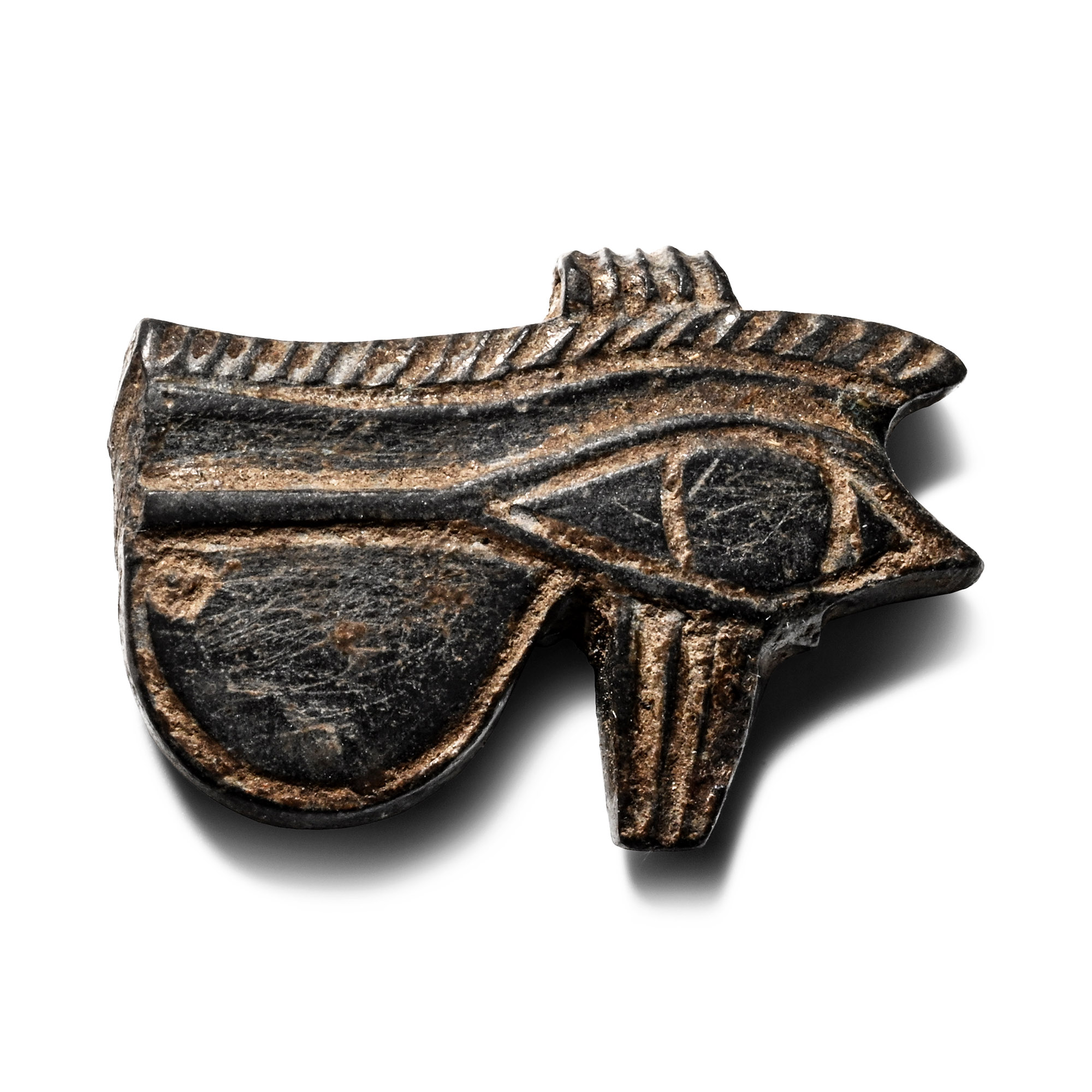
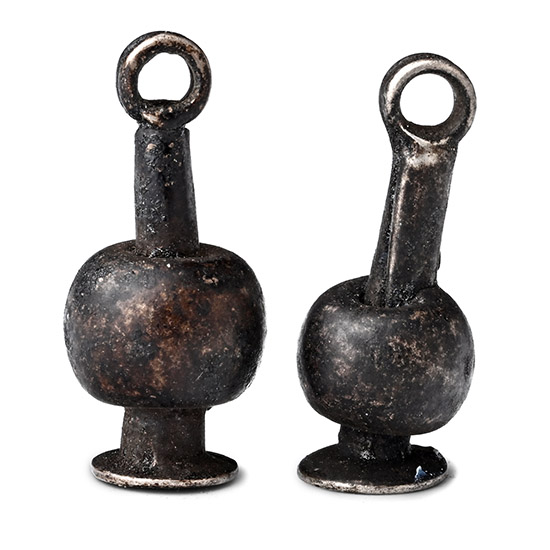
Egyptian Black Steatite Eye of Horus Amulet

LATE PERIOD, 664-332 B.C.

3/4 in. (1.45 grams, 19 mm).

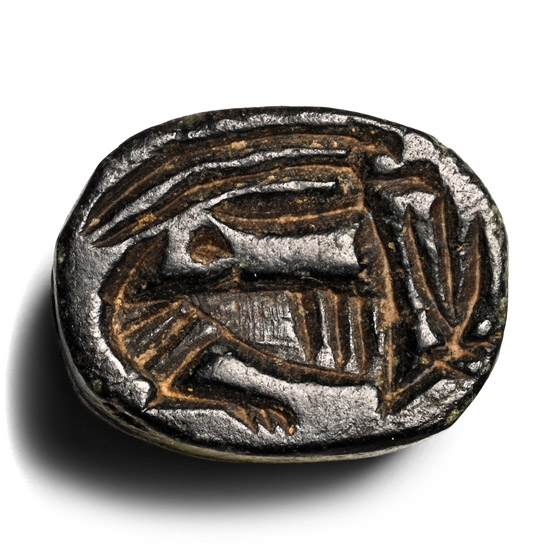
Carved unifacial amulet with hatched eyebrow and ribbed suspension loop.

Provenance

From a 20th century UK collection.

Literature

Cf. Flinders Petrie, W.M., Amulets, London, 1994, pl.XXV, fig.138l, for type.

Footnotes

The wedjat-eye amulet is a representation of the healed eye of the god Horus, featuring both human and falcon elements. The name Wedjat in ancient Egyptian means ‘the one that is sound.’ According to Egyptian mythology, Horus' eye was wounded or taken by the god Seth and restored by Thoth. The wedjat-eye amulet was thought to protect its wearer and bestow the power of recovery and regeneration onto them. It was very popular and used by both the living and the dead.

CONDITION
VETTING:

TimeLine Auctions follows a vetting process to ensure the authenticity and legality of all items, reinforcing our commitment to integrity and responsible trading. Each antiquity, antique, and coin lot undergoes thorough examination by a vetting committee of at least ten external specialists, professional trade association members, scientists, and archaeologists: Our Vetting Process


AUCTIONS:

TimeLine is a leading auction house specialising in antiquities, ancient art, collectables, natural history, coins, medals, and books. Our auctions offer museums, collectors, historians, and enthusiasts the opportunity to acquire unique and historically significant pieces.

LOT 0009

Egyptian Black Steatite Eye of Horus Amulet

Estimate £700 - 900€810 - 1,040 (for guidance only)$950 - 1,220 (for guidance only)

Opening Bid
£350 (EUR 406; USD 473) +BP*

Sign in to Bid

Please enter a e-mail
Please enter a password
Or Create Account here.
Please confirm to accept TC and Privacy policy

Bids: 0
RELATED LOTS
  • Romano-Egyptian Limestone Funerary Niche
    Romano-Egyptian Limestone Funerary Niche
    Coptic Period, 5th-6th century A.D.

    Estimate: £2,000 - 3,000 (+bp*)

    Opening Bid: £1,000

    Carved architectural block fragment comprising: a shallow niche with arched top and parallel sides, with concentric mouldings to create a reveal and ledge below to accept offerings; horizontal tiered base; attachment sockets for two figurines (absent) flanking the niche; to left, a column modelled in the half-round with two parallel vertical stems, shallow roundel to the base and stylised foliage at the top; pediment above with scooped profile; above each figurine an incised initial, 'A' and 'M'; facing surface keyed for plaster finish. 57.55 kg, 49 cm


    From the estate and private collection of Matthew Upham (1962-2025), an antiques trader from Budleigh Salterton, Devon, UK. Acquired at an estate sale at auction. Property of a Cambridgeshire, UK, gentleman. Accompanied by an academic report by Dr Raffaele D'Amato. This lot has been checked against the Interpol Database of stolen works of art and is accompanied by a search certificate number no. 13297-255939.

    In the Christian Roman Empire, the stelae in the form of aedicula, which could be funerary monuments with crosses or the images of the deceased, or devotional niches with images of saints, appear to be independent sculptures. These stelae consisted of a rectangular body surmounted by a circular arch or trapezoidal structure. At the centre of the niche, the deceased was often depicted full-length, in a praying position (orans). Devotional stelae were also placed inside a church or shrine, with images of the Virgin and Child, or saints.

    Lot Details

  • Very Large Egyptian Expedition Lithograph of the Temple of Philae
    Very Large Egyptian Expedition Lithograph of the Temple of Philae
    Early 19th century A.D.

    Estimate: £80 - 100 (+bp*)

    Opening Bid: £40

    Proof etching on laid paper of plate 6 from Description de l'egypte entitled Île de Philae. Coupe et élévation de la galerie de l'est. Élévations des deux colonnades et de l'édifice du sud. Élévation du premier pylône. 252 grams, 104 x 68.5 cm


    From the collection of a North American priest. Acquired between 1981-1996. Property of a North American collector.

    Produced between February 1802 and 1830 on the orders of Napoleon Bonaparte; published between 1809 and 1828. Just 1,000 copies were distributed to various institutions, printed on laid paper with an 'Égypte ancienne et moderne' watermark. The book is subtitled Recueil des observations et des recherches qui ont été faites en Égypte pendant l’expédition de l’Armée française, publié par les ordres de Sa Majesté l’Empereur Napoléon le Grand (Gathering of observations and discoveries which were made in Egypt during the expedition of the French army, published on the orders of His Majesty the Emperor Napoleon the Great). It was the world's first encyclopedia devoted exclusively to the remains of ancient Egypt. The plates of this book are the first to present the archaeological sites of Thebes (Luxor). The Philae temple complex was one of the major monuments dismantled from its original location and relocated to a new site during the Aswan High Dam project. Most of the complex dates to the Ptolemaic Period, although some earlier and later elements remain.

    Lot Details

  • Egyptian Becker Serpentine Vessel
    Egyptian 'Becker' Serpentine Vessel
    New Kingdom, 18th Dynasty, circa 1450 B.C.

    Estimate: £2,500 - 3,500 (‡+bp*)

    Opening Bid: £1,250

    Piriform jar with wide, flat rim and short neck, narrow neck and flat base. 1.2 kg, 15.5 cm


    Ex Becker collection, 1920s. Private collection, Los Angeles, USA, 1990s. Private European collection. Accompanied by an academic report by Dr Raffaele D’Amato. This lot has been checked against the Interpol Database of stolen works of art and is accompanied by a search certificate number no.12576-232111.

    Three forms of serpentine were mainly used by the ancient Egyptians for stone vessels: a) green or grey serpentine with black veins; b) translucent green serpentine with black patches; c) granular black serpentine with intermixed grey or brown granules. Type a) Serpentine, i.e. the green or grey one with black veins, has the longer time range, and was used for vessels from the Predynastic Period (Naqada II) through the New Kingdom. It was used for stone vessels, but also became common for statuettes and small toilet vessels. The class of green glazed kohl pots, many with carved or openwork decoration which are usually called ‘glazed steatite’ were more likely to be made of serpentine. The type here represented is a form known in the New Kingdom: a bag-shaped jar with neck, flat base, and wide thin rim. Similar vessels have been found in Thebes, Amarna, Kahun, among the other localities.

    Lot Details