
Loading, please wait...
LOT 0458
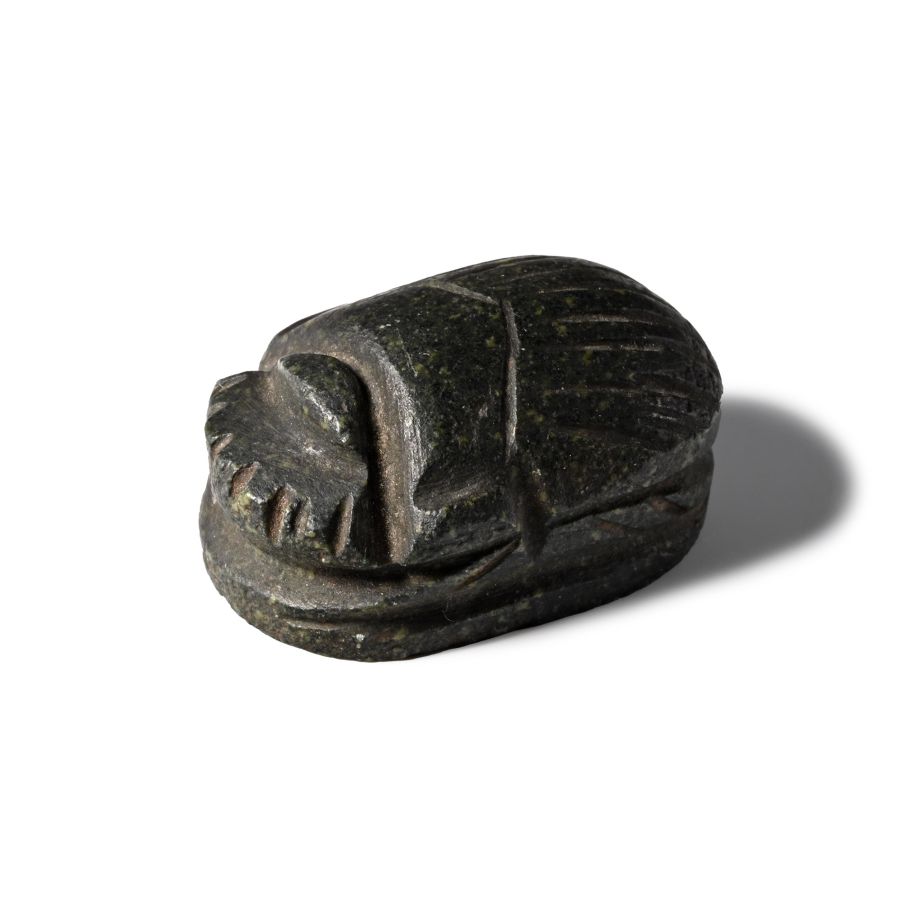
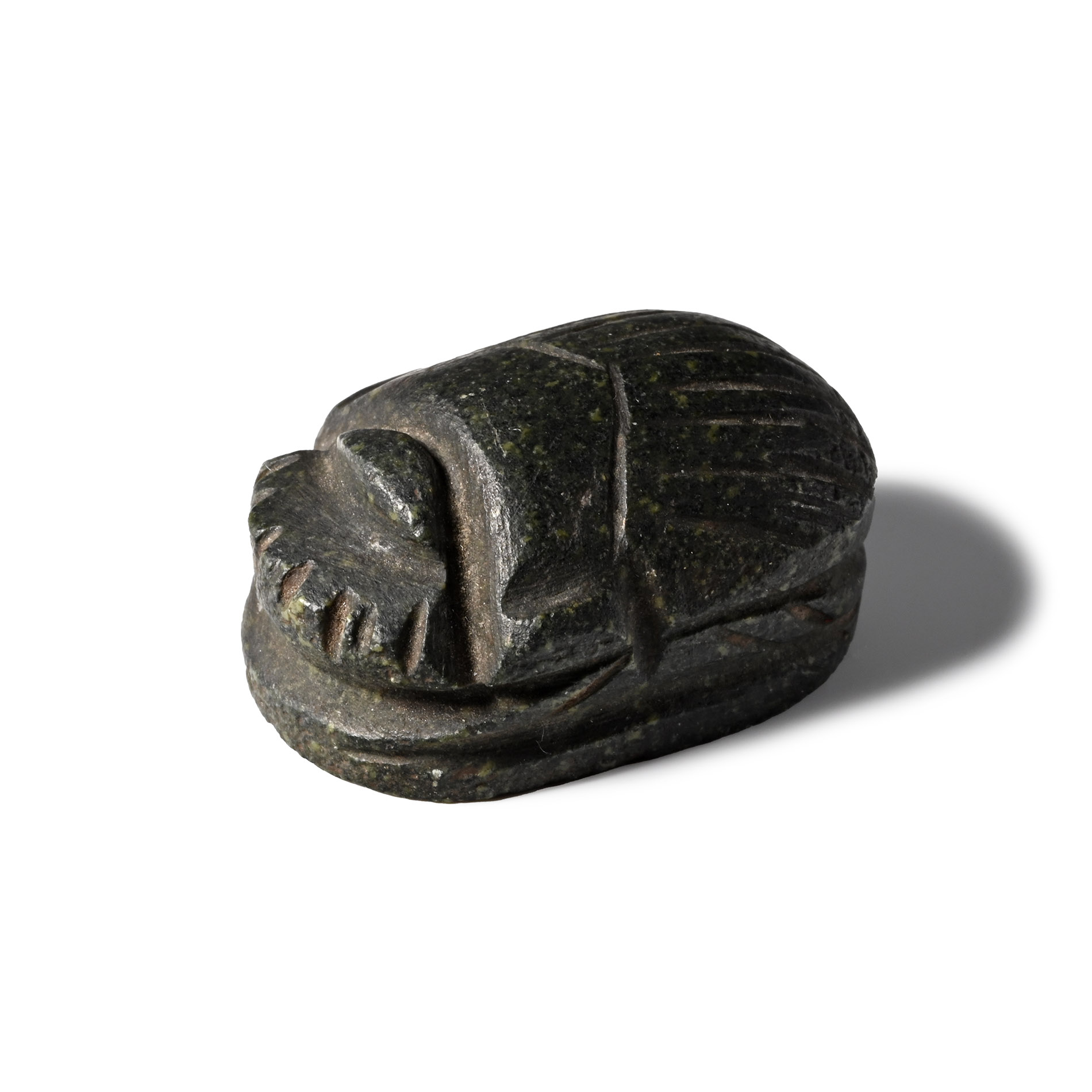
Egyptian Black Hardstone Scarab
LATE PERIOD, 664-332 B.C.
1 1/8 in. (17 grams, 29 mm).
Dark green hardstone with paler speckles; with a boldly carved head, clypeus, prothorax and elytra, and legs indicated at the sides; plain underside.
ProvenanceEx Irene Newman, Birdham, Chichester, West Sussex, England.
with Stride & Son Auctioneers, Chichester, West Sussex, England, 23 April 2015, no.1599 [Part].
Acquired by the present owner at the above sale.
Cf. Schulz, R., Seidel, M., Egyptian Art. The Walters Art Museum, Oakville, 2007, pl.18, cat. no. 126, for a similar example.
FootnotesThe scarab, which represented the dung beetle, was the most popular amulet in ancient Egypt for approximately two thousand years until the Ptolemaic Period when it gradually fell out of favour. The popularity of scarabs extended beyond the borders of Egypt, and they were also distributed and produced in other regions, such as Phoenicia and Israel. The beetle is named khepri, derived from the verb 'to come into existence', and was considered the embodiment of the creator god Khepri, who was self-engendered. The ancient Egyptians mistakenly believed that the young beetle emerging from the dung ball was the result of an act of self-creation.
CONDITIONTimeLine Auctions follows a vetting process to ensure the authenticity and legality of all items, reinforcing our commitment to integrity and responsible trading. Each antiquity, antique, and coin lot undergoes thorough examination by a vetting committee of at least ten external specialists, professional trade association members, scientists, and archaeologists: Our Vetting Process
AUCTIONS:
TimeLine is a leading auction house specialising in antiquities, ancient art, collectables, natural history, coins, medals, and books. Our auctions offer museums, collectors, historians, and enthusiasts the opportunity to acquire unique and historically significant pieces.
-
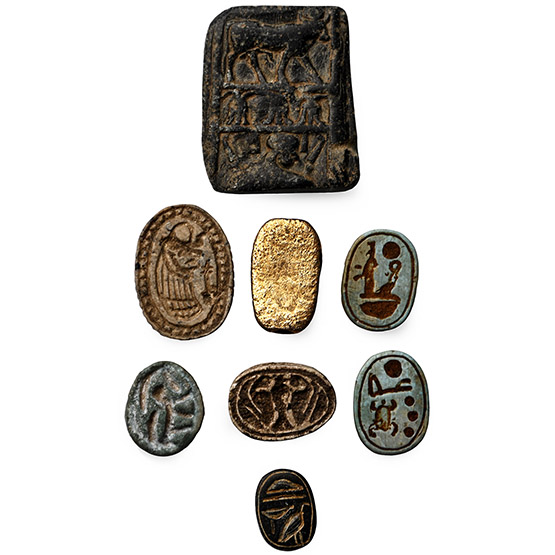
Egyptian Mixed Scarab Collection
2nd-1st millennium B.C. and laterSold for (Inc. bp): £780
Stone plaque with raised relief depictions of the Apis bull and a falcon deity beneath; a mixed group of scarabs and scaraboids, most bearing text or motifs on the underside, including: a rope border enclosing the head of a lion wearing a sun disc and uraeus; a plain gold scaraboid; a line border enclosing the throne name of Amenhotep III (neb-maat-Re); an indeterminate standing figure; a central hes- vase flanked by rearing cobras; a group of hieroglyphs, perhaps a slightly incorrect spelling of the throne name of Amenhotep II (akheperu-Re); and a group of four hieroglyphs. 36.9 grams total, 14-35 mm
From the collection of a gentleman, acquired on the London art market in the 1990s. -
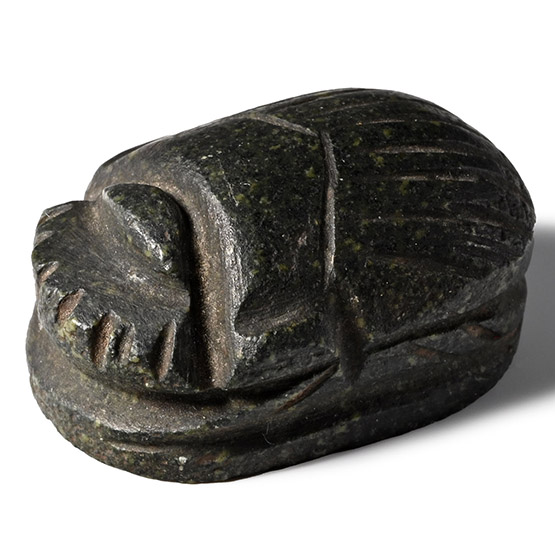
Egyptian Black Hardstone Scarab
Late Period, 664-332 B.C.Sold for (Inc. bp): £234
Dark green hardstone with paler speckles; with a boldly carved head, clypeus, prothorax and elytra, and legs indicated at the sides; plain underside. 17 grams, 29 mm
Ex Irene Newman, Birdham, Chichester, West Sussex, England. with Stride & Son Auctioneers, Chichester, West Sussex, England, 23 April 2015, no.1599 [Part]. Acquired by the present owner at the above sale.
The scarab, which represented the dung beetle, was the most popular amulet in ancient Egypt for approximately two thousand years until the Ptolemaic Period when it gradually fell out of favour. The popularity of scarabs extended beyond the borders of Egypt, and they were also distributed and produced in other regions, such as Phoenicia and Israel. The beetle is named khepri, derived from the verb 'to come into existence', and was considered the embodiment of the creator god Khepri, who was self-engendered. The ancient Egyptians mistakenly believed that the young beetle emerging from the dung ball was the result of an act of self-creation. -
.jpg)
Egyptian Pale Blue Steatite Scarab with Hieroglyphs
Late Period, 664-332 B.C. or laterSold for (Inc. bp): £104
Plano-convex in section with scarab detailing to the upper face; underside with hieroglyphic inscription; pierced longitudinally. 2.22 grams, 17 mm
Ex Constable collection, 1990s. Ex P. Morris collection.
