
Loading, please wait...
LOT 0402
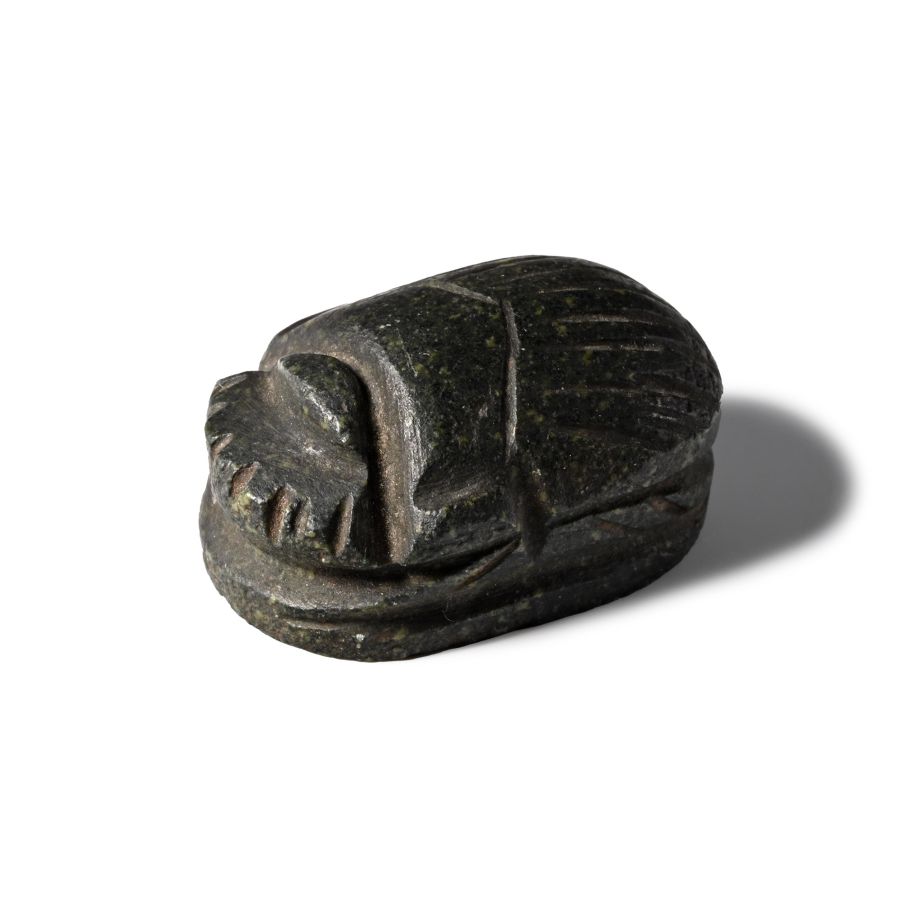
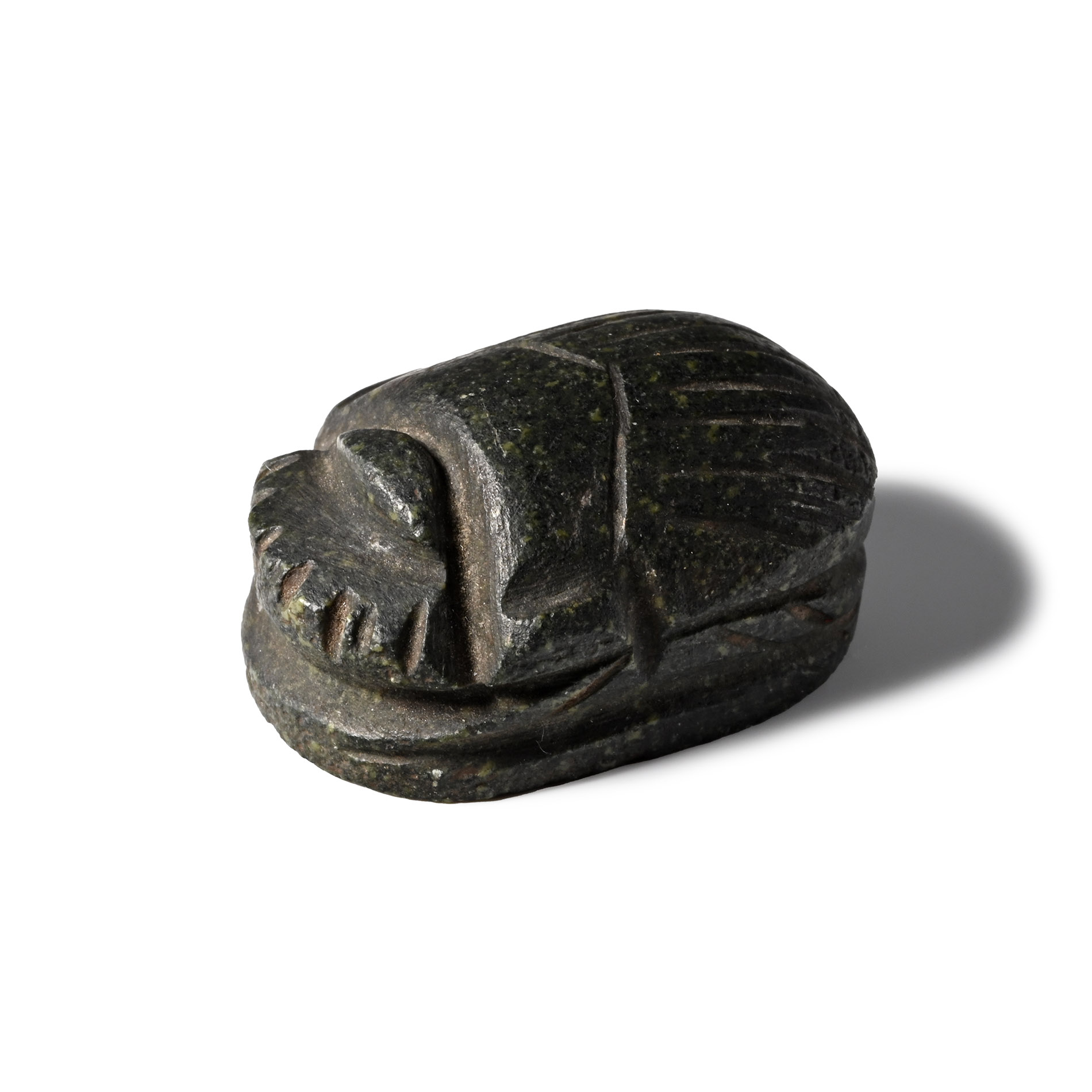
Egyptian Black Hardstone Scarab
LATE PERIOD, 664-332 B.C.
1 1/8 in. (17 grams, 29 mm).
Dark green hardstone with paler speckles; with a boldly carved head, clypeus, prothorax and elytra, and legs indicated at the sides; plain underside.
ProvenanceEx Irene Newman, Birdham, Chichester, West Sussex, England.
with Stride & Son Auctioneers, Chichester, West Sussex, England, 23 April 2015, no.1599 [Part].
Acquired by the present owner at the above sale.
This lot is accompanied by an illustrated lot declaration signed by the Head of the Antiquities Department, Dr Raffaele D’Amato.
Cf. Schulz, R., Seidel, M., Egyptian Art. The Walters Art Museum, Oakville, 2007, pl.18, cat. no. 126, for a similar example.
FootnotesThe scarab, which represented the dung beetle, was the most popular amulet in ancient Egypt for approximately two thousand years until the Ptolemaic Period when it gradually fell out of favour. The popularity of scarabs extended beyond the borders of Egypt, and they were also distributed and produced in other regions, such as Phoenicia and Israel. The beetle is named khepri, derived from the verb 'to come into existence', and was considered the embodiment of the creator god Khepri, who was self-engendered. The ancient Egyptians mistakenly believed that the young beetle emerging from the dung ball was the result of an act of self-creation.
CONDITIONTimeLine Auctions follows a vetting process to ensure the authenticity and legality of all items, reinforcing our commitment to integrity and responsible trading. Each antiquity, antique, and coin lot undergoes thorough examination by a vetting committee of at least ten external specialists, professional trade association members, scientists, and archaeologists: Our Vetting Process
AUCTIONS:
TimeLine is a leading auction house specialising in antiquities, ancient art, collectables, natural history, coins, medals, and books. Our auctions offer museums, collectors, historians, and enthusiasts the opportunity to acquire unique and historically significant pieces.
LOT 0402
Egyptian Black Hardstone Scarab
Estimate £400 - 600€460 - 700 (for guidance only)$540 - 810 (for guidance only)
-
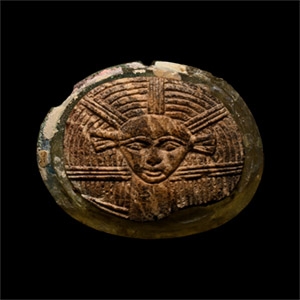
Egyptian Glass Ring with Hathor Cameo
Ptolemaic Period, circa 3rd century B.C.Sold for (Inc. bp): £3,900
Pale green transparent glass hoop with ellipsoid bezel, bevelled edge inlaid with a darker glass low-relief facing mask of the goddess Hathor with cow's ears and banded hairstyle. 17.65 grams, 39.43 mm overall, 20.51 mm internal diameter (approximate size British J, USA 4 3/4, Europe 8.69, Japan 8)
Acquired between 1965-2020. Private collection, London. This lot has been checked against the Interpol Database of stolen works of art and is accompanied by search certificate no.12484-229828. This lot has been cleared against the Art Loss Register database, and is accompanied by an illustrated lot declaration signed by the Head of the Antiquities Department, Dr Raffaele D’Amato.
Images of Hathor with a human face and cow ears combine her human and bovine aspects. She is shown with a serene human face, symbolising her nurturing nature, while the cow ears emphasise her roles in fertility and motherhood. Hathor was one of the most important deities in ancient Egypt, revered as the goddess of love, beauty, music, dance, fertility, and motherhood. She was also associated with joy, childbirth, and women’s health. Hathor was believed to protect and nurture, often depicted as a maternal figure. As such, she was closely linked with Isis. She was closely linked to the sun god Ra, acting as a cosmic force facilitating life. In funerary contexts, Hathor was also seen as a guide for the dead, helping them transition to the afterlife. Her multifaceted role made her one of Egypt's most widely worshipped goddesses. -
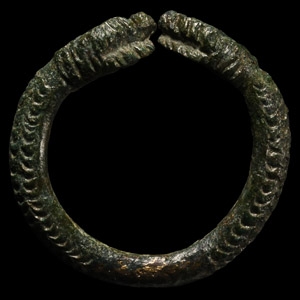
Romano-Egyptian Bronze Ring with Snake Heads
1st century B.C.-1st century A.D.Estimate: £150 - 200 (+bp*)
Opening Bid: £75
Penannular in form with scale detailing to the shoulders, opposed serpent-head finials. 4.99 grams, 24.51 mm overall, 17.75 mm internal diameter (approximate size British N 1/2, USA 6 3/4, Europe 14.35, Japan 13)
Ex German art market, 2000s. Acquired from an EU collector living in London. From the collection of Surrey, UK, gentleman. This lot is accompanied by an illustrated lot declaration signed by the Head of the Antiquities Department, Dr Raffaele D’Amato. -
.jpg)
Egyptian Decorated Wooden Mask From a Mummy
Late Period, 4th-3rd century B.C.Sold for (Inc. bp): £3,380
Displaying semi-naturalistic detailing in relief, beneath a band of headdress ornament composed of rows of architectural dot-and-dash and zig-zag patterns over a segmental panel, possible hieroglyphs to the top tier; attachment pegs to the sides of the face and through the head; extensive remains of painted black pigmentation and composition fill to the eyes. 677 grams, 36 cm
From a French estate, acquired between 1960 and 1980. with SAS Cornette de Saint Cyr Auction, Paris, Vente 882, Mobilier et Objets d'art, 2 December 2014, lot 69. Accompanied by a copy of a French cultural passport no.167062. Accompanied by an academic report by Dr Alberto Maria Pollastrini. This lot has been checked against the Interpol Database of stolen works of art and is accompanied by search certificate no.11807-206837. This lot has been cleared against the Art Loss Register database, and is accompanied by an illustrated lot declaration signed by the Head of the Antiquities Department, Dr Raffaele D’Amato.
