Loading, please wait...

Use mousewheel to zoom in and out, click to enlarge

Details

LOT 0502

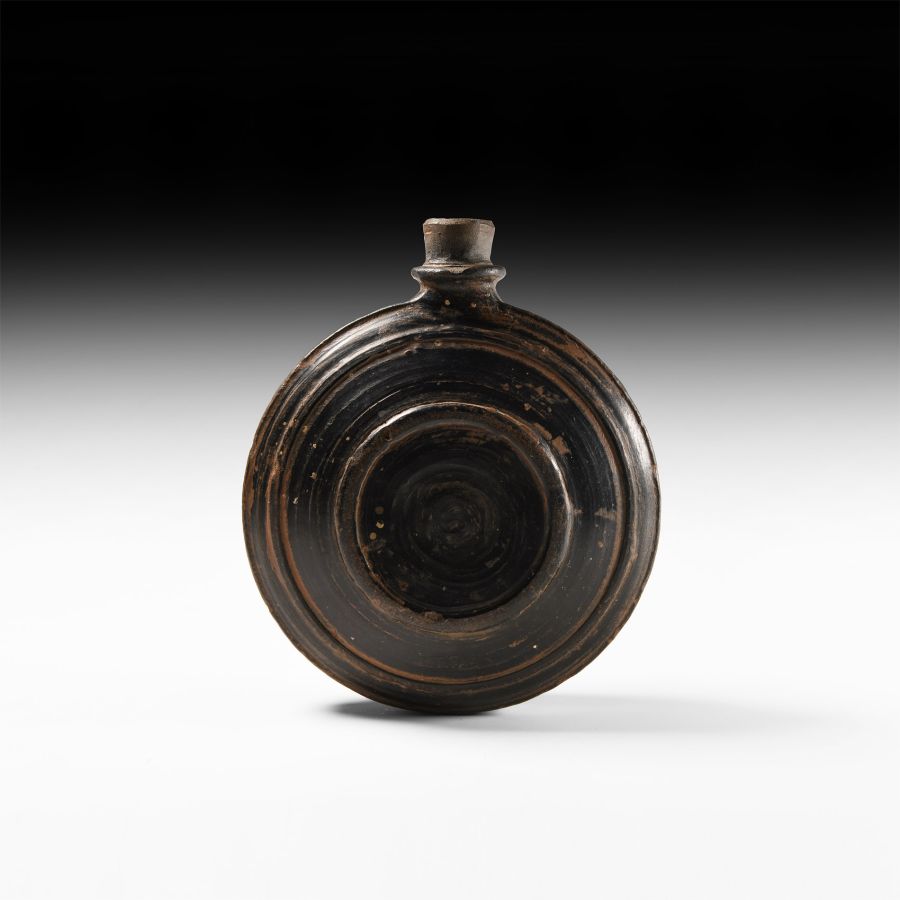
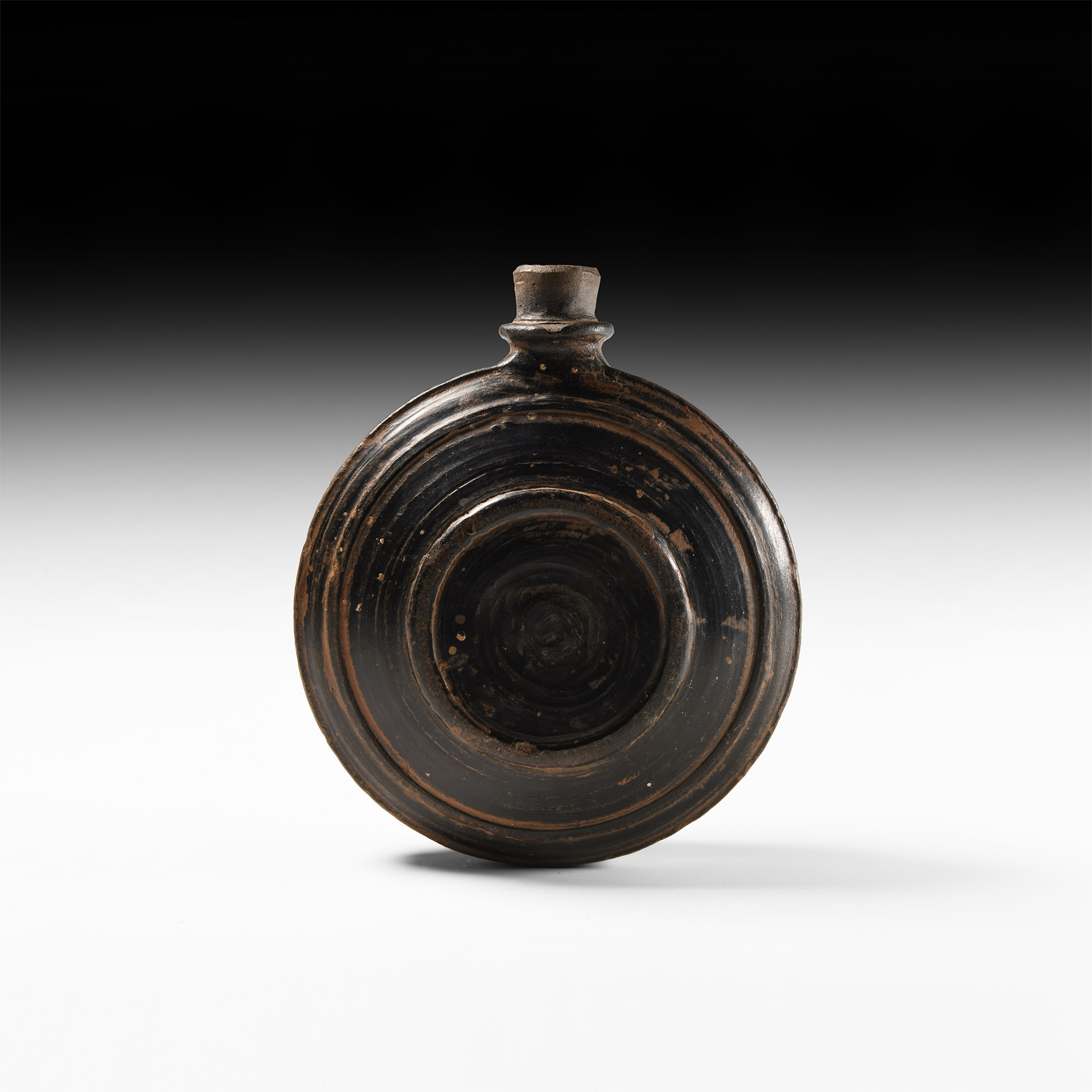
Egyptian Black Burnished Ware Pilgrim's Flask

GRAECO-ROMAN PERIOD, 332-30 B.C.

6 1/4 in. (296 grams, 15.8 cm high).

A ceramic black burnished ware pilgrim's flask of discoid form, short neck with collar, body with raised concentric roundels to both faces.

Provenance

Acquired in Egypt in 1960 whilst working at the British Council.
Ex Andrews collection.

Footnotes

This resembles an Etruscan style bucchero impasto flask of circa 700-600 B.C., suggesting that this was an import into Egypt; a comparable example is in the Penn Museum (inventory no. MS 3431).

CONDITION

VETTING:

TimeLine Auctions follows a vetting process to ensure the authenticity and legality of all items, reinforcing our commitment to integrity and responsible trading. Each antiquity, antique, and coin lot undergoes thorough examination by a vetting committee of at least ten external specialists, professional trade association members, scientists, and archaeologists: Our Vetting Process


AUCTIONS:

TimeLine is a leading auction house specialising in antiquities, ancient art, collectables, natural history, coins, medals, and books. Our auctions offer museums, collectors, historians, and enthusiasts the opportunity to acquire unique and historically significant pieces.

LOT 0502

Egyptian Black Burnished Ware Pilgrim's Flask

Sold for (Inc. bp): £130

Print page

RELATED LOTS

  • Phoenician Terracotta Mask
    Phoenician Terracotta Mask
    6th-4th century B.C.

    Sold for (Inc. bp): £826

    A cream-white ceramic mask with heavy brow over a narrow bridge to the nose, voids for the eyes, small deep-set mouth with full lower lip, rounded chin; accompanied by a custom-made display stand. 739 grams total, 25 cm high including stand

    Fine condition, edges chipped.

    Ex UK art market, 1970s. Property of a London gentleman.

    Lot Details

  • Egyptian Female Dwarf Statuette
    Egyptian Female Dwarf Statuette
    Middle Kingdom, late 12th-13th Dynasty, circa 1878-1750 B.C.

    Sold for (Inc. bp): £3,380

    A figurine in blue-green faience depicting a human female displaying traits of achondroplasia, with a disproportionate body, protruding abdomen, prominent buttocks, and shortened limbs; the large and exaggeratedly flattened head sports a distinctive hairstyle consisting of three ‘bunches’ on the front and three long braids at the back; the shaven top of the head is indicated by stippling; the figure wearing a long, single-strand shell necklace, armlets, and a girdle, all indicated in black pigment, as are the facial details, hair colour, pubic triangle, fingernails, and toenails. 50 grams, 66 mm high


    Acquired from Dr Jan Beekmans, circa 1985. UK private collection. Accompanied by an academic report by Egyptologist Paul Whelan. This lot has been checked against the Interpol Database of stolen works of art and is accompanied by search certificate no.11594-198343.

    This figurine belongs to a rare sub-type in a category of anthropomorphic figures produced during the late 12th-13th Dynasty. The category comprises around 200 figurines which include truncated-leg females, ‘grotesque’ human forms, and those displaying more distinct traits of achondroplasia, such as can be observed in this figurine. Very few examples of this particular sub-type are known, of which only one in the Metropolitan Museum of Art, New York provides a close parallel in terms of overall styling and form with this figurine. The purpose of this figurine is not fully understood, but other types of female representations in the large corpus of Middle Kingdom faience figurines are now considered to have embodied generative and regenerative power for their owners. This figurine shares the same distinctive three-braid hairstyle and the necklace, armlets, and girdle body adornments found on some. Body adornments of this kind also occur on wooden ‘paddle doll’ female figurines which are considered to have some connection with khener-dancers, who performed in royal, temple and funerary spheres. Since, in funeral contexts, ritual dances were often performed by dwarfs, a further connection can possibly be made between the role of khener-dancers and this figurine. The performance of such dancers in royal or funerary contexts was considered to bring the power of regeneration and potency to the recipient.

    Lot Details

  • Egyptian and Later Scarab and Intaglio Collection
    Egyptian and Later Scarab and Intaglio Collection
    Late Period, 664-332 B.C.

    Sold for (Inc. bp): £1,950

    A mixed group of scarabs and intaglios comprising: carnelian plaque with helmetted warrior holding shield with right hand and winged Nike on his left; green glazed composition scarab with enigmatic hieroglyphs on base; onyx scarab with an armed running warrior on base, cut in Rome; a later gold bracelet with an Etruscan scarab; one wedjat eye scaraboid; an Etruscan scarab with a centaur; one stone scarab with seated Ra-Horakhty above nb reading 'lord Ra Horakhty'; one pink stone scarab with bird. 4.13 grams total, 12-15 mm


    Supplied with small a handwritten note: 'Antiquities found in Rome, given to Henrietta Sophia Benfield by her mother'. Henrietta Sophia Benfield (1796-1857) was the daughter of Paul Benfield and his wife, Mary Frances, daughter of Henry Swinburne (1743-1803). Property of the Berkeley collection. With Sotheby's, London, 11 December 2019, lot 182. English private collection.

    Lot Details

Stay up-to-date with the latest from TimeLine Auctions by joining our mailing list