
Loading, please wait...
LOT 0498
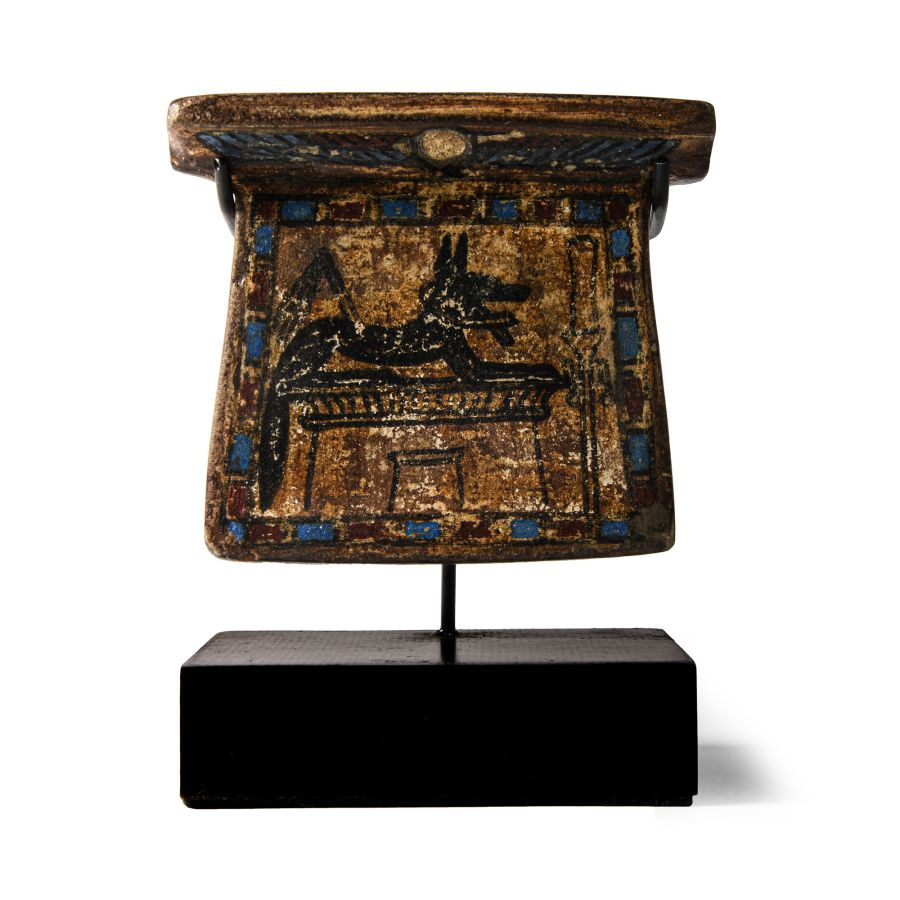
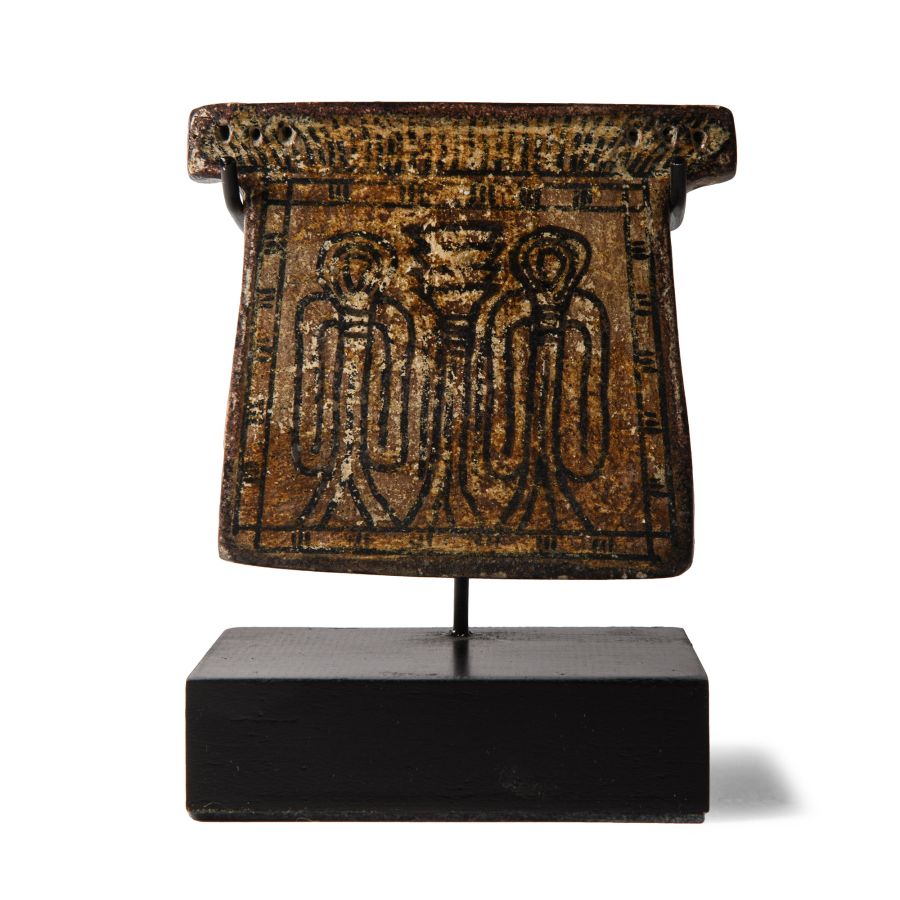
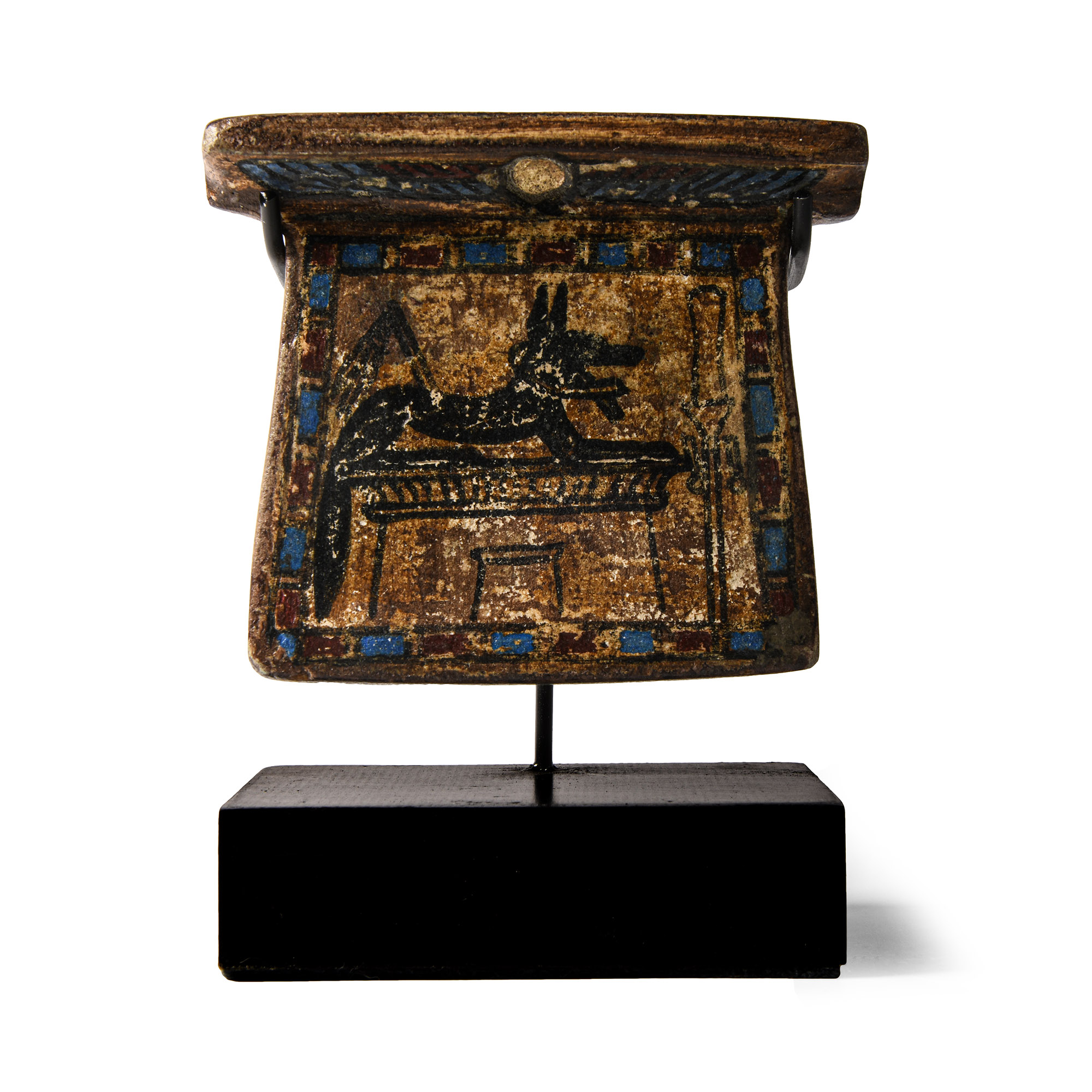
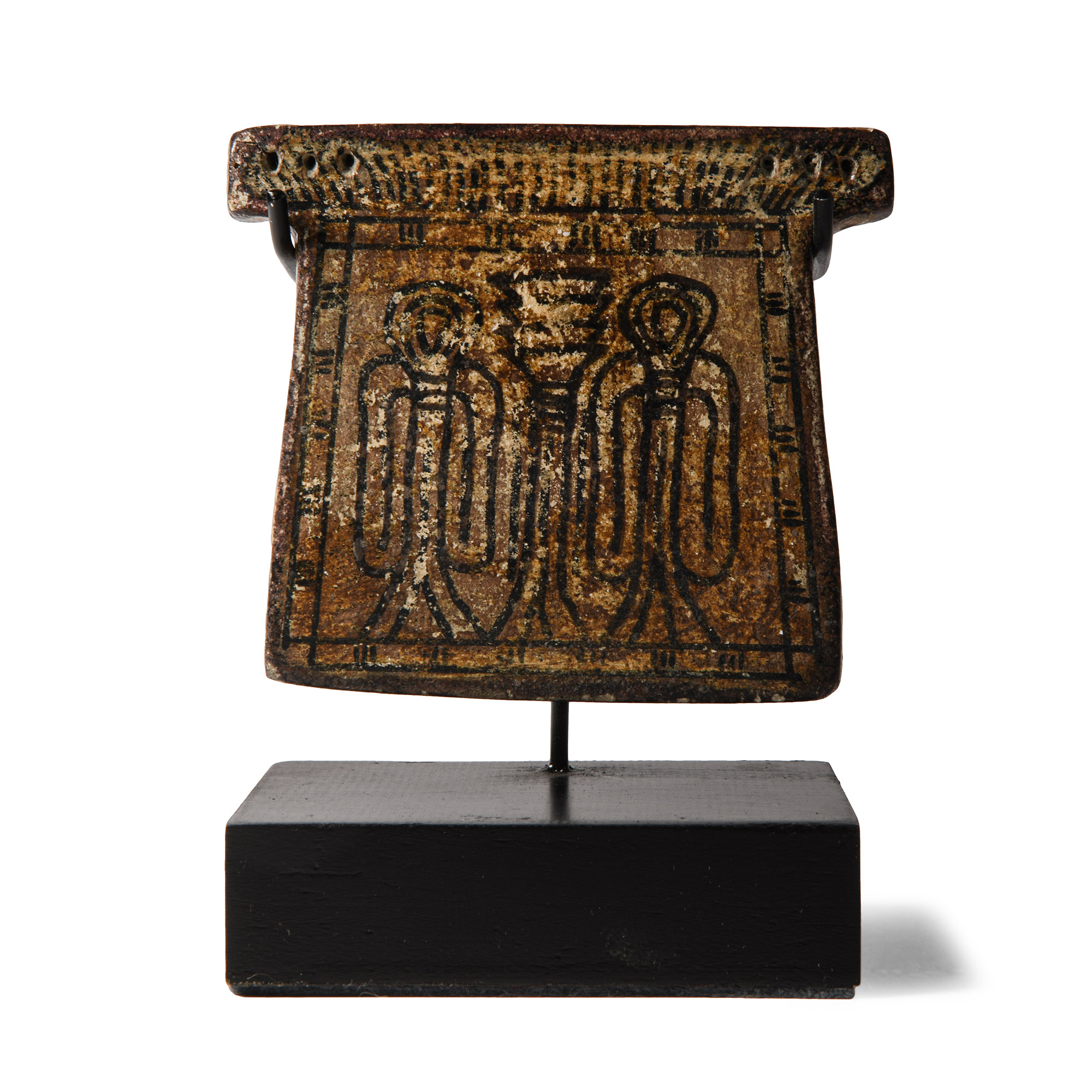
Egyptian Bifacial Faience Pectoral with Anubis
LATE NEW KINGDOM, 1290-1070 B.C.
3 1/4 in. (4 in.) (71 grams, 85 mm wide (223 grams total, 10.5 cm including stand)).
The obverse with a scene of Anubis recumbent on a pylon-shaped shrine with a standing sceptre in front; the reverse painted with a djed pillar flanked by two knots of Isis, remains of polychrome painted pigment; three piercings to both sides of the top; accompanied by a custom-made display stand.
ProvenanceFrom an early 20th century collection.
This lot has been checked against the Interpol Database of stolen works of art and is accompanied by search certificate number no.11104-182800.
Cf. The British Museum, museum number EA29370, for similar; Feucht, E., Pektorale nichtköniglicher Personen, (ÄB 22), Wiesbaden, 1971, pls.XXIII-XXIV, for obverse and XXXVI, esp. 214, for reverse.
FootnotesPectorals worn by the living were made from metal, usually gold; for the dead, glazed composition was an acceptable substitute, indicating the funerary nature of such objects. Circular piercings have been made through the cavetto cornice, enabling the piece to be stitched to the bandages covering a mummy's chest.
The shape of the pectoral imitates that of a pylon, the rectangular tower which flanked the gateway into an Egyptian temple. The cavetto cornice is decorated with a winged and gilded sun-disk. All four sides are adorned with a block pattern. A jackal reclining on a pylon-shaped shrine represents Anubis, god of embalming. He has a magical tie or scarf around his neck and is shown with a flagellum. Such imagery is found in New Kingdom tombs at Thebes. In front of the shrine is the sekhem sceptre of power. The reverse depicts a djed pillar, believed to represent the backbone with ribs of Osiris, god of the dead, flanked by the Girdle of Isis or 'tit' amulet. Both were standard funerary amulets.
TimeLine Auctions follows a vetting process to ensure the authenticity and legality of all items, reinforcing our commitment to integrity and responsible trading. Each antiquity, antique, and coin lot undergoes thorough examination by a vetting committee of at least ten external specialists, professional trade association members, scientists, and archaeologists: Our Vetting Process
AUCTIONS:
TimeLine is a leading auction house specialising in antiquities, ancient art, collectables, natural history, coins, medals, and books. Our auctions offer museums, collectors, historians, and enthusiasts the opportunity to acquire unique and historically significant pieces.
-
Egyptian Faience Bead Mummy Mask with Collar
Late Period, 664-332 B.C.Estimate: £1,000 - 1,400 (‡+bp*)
Opening Bid: £500
Comprising a restrung panel of small glazed composition beads in various colours representing a mummy face mask with false beard and collar; framed and glazed. 556 grams, 27.5 x 28.5 cm
Ex collection of Mr & Ms François & Marion Reber - Burki, Rue des Beaux-Arts 10, Neuchâtel, Switzerland. Collected in the first part of 20th century by Mr F. Burki, father of Ms Marion Reber. -
Stone Age Flint Hand Axe
Lower Palaeolithic Period, circa 400,000-200,000 B.P.Sold for (Inc. bp): £286
Finely knapped bifacial hand axe of triangular form with rounded butt; with printed and inked 'MADIJEN / EI:190M / THEBES / 1905' findspot label; with custom-made display stand. 480 grams total, 16.5 cm
Found Madijen, Thebes, 1905. Old German collection, before 1920. -
.jpg)
Egyptian Faience Ushabti of a Prince, Sem Priest of Ptah Khaemwaset
Late New Kingdom, 19th Dynasty, 1279 -1213 B.C.Sold for (Inc. bp): £2,600
Decorated using turquoise glaze and painted face, collar and hand detailing, wearing short wig and Sidelock of Youth (typical of a Sem priest); column of hieroglyphs to the lower body reading 'King's son, Sem priest of Ptah Khaemwaset, true of voice'; accompanied by a custom-made display stand. 55 grams, 11.6 cm (159 grams total, 13 cm high including stand)
Acquired on the London art market, early 1980s. Private European collection. Accompanied by an academic report by Egyptologist Paul Whelan. This lot has been checked against the Interpol Database of stolen works of art and is accompanied by search certificate number no.11837-206506.
There are various short inscriptions found on faience shabtis of Khaemwaset. The inscription on this shabti is notable for including the uncommon possessive element 'of Ptah' following the writing of 'Sem(-priest)'. It features on none of the inscriptions on the 43 published faience shabtis in the Louvre, but is found on an alabaster shabti of Khaemwaset in the Vatican's Museo Gregoriano Egizio (inv.no.19332). Also, the arm sign serving as a phonetic complement in the writing of his name is fairly uncommon on his faience shabtis, although it is found, for instance, in the inscriptions on two in the Louvre (inv.nos. N 456 A and N 768.14) and on another in the Amasis Collection (inv.no.S-1577).
