
Loading, please wait...
_900x900.jpg "Egyptian 'Becker' Serpentine Vessel")
_200x200.jpg "Egyptian 'Becker' Serpentine Vessel")
.jpg "Egyptian 'Becker' Serpentine Vessel")
LOT 0018
Egyptian 'Becker' Serpentine Vessel
NEW KINGDOM, 18TH DYNASTY, CIRCA 1450 B.C.
6 1/8 in. (1.2 kg, 15.5 cm).
Piriform jar with wide, flat rim and short neck, narrow neck and flat base.
ProvenanceEx Becker collection, 1920s.
Private collection, Los Angeles, USA, 1990s.
Private European collection.
Accompanied by an academic report by Dr Raffaele D’Amato.
This lot has been checked against the Interpol Database of stolen works of art and is accompanied by a search certificate number no.12576-232111.
See Aston, B.G., Ancient Egyptian Stone Vessels, materials and forms, Heidelberg, 1994, pl.12, for examples of serpentine vessels; for the shape of the vessel, idem, p.97, no.185, type a (p.154, New Kingdom); Lilyquist, C., Egyptian Stone Vessels, Khian through Tuthmosis IV, New York, 1995, figs.67, 68, 85, 87.
FootnotesThree forms of serpentine were mainly used by the ancient Egyptians for stone vessels: a) green or grey serpentine with black veins; b) translucent green serpentine with black patches; c) granular black serpentine with intermixed grey or brown granules. Type a) serpentine, i.e. the green or grey one with black veins, has the longer time range, and was used for vessels from the Predynastic Period (Naqada II) through the New Kingdom. It was used for stone vessels, but also became common for statuettes and small toilet vessels. The class of green glazed kohl pots, many with carved or openwork decoration which are usually called ‘glazed steatite’ were more likely to be made of serpentine. The type here represented is a form known in the New Kingdom: a bag-shaped jar with neck, flat base, and wide thin rim. Similar vessels have been found in Thebes, Amarna, Kahun, among other localities.
CONDITIONTimeLine Auctions follows a vetting process to ensure the authenticity and legality of all items, reinforcing our commitment to integrity and responsible trading. Each antiquity, antique, and coin lot undergoes thorough examination by a vetting committee of at least ten external specialists, professional trade association members, scientists, and archaeologists: Our Vetting Process
AUCTIONS:
TimeLine is a leading auction house specialising in antiquities, ancient art, collectables, natural history, coins, medals, and books. Our auctions offer museums, collectors, historians, and enthusiasts the opportunity to acquire unique and historically significant pieces.
LOT 0018
Egyptian 'Becker' Serpentine Vessel
Estimate £2,500 - 3,500€2,900 - 4,060 (for guidance only)$3,380 - 4,730 (for guidance only)
-
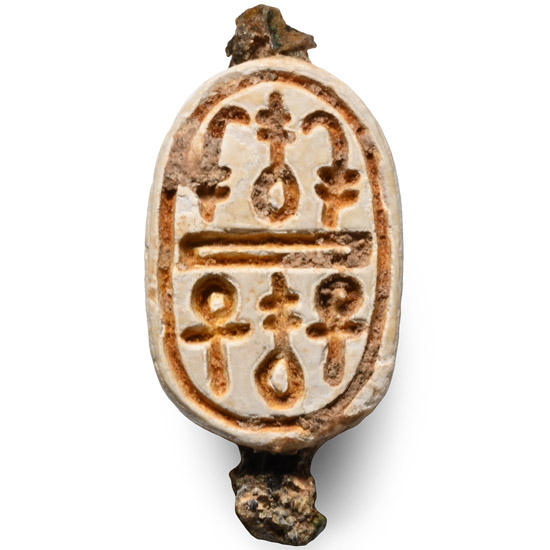
Egyptian Faience Scarab
2nd millennium B.C.Sold for (Inc. bp): £104
Anatomical detailing on the head and legs, with the underside featuring sedge plant (swt), ankh, and nefer symbols. 0.89 grams, 18 mm
Private collection, 1990s-early 2000s.
Scarabs featuring this design arrangement have been found in numerous sites in Palestine and were inspired by Middle Kingdom prototypes. -
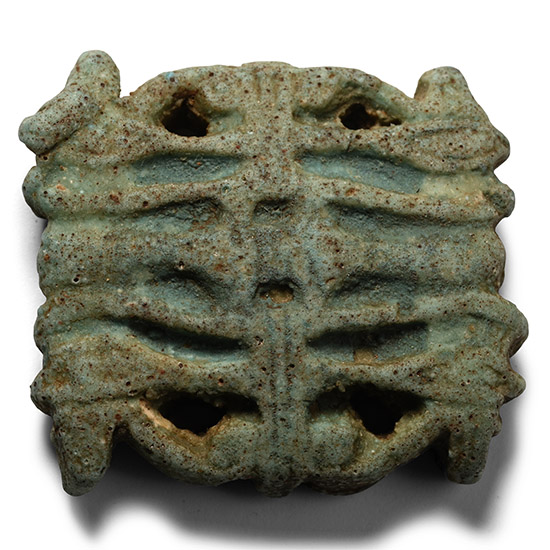
Egyptian Faience Multiple Eye of Horus Amulet
New Kingdom-Late Period, 1550-332 B.C.Estimate: £200 - 300 (+bp*)
Current Winning Bid: £5
Green glazed amulet with two wedjats at the top and the mirror image below, pierced through the centre for suspension. 11.83 grams, 33 mm
From an early 20th century UK collection. Accompanied by a previously illustrated catalogue card with provenance. -
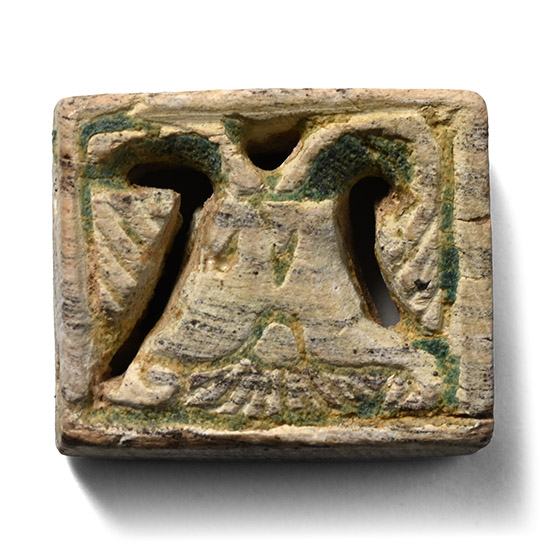
Egyptian Steatite Plaque Amulet with Lotus
Late Period, 664-332 B.C.Estimate: £100 - 140 (+bp*)
Opening Bid: £50
Rectangular openwork plaque with two blooming lotus flowers, one on each side, pierced twice for suspension. 1.77 grams, 14 mm
From an early 20th century UK collection. Accompanied by a previously illustrated catalogue card with provenance.
