
Loading, please wait...
_900x900.jpg "Egyptian Banded Alabaster Alabastron")
_200x200.jpg "Egyptian Banded Alabaster Alabastron")
.jpg "Egyptian Banded Alabaster Alabastron")
LOT 0001
Egyptian Banded Alabaster Alabastron
LATE PERIOD, 664-332 B.C.
5 1/2 in. (322 grams, 14 cm high including stand).
With a tapering honey-coloured piriform body and rimmed mouth, incised circumferential line on the shoulder; accompanied by a display stand.
ProvenanceEx Charlie Chaplin collection.
Private New York State collection, U.S.A.
Acquired from a North American auction 27 October 2009.
Private collection of Professor Kenneth Graham, London, UK.
Accompanied by the original catalogue page.
TimeLine Auctions follows a vetting process to ensure the authenticity and legality of all items, reinforcing our commitment to integrity and responsible trading. Each antiquity, antique, and coin lot undergoes thorough examination by a vetting committee of at least ten external specialists, professional trade association members, scientists, and archaeologists: Our Vetting Process
AUCTIONS:
TimeLine is a leading auction house specialising in antiquities, ancient art, collectables, natural history, coins, medals, and books. Our auctions offer museums, collectors, historians, and enthusiasts the opportunity to acquire unique and historically significant pieces.
-
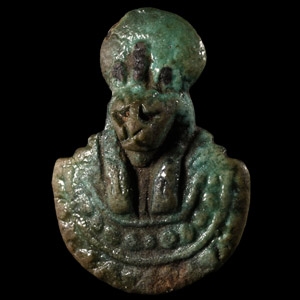
Egyptian Faience Aegis Amulet
Late Period-Ptolemaic Period, 664-30 B.C.Sold for (Inc. bp): £281
Green glazed composition with mask of Sekhmet with tripartite wig and solar disc; loop to the reverse. 5.47 grams, 39 mm
Part of an old collection dating back to the 19th century. Ex property of a gentleman, acquired before the 1980s. Private collection of Mr T.H., Norfolk, UK. -
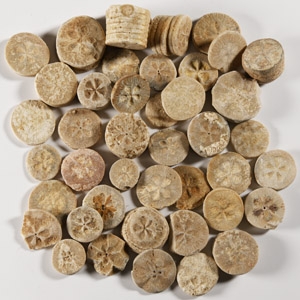
Egyptian Limestone Floral Inlay Group
Roman Period, 30 B.C.-323 A.D.Sold for (Inc. bp): £117
Group of discoid inlay plaques with cinquefoil motif. 77 grams total, 11-20 mm
From a central London ADA member's gallery, 1990s. -
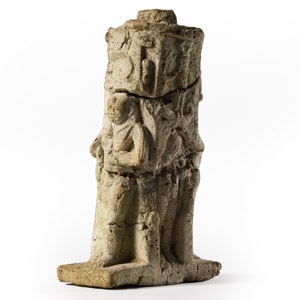
Egyptian Faience Amulet with Figures
Late Period-Ptolemaic Period, 664-30 B.C.Sold for (Inc. bp): £221
The large architectural amulet, rectangular in section with base and scarab finial; the narrow sides each with a high-relief standing figure, both holding a flail, wearing a royal nemes headdress and solar disc; the wider sides each with a facing male figure within a naos surmounted by a smaller facing figure, one Harpocrates holding a snake, the other Bes(?) with a high-plumed headress; repaired. 100 grams, 95 mm
Ex property of a London gentleman; acquired in the 1970s. Private collection of Mr T.H., Norfolk, UK.
The presence of Harpocrates holding a snake and possibly Bes, suggests that this functioned as a cippus amulet offering protection and with curative properties.
