
Loading, please wait...
_900x900.jpg "Egyptian Baboon-Headed Hapi Four Sons of Horus Amulet")
_200x200.jpg "Egyptian Baboon-Headed Hapi Four Sons of Horus Amulet")
.jpg "Egyptian Baboon-Headed Hapi Four Sons of Horus Amulet")
LOT 0505
Egyptian Baboon-Headed Hapi Four Sons of Horus Amulet
LATE PERIOD, CIRCA 500 B.C.
3 in. (7.13 grams, 78 mm).
A blue-glazed composition amulet formed as baboon-headed Hapi with stylised detailing to one face; two piercings for attachment or suspension. [No Reserve]
ProvenanceFrom an old UK collection.
Acquired 1960s-1990s.
From the private collection of Alf Baxendale (1941-2016), keen Egyptologist, member of the Egyptology Society, trustee of the Amarna Trust; thence by descent.
Accompanied by an identification display card.
Accompanied by a copy of his obituary published in Horizon, The Amarna Project and Amarna Trust newsletter, Issue 18, 2017, p.21, by Barry John Kemp, CBE, FBA, Professor Emeritus of Egyptology at the University of Cambridge and directing excavations at Amarna in Egypt.
Alf Baxendale (1941-2016), was a keen amateur Egyptologist, active from the 1960s. He was a good friend of Egyptologist Barry John Kemp who directs excavations at Amarna in Egypt. Alf helped raise funds for equipment and materials for the excavations since the 1980s, and also secured a major sponsorship from one of Britain’s leading brewers, Scottish and Newcastle. He was a member of the Egyptology Society, and became a founder trustee of the Amarna Trust in 2005. Alf bequeathed a major part of his extensive library to the Amarna Project’s offices in Cairo.
CONDITIONTimeLine Auctions follows a vetting process to ensure the authenticity and legality of all items, reinforcing our commitment to integrity and responsible trading. Each antiquity, antique, and coin lot undergoes thorough examination by a vetting committee of at least ten external specialists, professional trade association members, scientists, and archaeologists: Our Vetting Process
AUCTIONS:
TimeLine is a leading auction house specialising in antiquities, ancient art, collectables, natural history, coins, medals, and books. Our auctions offer museums, collectors, historians, and enthusiasts the opportunity to acquire unique and historically significant pieces.
-
.jpg)
Egyptian Faience Scaraboid of Seti I and Thutmose III
New Kingdom, 19th Dynasty, 1314-1304 B.C.Sold for (Inc. bp): £1,040
A blue glazed bifacial scaraboid; one side bearing the cartouche of Thutmose III and the legend “Enduring image of Re” and the other side Seti I’s throne name Men-Maat-Re (meaning “Eternal is the Justice of Re”) with other signs for an epithet that perhaps reads as “truly praised (of Re)”; pierced for suspension. 4.11 grams, 23 mm
From an old UK collection. From the private collection of Alf Baxendale (1941-2016) part 2, keen Egyptologist, member of the Egyptology Society, trustee of the Amarna Trust; thence by descent. Accompanied by an identification display card. Accompanied by a copy of his obituary published in Horizon, The Amarna Project and Amarna Trust newsletter, Issue 18, 2017, p.21, by Barry John Kemp, CBE, FBA, Professor Emeritus of Egyptology at the University of Cambridge and directing excavations at Amarna in Egypt.
Seti I's reign saw the production of many scarabs, scaraboids and plaques bearing his name as well as that of Thutmose III - who was considered a great warrior king. -
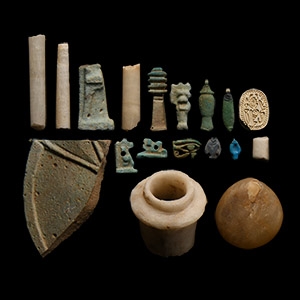
Egyptian Amulet and Other Artefact Collection
Middle Kingdom-Roman Period, 2024-30 B.C.Sold for (Inc. bp): £338
A mixed group of mainly composition artefacts and fragments comprising: a steatite scarab beetle inscribed with a scarab, cobra and crown to base, 2024-1700 B.C.; tilapia fish, symbol of regeneration, c.1300 B.C.; Taweret hippopotamus goddess of child birth, c.1300 B.C.; sphinx amulet, c.1300 B.C; alabaster kohl jar fragment sticks, c.1400 B.C.; Djed pillar amulet, c.600-300 B.C.; stone playing counter, c.300-50 B.C.; two fruit amulets, c.18th-19th Dynasty; fragment of a large Eye of Horus, c.600 B.C.; Eye of Horus amulet with nfr sign on reverse, c. 1000 B.C. 66.8 grams total, 8-39 mm
From an old UK collection. From the private collection of Alf Baxendale (1941-2016) part 2, keen Egyptologist, member of the Egyptology Society, trustee of the Amarna Trust; thence by descent. Accompanied by twelve identification display cards. Accompanied by a copy of his obituary published in Horizon, The Amarna Project and Amarna Trust newsletter, Issue 18, 2017, p.21, by Barry John Kemp, CBE, FBA, Professor Emeritus of Egyptology at the University of Cambridge and directing excavations at Amarna in Egypt. -
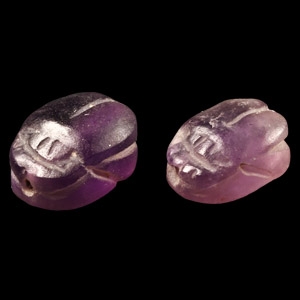
Egyptian Amethyst Scarab Group
Graeco-Roman Period, 332 B.C.-323 A.D.Sold for (Inc. bp): £338
A group of two amethyst scarabs pierced for suspension, each with simple detailing to the wings, head and legs. 1.12 grams total, 8-9 mm
Acquired 1980s. Private collection of L.H., Staffordshire, UK. Property of a Sussex, UK, teacher.
