
Loading, please wait...



LOT 0683
Egyptian Assorted Faience and Other Beads in Early 20th Century Tin Box
LATE PERIOD-PTOLEMAIC PERIOD, CIRCA 664-30 B.C.
1/8 - 5/8 in. (74 grams total including tin, 1-16 mm).
Comprising mostly glazed tubular, globular, barrel and other beads; in a vintage 'MacRobertson's' chocolate box. [No Reserve]
ProvenanceExcavated from Egypt in 1914.
From the private collection of Mr David Sams and his wife Elizabeth Kate Sams, gentry and amateur archaeologists who travelled to Egypt in 1914 with their daughter Ethel. Mr Sams and his wife led digging expeditions from which these items come from the family estate of Mr and Mrs Sams, by direct descent to their granddaughter.
TimeLine Auctions follows a vetting process to ensure the authenticity and legality of all items, reinforcing our commitment to integrity and responsible trading. Each antiquity, antique, and coin lot undergoes thorough examination by a vetting committee of at least ten external specialists, professional trade association members, scientists, and archaeologists: Our Vetting Process
AUCTIONS:
TimeLine is a leading auction house specialising in antiquities, ancient art, collectables, natural history, coins, medals, and books. Our auctions offer museums, collectors, historians, and enthusiasts the opportunity to acquire unique and historically significant pieces.
LOT 0683
Egyptian Assorted Faience and Other Beads in Early 20th Century Tin Box
Estimate £60 - 80€70 - 93 (for guidance only)$81 - 108 (for guidance only)
Opening Bid
£5 (EUR 6; USD 7) +BP*
-
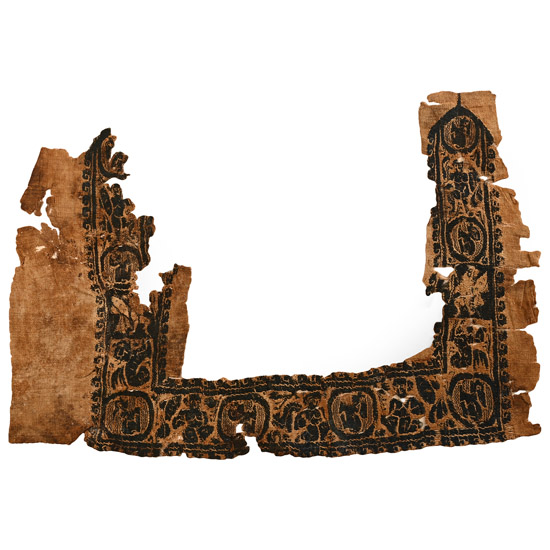
Large Egyptian Coptic Textile Fragment of a Tunic Embroidered with Putto Warriors and Hares
Circa 5th-6th century A.D.Estimate: £120 - 170 (+bp*)
Opening Bid: £5
Decoration from the lower part of a tunic, featuring segmenta and clavi adorned with oval medallions (orbiculi) enclosing running hares and two nude, striding warrior figures facing in opposite directions, each holding a shield; white linen ground with tapestry-woven decoration, S-twist. 51 grams total including paper folder, 49.5 cm
Acquired 1970s-1996. Property of a North American collector. London collection, 2016.
The theme of rabbits or hares, in association with other characters and animals of the Dionysian thiasos in a hunting setting, has notable parallels. Such representations are linked to narratives of the Dionysian cycle. -
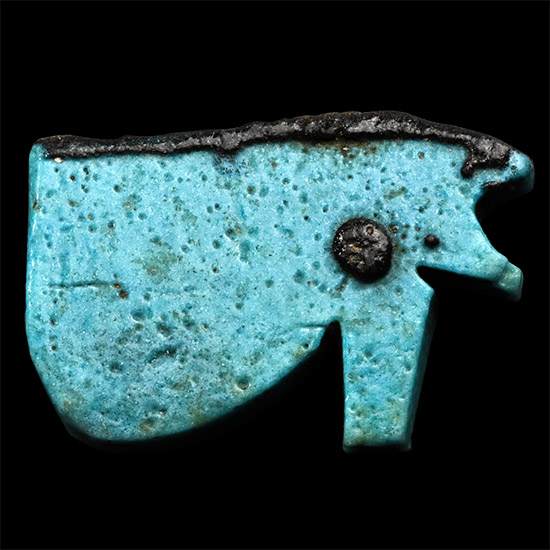
Large Egyptian Blue Glazed Faience Eye of Horus Amulet
New Kingdom-Late Period, circa 1550-332 B.C.Estimate: £500 - 700 (+bp*)
Opening Bid: £250
The body displaying the characteristic shape combining human and falcon ocular imagery, the brow and pupil detailed in black faience, pierced longitudinally for suspension. 8.34 grams, 41 mm
Early 20th century UK collection. Accompanied by a previous catalogue information page.
The wedjat-eye amulet depicts Horus’s healed eye, blending human and falconine features. Its ancient Egyptian name means ‘the one that is sound’. According to myth, Seth wounded or took the eye, and Thoth later restored it. Believed to offer protection, healing, and regeneration, the popular amulet was worn by the living and the dead. -
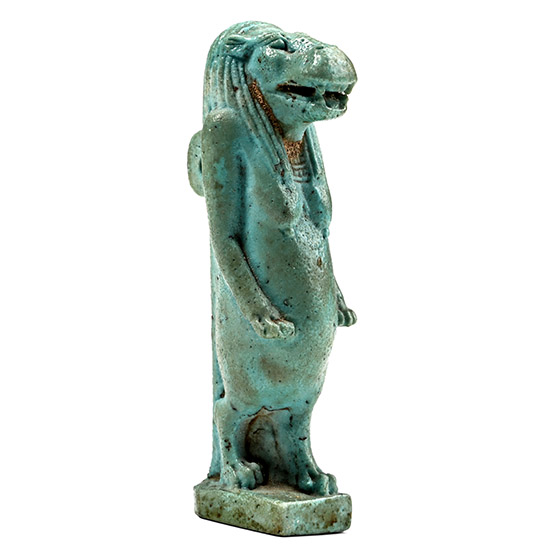
Egyptian Turquoise Blue Glazed Faience Amulet of Taweret
Late Period, circa 664-332 B.C.Estimate: £600 - 800 (+bp*)
Opening Bid: £5
Amuletic pendant with the deity's characteristic hybrid animal elements, dominated by its hippopotamus head, with a plain dorsal pillar with a loop. 16.58 grams, 61 mm
Received as a gift from archaeologist Cyril Aldred, April 1970, when expecting their son Rupert. From the private collection of Peter Clayton, FCILIP, Dip, Arch, FSA, FRNS, Hemel Hempstead, Hertfordshire, UK; formed since the late 1950s. Accompanied by an old handwritten information card by Peter Clayton, collection no.124.
Taweret is an ancient Egyptian goddess associated with fertility, childbirth, motherhood, and protecting women during pregnancy and labour. She is depicted as a composite being with animal features and stands out as one of the most distinctive and striking deities in the Egyptian pantheon. Taweret’s name derives from the Egyptian word for "great" or "large" (tꜣwꜣrt), emphasising her formidable and protective nature. Cyril Aldred (1914-1991) was a British Egyptologist and art historian who served at the Royal Scottish Museum, Edinburgh, from 1937 until his retirement in 1974. He published widely on Egyptian art, including Old Kingdom Art in Ancient Egypt (1949) and Akhenaten, Pharaoh of Egypt (1968), and became a leading authority on Amarna Period art, notably through his 1973 Brooklyn Museum exhibition catalogue, Akhenaten and Nefertiti.
