
Loading, please wait...


LOT 0029
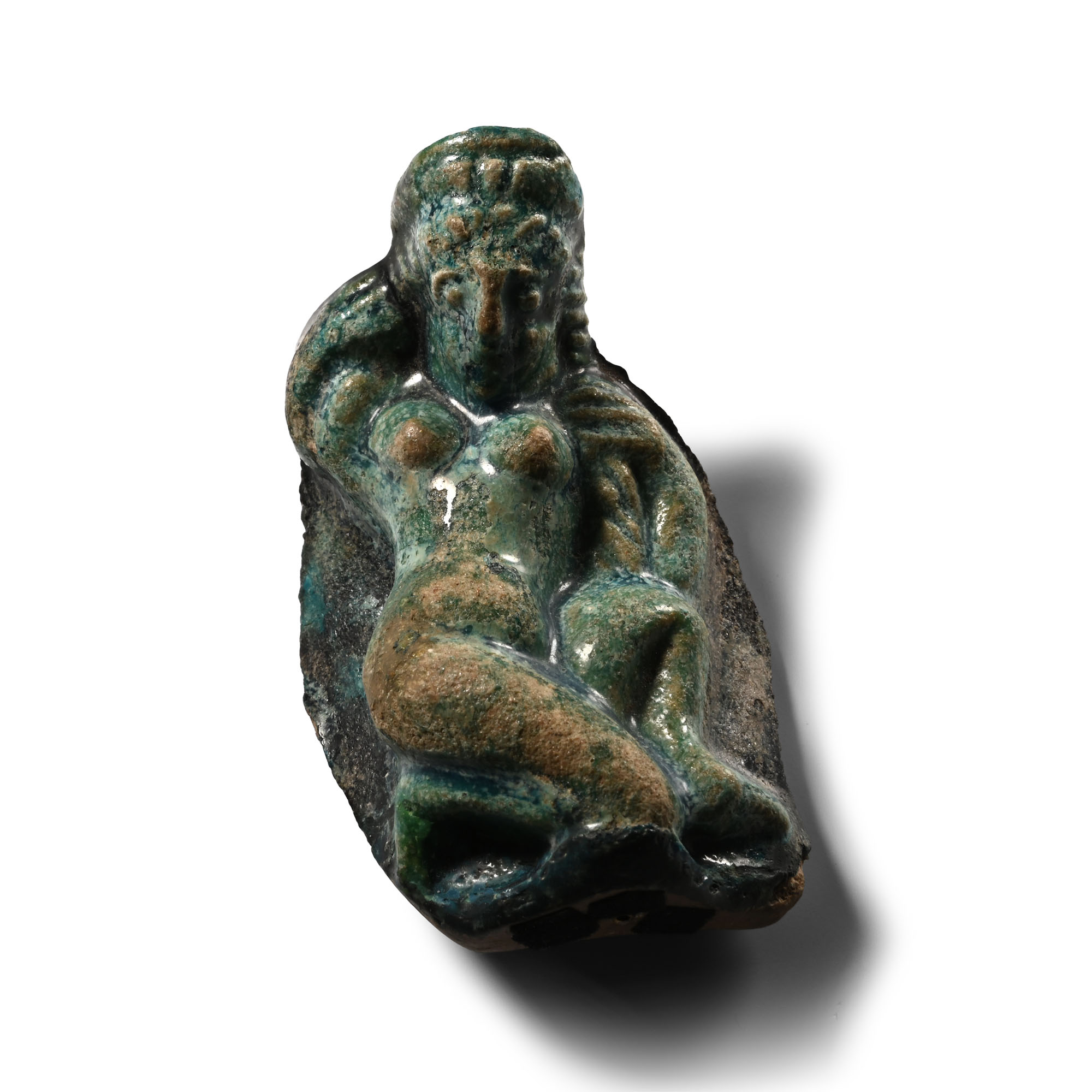
Egyptian Applique with Aphrodite
PTOLEMAIC PERIOD, 332-30 B.C.
3 3/8 in. (85 grams, 86 mm).
Fragment from a representation of the nude Aphrodite in high-relief, crouching with her left knee raised and her right knee touching the ground, holding her long hair with her hands and wearing a diadem on her head; an appliqué from a vessel with minor filling at the right thigh.
ProvenancePrivate collection, Somerset, England.
with M.B., Los Angeles County, acquired 2014-2015 at a sale in the UK.
with Ancient Resource, USA, Auction 70, 06 October 2018, no.7.
This lot has been checked against the Interpol Database of stolen works of art and is accompanied by a search certificate number no.12827-240895.
This lot is accompanied by an illustrated lot declaration signed by the Head of the Antiquities Department, Dr Raffaele D’Amato.
This lot is accompanied by an illustrated lot declaration signed by the Head of the Antiquities Department, Dr Raffaele D'Amato.
Cf. for similar typologies Reinach, S., Répertoire de la statuaire grecque et romaine, Paris, 1897, p.341.
CONDITIONTimeLine Auctions follows a vetting process to ensure the authenticity and legality of all items, reinforcing our commitment to integrity and responsible trading. Each antiquity, antique, and coin lot undergoes thorough examination by a vetting committee of at least ten external specialists, professional trade association members, scientists, and archaeologists: Our Vetting Process
AUCTIONS:
TimeLine is a leading auction house specialising in antiquities, ancient art, collectables, natural history, coins, medals, and books. Our auctions offer museums, collectors, historians, and enthusiasts the opportunity to acquire unique and historically significant pieces.
LOT 0029
Egyptian Applique with Aphrodite
Estimate £600 - 800€700 - 930 (for guidance only)$810 - 1,080 (for guidance only)
-
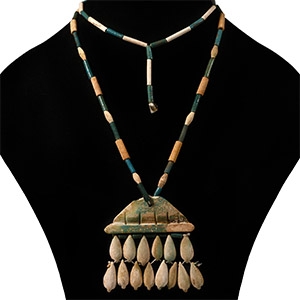
Egyptian Faience Necklace with Pendant
New Kingdom, 1400-1100 B.C.Estimate: £600 - 800 (‡+bp*)
Opening Bid: £333
Restrung group of tubular and fusiform faience beads with D-shaped pendant and two tiers of dangles beneath. 48 grams, 80 cm long
Acquired in the mid 1980s-1990s. Private collection, Switzerland, thence by descent. Private collection, since the late 1990s. This lot is accompanied by an illustrated lot declaration signed by the Head of the Antiquities Department, Dr Raffaele D’Amato. This lot is accompanied by an illustrated lot declaration signed by the Head of the Antiquities Department, Dr Raffaele D'Amato. -
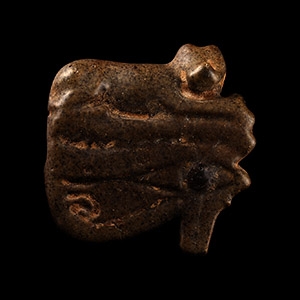
Egyptian Hardstone Eye of Horus with Recumbent Lion
Late Period, 664-332 B.C.Estimate: £300 - 400 (+bp*)
Opening Bid: £150
Wedjat-eye amulet with reclining lioness to the top, pierced for suspension. 6.79 grams, 29 mm
From an early 20th century collection. Ex London, UK, gallery. This lot is accompanied by an illustrated lot declaration signed by the Head of the Antiquities Department, Dr Raffaele D'Amato.
The wedjat-eye and lioness are potent, often intertwined symbols in ancient Egyptian mythology. The wedjat, representing Horus’s healed eye, signifies protection and healing, while the lioness—linked to the goddesses Sekhmet, Bastet, and Wadjet—embodies power and fierce defence as the “Eye of Ra”. Together in amulets, as in Egyptian art, they convey healing, protection, and strength. Sometimes the name of a specific goddess was inscribed on the back of the amulet, though here the recumbent lioness serves as the divine symbol. -
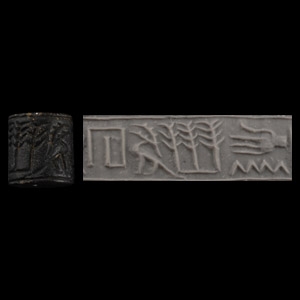
Egyptian Black Stone Cylinder Seal Inscribed with Hieroglyphs for the Name Deneh
Circa 2900 B.C.Sold for (Inc. bp): £2,470
With hieroglyphic inscription, restrung pair of red stone beads, old handwritten label '1633'; accompanied by a copy of an old scholarly note, typed and signed by W.G. Lambert, late Professor of Assyriology, University of Birmingham, 1970-1993, which states: 'Cylinder Seal of Soft Black Stone, 15 x 13.5 mm. Between upper and lower rules five Egyptian hieroglyphs are engraved skillfully. The bird is 'akh', "soul", the following house, hand and wavey line, are probably a personal name Deneh or Dehen, and the remaining sign consisting of three trees or plants may be a title. This is an old Egyptian cylinder seal from the Second Dynasty, c. 2900 B.C., and the inscriptions are still in the process of being deciphered. The occurrence of "soul" suggests mortuary use, but the Egyptians made preparations for such things during life, so the owner may well have had this object during his life. It is in fine state of preservation.'; accompanied by a museum-quality impression. 6.5 grams, 14 mm
UK private collection, acquired 1980-1983. Accompanied by a copy of a scholarly note, typed and signed by Professor Wilfrid George Lambert in 1992. This lot is accompanied by an illustrated lot declaration signed by the Head of the Antiquities Department, Dr Raffaele D'Amato.
Cylinder seals are typically engraved, cylindrical stone objects designed to be rolled over clay, leaving impressions of images and often text carved in reverse. In Egypt, they appeared early in the historical record, likely due to Mesopotamian influence, with the more familiar button and stamp seals becoming prevalent later, particularly during the First Intermediate Period.
