
Loading, please wait...
LOT 0462
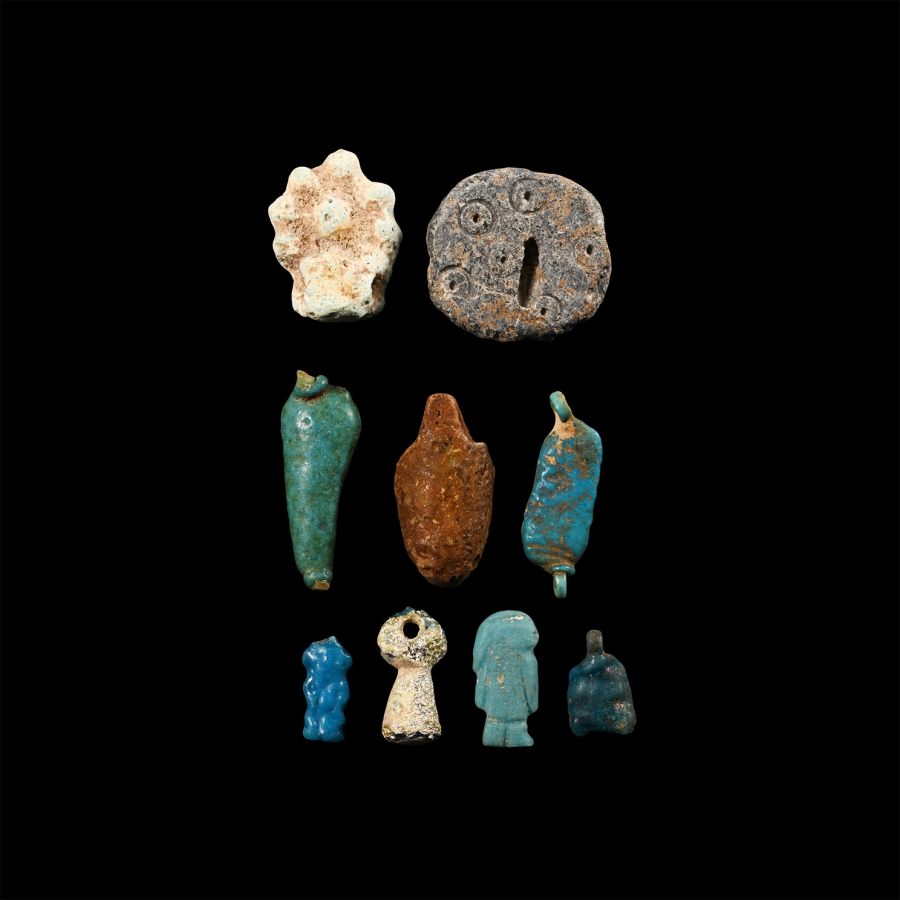
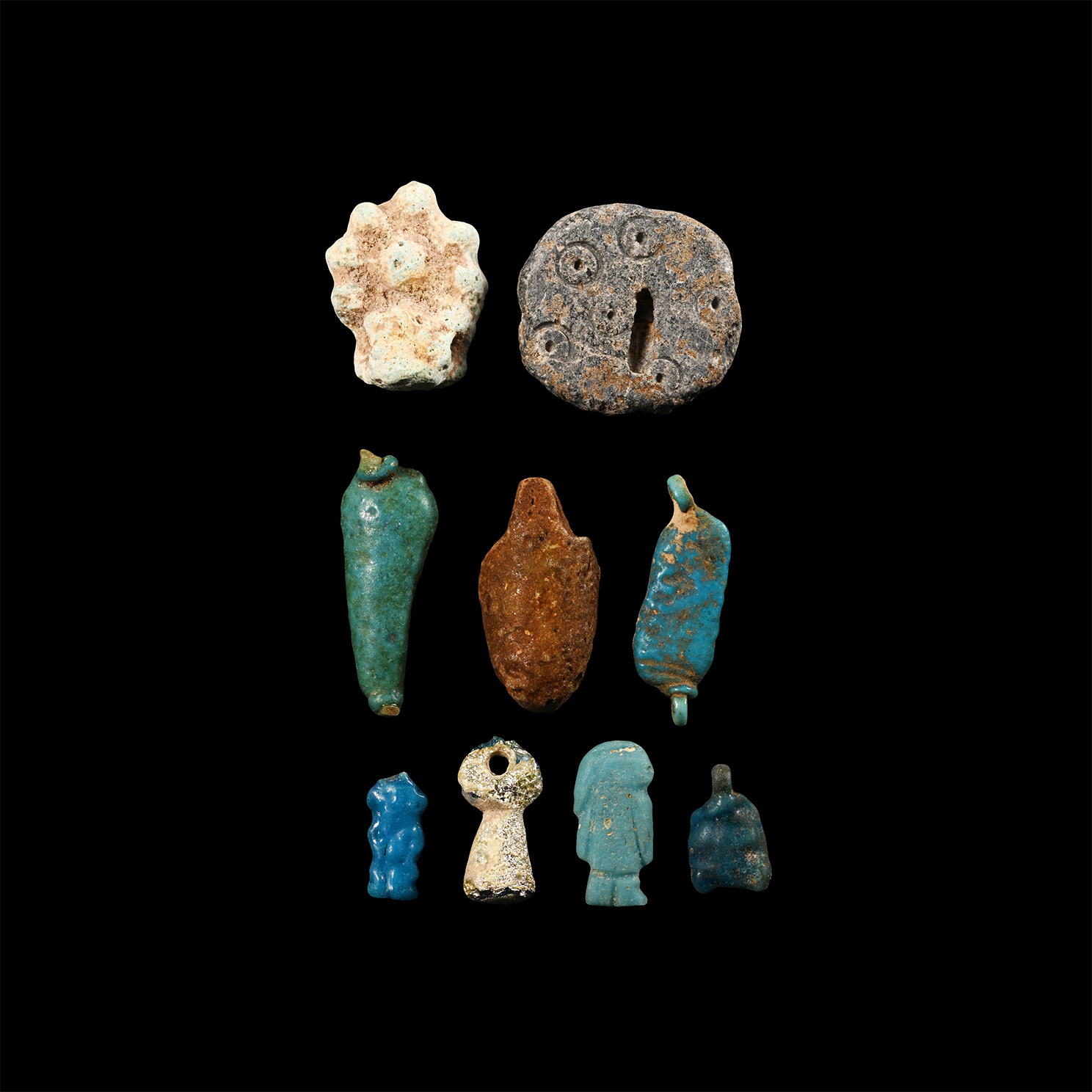
Egyptian and Roman Period Amulet Collection
1ST MILLENNIUM B.C. AND LATER
3/8 - 7/8 in. (8.9 grams total, 11-23 mm).
A mixed group of mainly composition and glass amulets, most with piercings or loops for suspension; including glazed fruit, figures, amulets with geometric motifs and others. [9]
ProvenanceFrom an early 20th century UK collection.
CONDITIONTimeLine Auctions follows a vetting process to ensure the authenticity and legality of all items, reinforcing our commitment to integrity and responsible trading. Each antiquity, antique, and coin lot undergoes thorough examination by a vetting committee of at least ten external specialists, professional trade association members, scientists, and archaeologists: Our Vetting Process
AUCTIONS:
TimeLine is a leading auction house specialising in antiquities, ancient art, collectables, natural history, coins, medals, and books. Our auctions offer museums, collectors, historians, and enthusiasts the opportunity to acquire unique and historically significant pieces.
-
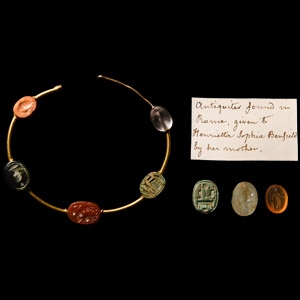
Egyptian and Later Scarab and Intaglio Collection
Late Period, 664-332 B.C.Sold for (Inc. bp): £1,950
A mixed group of scarabs and intaglios comprising: carnelian plaque with helmetted warrior holding shield with right hand and winged Nike on his left; green glazed composition scarab with enigmatic hieroglyphs on base; onyx scarab with an armed running warrior on base, cut in Rome; a later gold bracelet with an Etruscan scarab; one wedjat eye scaraboid; an Etruscan scarab with a centaur; one stone scarab with seated Ra-Horakhty above nb reading 'lord Ra Horakhty'; one pink stone scarab with bird. 4.13 grams total, 12-15 mm
Supplied with small a handwritten note: 'Antiquities found in Rome, given to Henrietta Sophia Benfield by her mother'. Henrietta Sophia Benfield (1796-1857) was the daughter of Paul Benfield and his wife, Mary Frances, daughter of Henry Swinburne (1743-1803). Property of the Berkeley collection. With Sotheby's, London, 11 December 2019, lot 182. English private collection. -
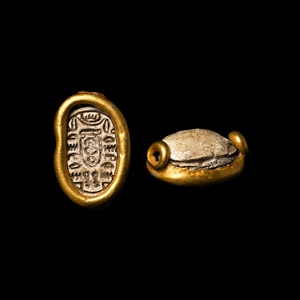
Egyptian Scarab in Gold Mount
New Kingdom, circa 1500 B.C. or earlierSold for (Inc. bp): £610
A glazed composition scarab with detailed serrated legs and with a-n-r, nub and nefer signs around a cartouche containing the incomplete name of Thutmose III to the underside; set in a later gold mount for suspension. 2.34 grams, 18 mm
Fine condition.
Acquired 1969-1999. London collection of the late Mr S.M., thence by descent.
The sign groups surrounding the cartouche are indicative of Asiatic scarab production of the Second Intermediate Period, where the craftsmen did not understand the meaning of hieroglyphs and used them for purely decorative reasons. This suggests that either the beetle and sun-disc signs in the cartouche are unintentionally similar to those of Thutmose III, or that this is a later scarab with an inaccurately rendered name of the king -
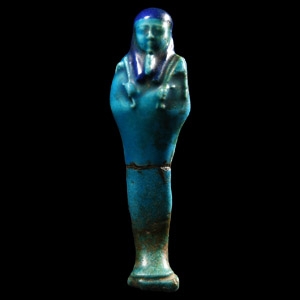
Egyptian Blue Faience Shabti
Early Ptolemaic Period, circa 3rd century B.C.Estimate: £1,000 - 1,400 (‡+bp*)
Opening Bid: £500
A mummiform shabti with a thick and lustrous turquoise glaze, sporting a tripartite wig highlighted in darker blue glaze, and a long beard; holding a pick, hoe and a cord for a seed bag hanging over the left shoulder; raised dorsal pillar and an integral plinth; repaired. 44 grams, 11.5 cm high
Ex collection of Jacques René Fiechter, Switzerland (1920-1950). with Auction Martin, Egyptian Collection André Bircher, 1949. Accompanied by an academic report by Egyptologist Paul Whelan.
The lack of inscription hinders positive identification, but the shabti’s proportions, elegant modelling, and lustrous glaze closely match others considered to have come from an area of the extensive necropolis at Abydos, labelled “Cemetery G” by its excavator Flinders Petrie, where hundreds of blue lustrous-glazed shabtis of varying qualities were recovered. This figure is closest in style to those belonging to Petosiris, son of Djed-hor. Both were buried with similarly blue lustrous-glazed shabtis that were mostly plain although a few were inscribed with an inscription.
