
Loading, please wait...
LOT 0465
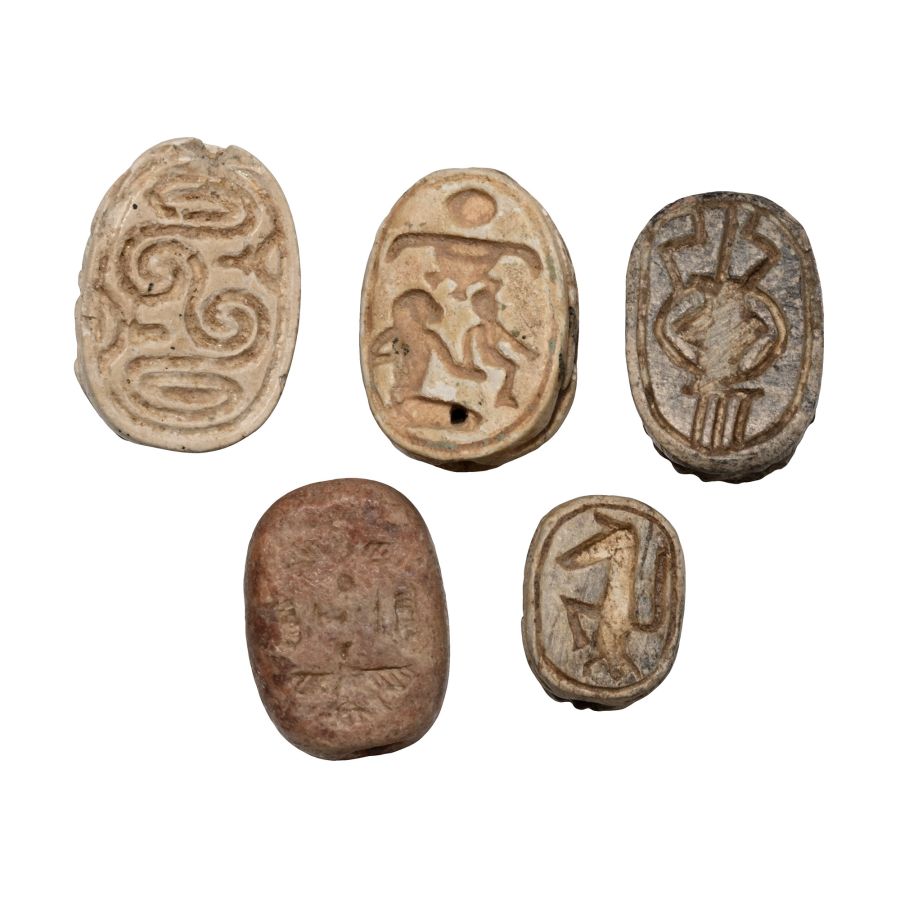
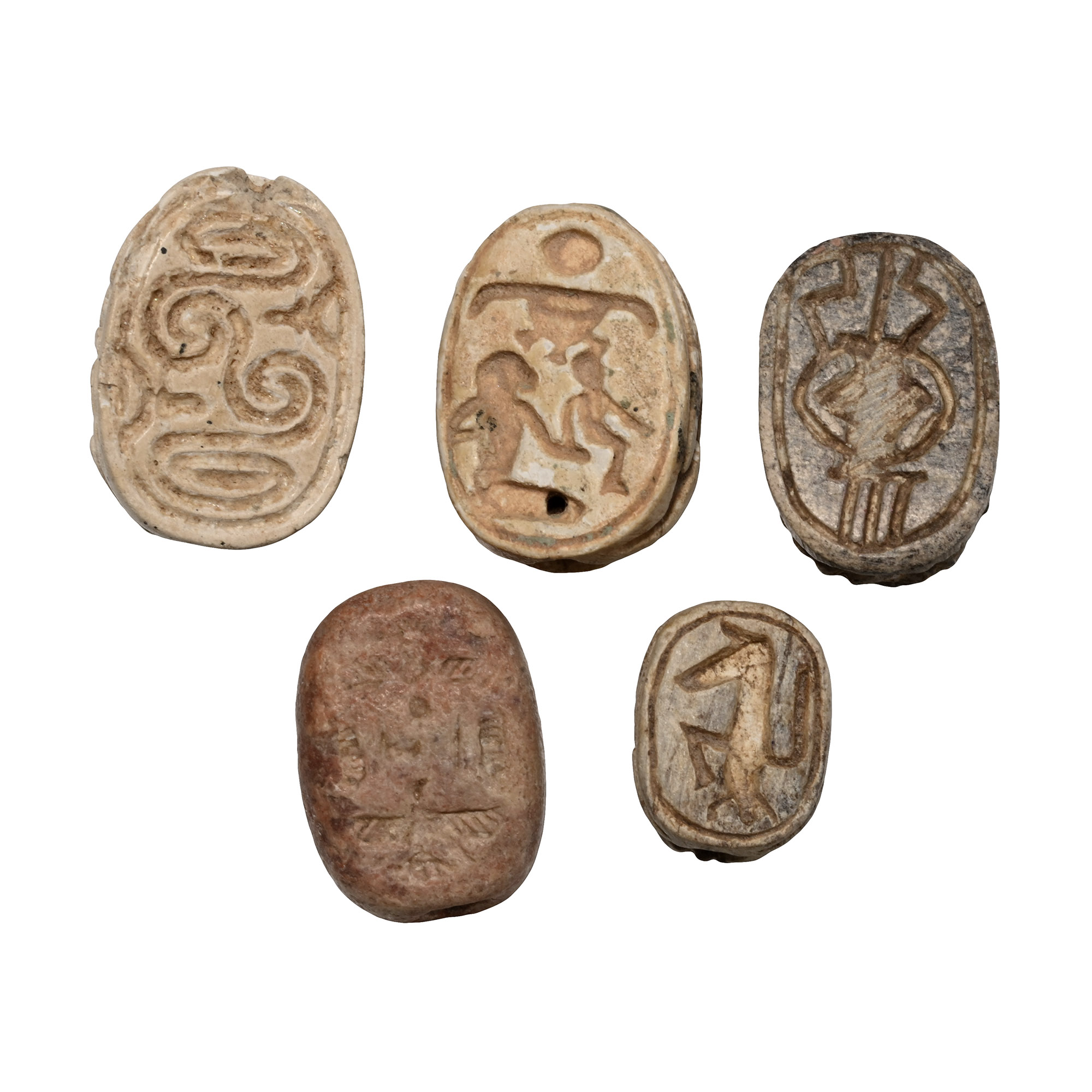
Egyptian and Phoenician Stone Scarab Group
SECOND INTERMEDIATE PERIOD, CIRCA 1650 B.C. AND LATER
3/8 - 1/2 in. (4.85 grams total, 9-14 mm).
Comprising: one with interlocking spirals; one depicting an adult and child with the hieroglyphs for gold (nbw) and the sun disc above; one bearing the schematic image of Bes; one pink stone scaraboid with two birds with open wings and other symbols; and one with a kneeling figure with hand to mouth. [5, No Reserve]
ProvenanceFrom the private collection of a European gentleman (1942-2024), formed since the 1970s.
LiteratureCf. Ben-Tor, D., Scarabs, Chronology, and Interconnections: Egypt and Palestine in the Second Intermediate Period, Fribourg/Göttingen, 2007, pl. 32, Design Class 2B, for examples of the interlocking spiral motif; Newberry, P.E., Catalogue général des antiquités égyptiennes du Musée du Caire N° 36001-37521, Scarab-shaped Seals, Cairo, 1907, pl. IX, no. 36313, for a scarab with a similarly schematic Bes; Petrie, W.M.F., Button and Design Scarabs, London, 1925, pl. XIV, no. 943, for a scarab with a kneeling figure.
CONDITIONTimeLine Auctions follows a vetting process to ensure the authenticity and legality of all items, reinforcing our commitment to integrity and responsible trading. Each antiquity, antique, and coin lot undergoes thorough examination by a vetting committee of at least ten external specialists, professional trade association members, scientists, and archaeologists: Our Vetting Process
AUCTIONS:
TimeLine is a leading auction house specialising in antiquities, ancient art, collectables, natural history, coins, medals, and books. Our auctions offer museums, collectors, historians, and enthusiasts the opportunity to acquire unique and historically significant pieces.
-
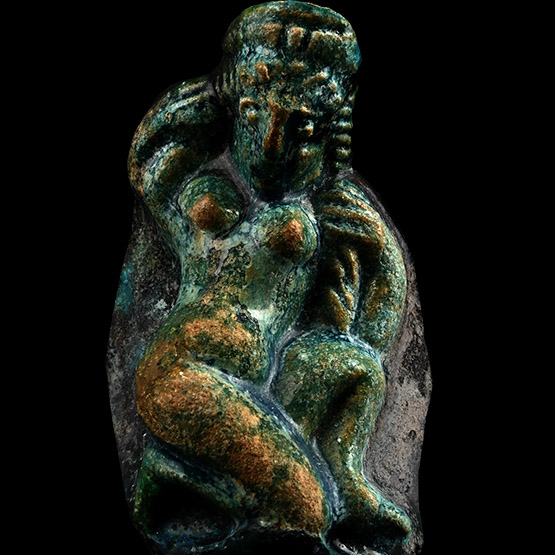
Egyptian Applique with Aphrodite
Ptolemaic Period, 332-30 B.C.Estimate: £350 - 450 (‡+bp*)
Opening Bid: £190
Fragment from a representation of the nude Aphrodite in high-relief, crouching with her left knee raised and her right knee touching the ground, holding her long hair with her hands and wearing a diadem on her head; an appliqué from a vessel with minor filling at the right thigh. 85 grams, 86 mm
Private collection, Somerset, England. with M.B., Los Angeles County, acquired 2014-2015 at a sale in the UK. with Ancient Resource, USA, Auction 70, 06 October 2018, no.7. This lot has been checked against the Interpol Database of stolen works of art and is accompanied by a search certificate number no.12827-240895. -
.jpg)
Egyptian Seated Gold Bastet Cat Amulet
Late New Kingdom-Third Intermediate Period, circa 1069-900 B.C. or laterSold for (Inc. bp): £527
Modelled seated on a tongue-shaped base, with simple facial detailing and a suspension loop to the back. 0.54 grams, 8 mm
Ex French art market, 1920s.
The goddess Bastet was believed to be the daughter of the sun god and was shown with the features of a lion up until about 1000 B.C., when she was first portrayed as a cat or human with a cat head. As the daughter of Ra, she was associated with the rage inherent in the sun god's eye, which was considered to be his instrument of vengeance. Her development into a cat goddess occurred during the New Kingdom, but did not fully develop until the Late Period. She was still associated with the destructive power of the sun and was shown on the prow of the solar boat, decapitating the evil serpent Apophis in the Book of the Dead. The maternal, protective and hunting characteristics of the cat are obvious in Bastet, and she was seen as a protector of pregnant women and young children. In the Pyramid Texts, she is invoked by the deceased king to act as his protector and to help him reach the sky to join the sun god; the king proclaims that Bastet is his mother and nurse. Like her counterpart, Sekhmet, Bastet has an aggressive side and, in a text from Karnak, Amenhotep II described his enemies being slaughtered like the victims of Bastet. The goddess had a shrine at Karnak, where she is known as the 'Lady of Asheru', which aligns her closely with the goddess Mut, the consort of Amun-Ra. Her most famous shrine was in the north-east Delta region, at Bubastis, and was known as Per-Bastet or 'the House of Bastet.' Herodotus describes the festival of Bastet as one of the most elaborate in all of Egypt and identifies her with the Greek Artemis. Cemeteries of cats have been excavated at Bubastis, and at Saqqara and Memphis. -
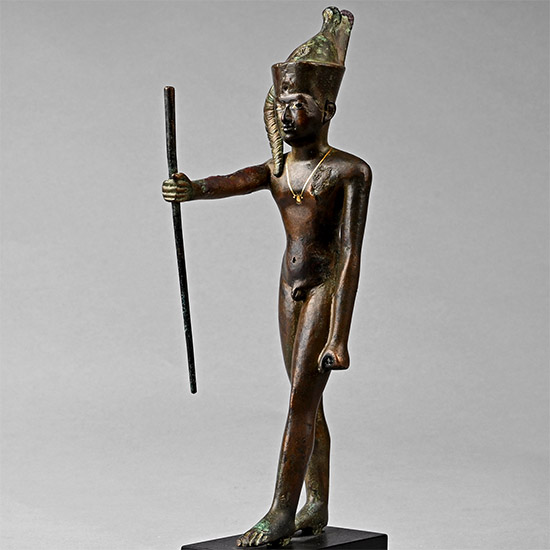
Large Egyptian Bronze Statue of the God Ihy with Gold Necklace and Silver Inlaid Eyes
Late Period, 664-332 B.C.Sold for (Inc. bp): £20,800
Depicted nude in an advancing pose; silver inlaid eyes, braided sidelock of youth; left hand by his side, drilled to accept a separate element, the other outstretched at a right angle to his body, holding a tapering cylindrical staff, not belonging; he may originally have held a sistrum, an ancient Egyptian percussion instrument, or a menat, both closely associated with the goddess Hathor; here, Ihy wears the Pschent crown with remains of uraeus, and an inlaid gold necklace suspended with an ib pendant around his neck; finely detailed facial features, with engraved Nekhbet vulture with outspread wings at the back of the crown; integral lugs on soles of feet; mounted on a custom-made stand. 899 grams total, 25 cm including stand
From the Singer family collection, Germany, acquired circa 1962. with A.A.L., Geneva, 1980. with Christie's, London, 25 April 2015, no.163 [£50,000-£70,000]. Private collection, London, UK. Accompanied by copies of the relevant Christie's catalogue pages. This lot has been checked against the Interpol Database of stolen works of art and is accompanied by search certificate number no.13309-258229.
Ihy was an Egyptian god associated with music, joy, and ritual celebrations, particularly as the divine child of Hathor and of Horus or Ra. He is typically depicted as a youthful figure, often naked or lightly clothed, wearing a sidelock of youth and carrying a sistrum or menat, both percussion instruments closely connected with ritual performances in Hathor's cult, especially at the temples of Dendera and Edfu. His name is generally understood to mean 'the musician' or 'the one who plays music,' although it may also mean 'calf', a reference to his relationship with the cow-goddess Hathor. Bronze statuettes of Ihy, such as this example, were probably produced as votive offerings dedicated in temples, especially those devoted to Hathor. Worshippers may have commissioned such figures in the hope of obtaining divine favour, protection, fertility, healing, or participation in the blessings linked with music and festivity. Some examples may also have served as cult images used in temple ceremonies or as protective objects placed in domestic or funerary settings.
