
Loading, please wait...
LOT 0493
Egyptian and Other Artefact Collection
1ST MILLENNIUM B.C. AND LATER
1/4 - 1 3/4 in. (5.35 grams total, 6-46 mm).
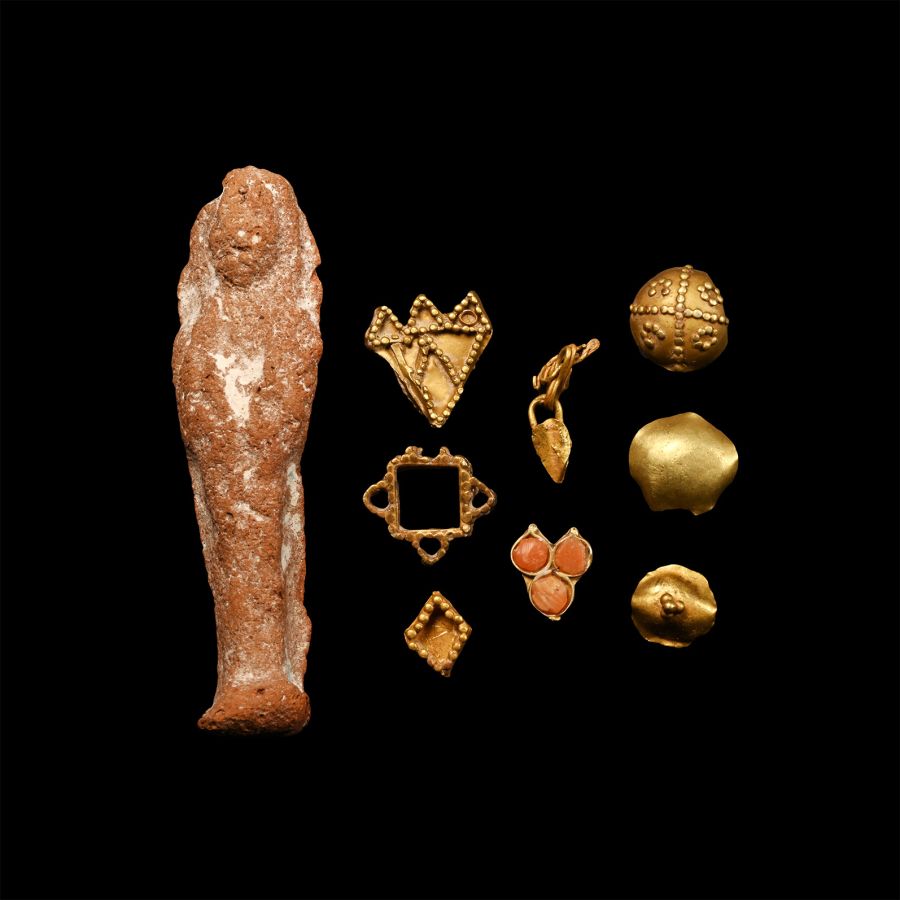
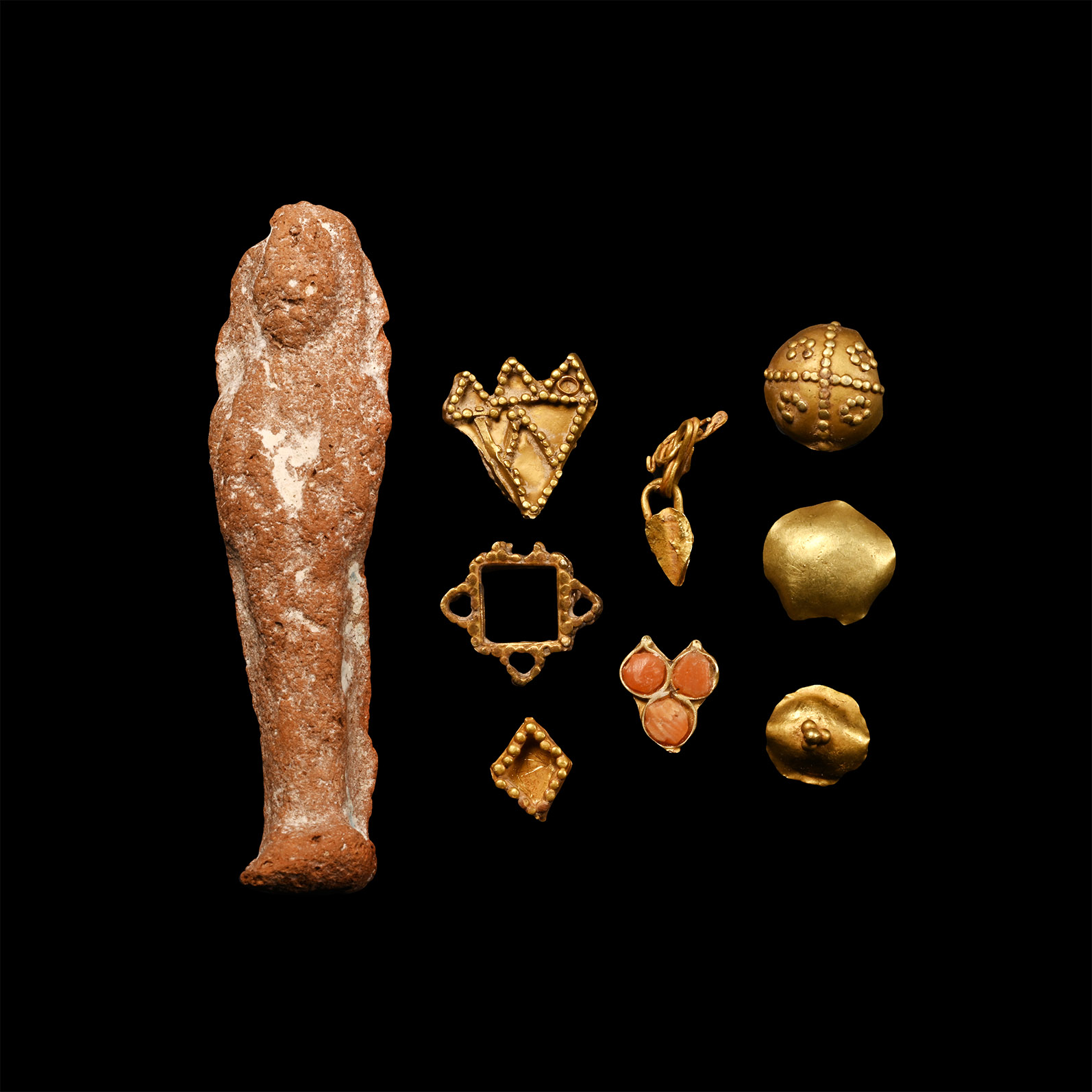
A mixed group comprising: a miniature glazed composition shabti; two gold domed discs, one with a granule cluster to the apex; a gold lozenge cell with granulation to the rim; a square gold cell with flanking loops and granulation; a gold triangular panel with granulated dividers, triangles to the upper edge; a gold domed disc with quartered design and rosettes, granulated; a gold leaf-shaped pendant and chain links; three gold cells with carnelian inlays. [8]
ProvenanceAcquired 1990s.
English private collection.
Property of an Essex gentleman.
TimeLine Auctions follows a vetting process to ensure the authenticity and legality of all items, reinforcing our commitment to integrity and responsible trading. Each antiquity, antique, and coin lot undergoes thorough examination by a vetting committee of at least ten external specialists, professional trade association members, scientists, and archaeologists: Our Vetting Process
AUCTIONS:
TimeLine is a leading auction house specialising in antiquities, ancient art, collectables, natural history, coins, medals, and books. Our auctions offer museums, collectors, historians, and enthusiasts the opportunity to acquire unique and historically significant pieces.
-
Egyptian Harpocrates Amulet
Late Period, 664-332 B.C.Estimate: £300 - 400 (+bp*)
Opening Bid: £150
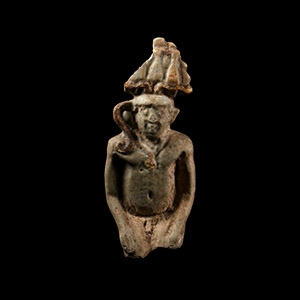
A composition amulet fragment of the god Harpocrates, modelled nude, with stylised facial features and the Sidelock of Youth; light blue-green glaze with darker glaze to his hair and the lower part of the hem-hemet crown; pierced lug to reverse of crown for suspension. 6.72 grams, 51 mm high
Acquired 1980s-1990s. H.N. collection, Milton Keynes, Bedfordshire, UK. -
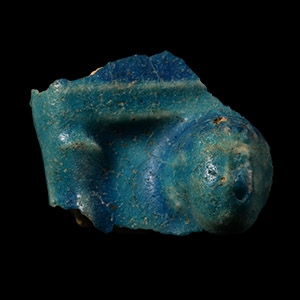
Egyptian Blue Faience Plaque Fragment
Ptolemaic Period, 332-30 B.C.Sold for (Inc. bp): £33
A fragment of a glazed composition frieze with corner-angle frame and head wearing a tripartite wig, possibly from a divine triad group; set within a kiosk with supporting papyrus columns. 4.68 grams, 31 mm
From a UK private collection, 1975-1978. -
.jpg)
Egyptian Faience Scaraboid of Seti I and Thutmose III
New Kingdom, 19th Dynasty, 1314-1304 B.C.Sold for (Inc. bp): £1,040
A blue glazed bifacial scaraboid; one side bearing the cartouche of Thutmose III and the legend “Enduring image of Re” and the other side Seti I’s throne name Men-Maat-Re (meaning “Eternal is the Justice of Re”) with other signs for an epithet that perhaps reads as “truly praised (of Re)”; pierced for suspension. 4.11 grams, 23 mm
From an old UK collection. From the private collection of Alf Baxendale (1941-2016) part 2, keen Egyptologist, member of the Egyptology Society, trustee of the Amarna Trust; thence by descent. Accompanied by an identification display card. Accompanied by a copy of his obituary published in Horizon, The Amarna Project and Amarna Trust newsletter, Issue 18, 2017, p.21, by Barry John Kemp, CBE, FBA, Professor Emeritus of Egyptology at the University of Cambridge and directing excavations at Amarna in Egypt.
Seti I's reign saw the production of many scarabs, scaraboids and plaques bearing his name as well as that of Thutmose III - who was considered a great warrior king.
