
Loading, please wait...
_900x900.jpg "Egyptian Amarna Sandstone Relief Fragment")
_200x200.jpg "Egyptian Amarna Sandstone Relief Fragment")
.jpg "Egyptian Amarna Sandstone Relief Fragment")
LOT 0036
Egyptian Amarna Sandstone Relief Fragment
NEW KINGDOM, 18TH DYNASTY, 14TH CENTURY B.C.
13 in. (5.11 kg, 33 cm).
Rectangular in plan with irregular left and lower edge; carved in low-relief in two registers with narrow border; lower register - plain with cream-white pigment; upper register – a combat or possibly post battle or tribute scene depicting two profile male heads with stern features, lentoid eye, strong mouth and chin, wearing brow-bands, probably Western Asiatics; with the leg of a kneeling(?) figure to the right; the reverse dressed but undecorated; two modern mounting holes to the long edge.
ProvenancePrivate collection, 1980s.
Private European collection, 2008.
This lot has been checked against the Interpol Database of stolen works of art and is accompanied by a search certificate number no.12853-241665.
This lot has been cleared against the Art Loss Register database, and is accompanied by an illustrated lot declaration signed by the Head of the Antiquities Department, Dr Raffaele D'Amato.
Cf. Martin, G.T., The Memphite Tomb of Ḥoremḥeb Commander-in-Chief of Tut’ankhamūn I, London, 1989, pl. 114, for a chaotic scene of foreign delegations in audience with the Pharaoh Tutankhamun.
FootnotesScenes of captured enemies and especially foreign envoys in audience with the pharaoh depict figures in various humiliating, supplicatory poses, including prostration and kneeling.
CONDITIONTimeLine Auctions follows a vetting process to ensure the authenticity and legality of all items, reinforcing our commitment to integrity and responsible trading. Each antiquity, antique, and coin lot undergoes thorough examination by a vetting committee of at least ten external specialists, professional trade association members, scientists, and archaeologists: Our Vetting Process
AUCTIONS:
TimeLine is a leading auction house specialising in antiquities, ancient art, collectables, natural history, coins, medals, and books. Our auctions offer museums, collectors, historians, and enthusiasts the opportunity to acquire unique and historically significant pieces.
-
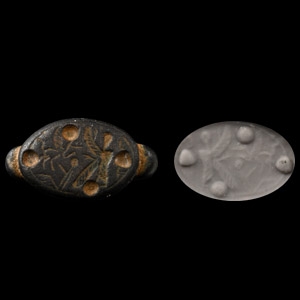
Phoenician Bronze Scarab Pendant
6th-4th century B.C.Estimate: £250 - 350 (+bp*)
Opening Bid: £125
With suspension loop and frame, intaglio figural scene including stylised birds and winged scarabs, with recesses; with museum-quality impression. 13.5 grams, 23 mm
Ex London, UK, gentleman 1980-2000s. This lot is accompanied by an illustrated lot declaration signed by the Head of the Antiquities Department, Dr Raffaele D'Amato. -
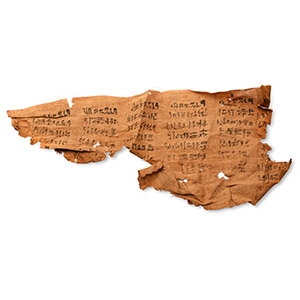
Egyptian Mummy Shroud Section with Hieratic Text
Late-Ptolemaic Period, circa 480-30 B.C.Sold for (Inc. bp): £1,170
A section of woven linen textile featuring lines of neat hieratic text in black. 5.61 grams, 16 cm
From the collection of a gentleman, acquired on the London art market in the 1990s. This lot is accompanied by an illustrated lot declaration signed by the Head of the Antiquities Department, Dr Raffaele D'Amato.
From the fifth century B.C., mummy wrappings for the affluent frequently display lines of hieratic script—a cursive variant of Egyptian hieroglyphs used for both daily and religious writings. These often include excerpts from funerary texts like the Book of the Dead, along with prayers and invocations designed to safeguard and guide the deceased in the afterlife. These texts, sometimes accompanied by vignettes, were inscribed directly on the linen strips before or during the mummification process. Some of these bandages could be remarkably long; one example from Brussels, measuring only 6.2 cm in width, spans an incredible 26 metres. -
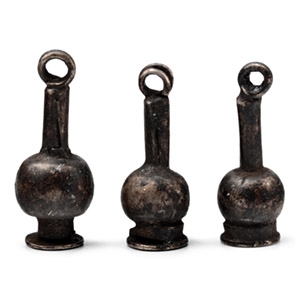
Egyptian Silver Poppy Amulet Group
Late-Ptolemaic Period, 664-30 B.C.Sold for (Inc. bp): £143
Three pendants each with poppy-head and loop at the apex. 3.22 grams total, 16-18 mm
Ex London, UK, art market, 1990s. This lot is accompanied by an illustrated lot declaration signed by the Head of the Antiquities Department, Dr Raffaele D'Amato.
Amulets in the form of poppies were used to heal and alleviate pain and to ward off death. These types of amulets were also linked to Osiris, the Egyptian deity of agriculture, death, and the afterlife.
