
Loading, please wait...
LOT 0439
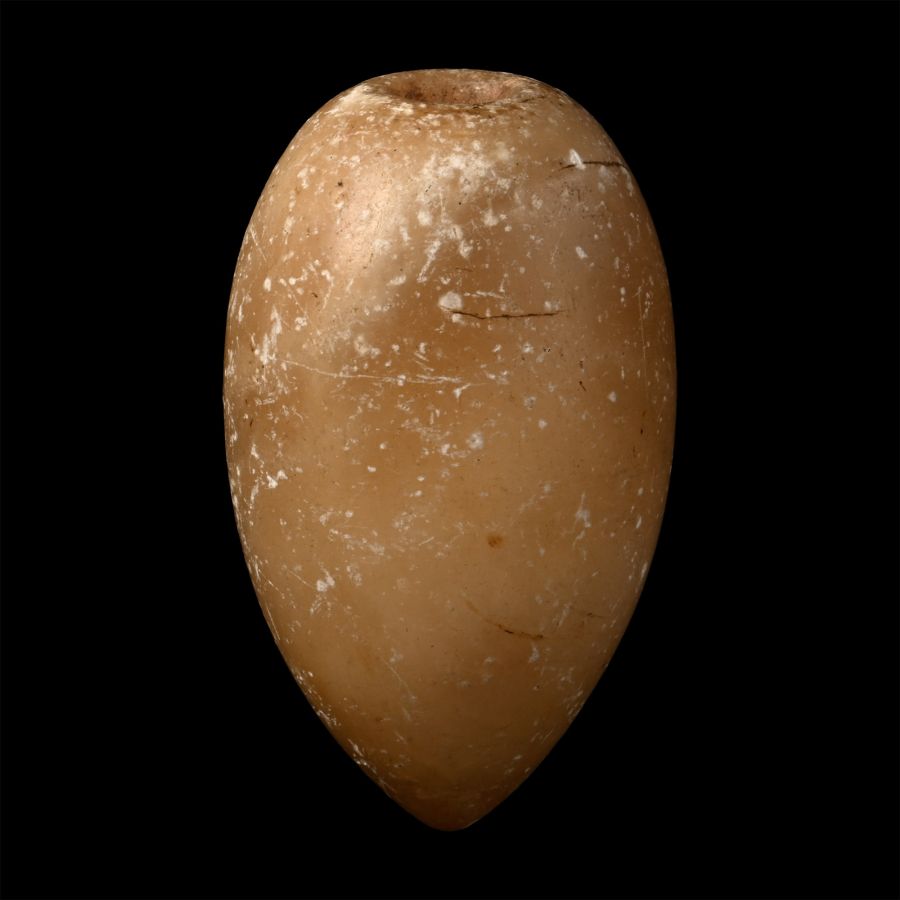
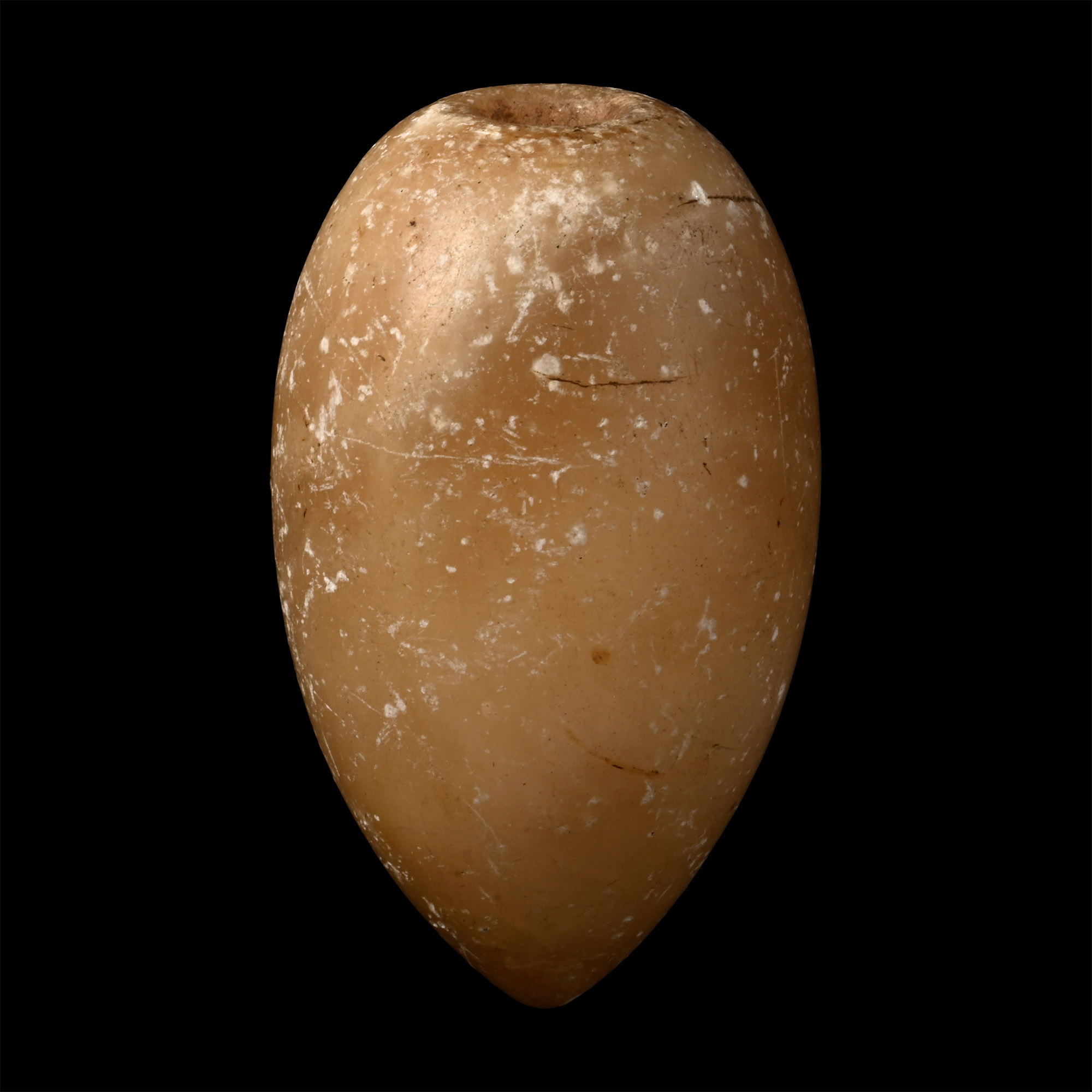
Egyptian Alabaster Miniature 'Torpedo' Flask
MIDDLE KINGDOM, 2ND MILLENNIUM B.C.
2 1/4 in. (62.6 grams, 57 mm).
Ovoid in profile with a pointed base, narrow opening, and hollowed interior. [No Reserve]
ProvenanceFrom a UK private collection since at least 1946.
Property of a West London, UK, gentleman.
Cf. Vandier d’Abbadie, J., Les objets de toilette égyptiens au Musée du Louvre, Paris, 1972, pp. 120-121, no. 508, for a similar vessel.
FootnotesAncient Egyptian cosmetics included volatile essential oils, animal fats, or scented plant resins. The ‘torpedo’ shape of the vessel required it to be positioned horizontally, ensuring the fluid remained in contact with the stopper or seal to prevent it from drying out or leaking.
CONDITIONTimeLine Auctions follows a vetting process to ensure the authenticity and legality of all items, reinforcing our commitment to integrity and responsible trading. Each antiquity, antique, and coin lot undergoes thorough examination by a vetting committee of at least ten external specialists, professional trade association members, scientists, and archaeologists: Our Vetting Process
AUCTIONS:
TimeLine is a leading auction house specialising in antiquities, ancient art, collectables, natural history, coins, medals, and books. Our auctions offer museums, collectors, historians, and enthusiasts the opportunity to acquire unique and historically significant pieces.
-
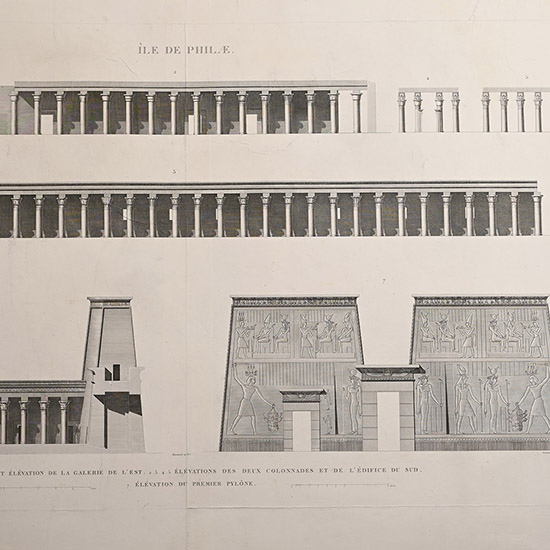
Very Large Egyptian Expedition Lithograph of the Temple of Philae
Early 19th century A.D.Sold for (Inc. bp): £94
Proof etching on laid paper of plate 6 from Description de l'egypte entitled Île de Philae. Coupe et élévation de la galerie de l'est. Élévations des deux colonnades et de l'édifice du sud. Élévation du premier pylône. 252 grams, 104 x 68.5 cm
From the collection of a North American priest. Acquired between 1981-1996. Property of a North American collector.
Produced between February 1802 and 1830 on the orders of Napoleon Bonaparte; published between 1809 and 1828. Just 1,000 copies were distributed to various institutions, printed on laid paper with an 'Égypte ancienne et moderne' watermark. The book is subtitled Recueil des observations et des recherches qui ont été faites en Égypte pendant l’expédition de l’Armée française, publié par les ordres de Sa Majesté l’Empereur Napoléon le Grand (Gathering of observations and discoveries which were made in Egypt during the expedition of the French army, published on the orders of His Majesty the Emperor Napoleon the Great). It was the world's first encyclopedia devoted exclusively to the remains of ancient Egypt. The plates of this book are the first to present the archaeological sites of Thebes (Luxor). The Philae temple complex was one of the major monuments dismantled from its original location and relocated to a new site during the Aswan High Dam project. Most of the complex dates to the Ptolemaic Period, although some earlier and later elements remain. -
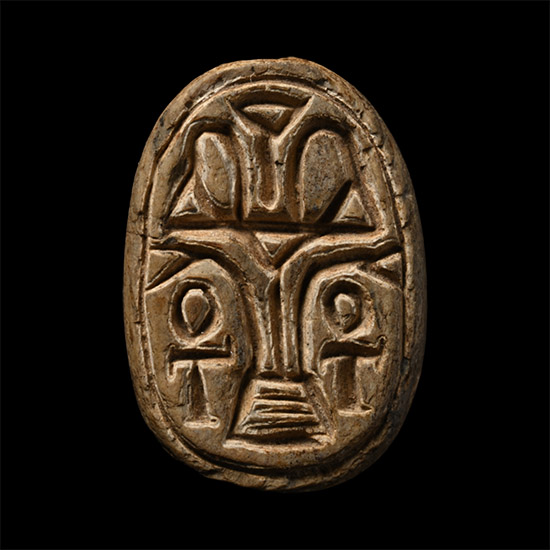
Egyptian Steatite Scarab
Middle Kingdom-Second Intermediate Period, circa 1900-1560 B.C.Sold for (Inc. bp): £182
Plano-convex in section with segmented carapace and mouth parts; to the underside, the 'Sema-Tawy' central motif and two flanking ankh glyphs. 5.2 grams, 22 mm
From the collection of David Donlan (1947-2025), a dedicated and lifelong collector with a passion for the ancient world and the natural sciences, forming his collection from the 1960s onwards, using many reputable dealers across the United Kingdom, including the well-regarded Coincraft and The Parthenon Gallery.
The 'sema- tawy' is a powerful symbol representing the unification of Upper and Lower Egypt. It traditionally consists of a windpipe entwined with lotus and papyrus plants. The ankh signs are the Egyptian hieroglyphs for 'life'. -
.jpg)
Egyptian Steatite Bust in a Gold Pendant
Ptolemaic-Roman Period, 2nd century B.C.-2nd century A.D.Sold for (Inc. bp): £1,300
Fragment of a carved panel or vessel depicting a female bust, possibly a queen or Isis, modelled in half-round relief, wearing a loosely draped tunic, a tiered wesekh collar, and a heavy curled, tripartite wig; reverse with lotus flower ropework and other ornamentation; mounted in a later gold suspension frame. 8.75 grams, 38 mm
Private collection, Southern France, 1970s. Acquired on the English art market.
This fragment likely originates from an elaborately decorated bowl belonging to a specific group thought to have been made in Alexandria (cf. Page-Gasser, M., Wiese, A.B., Ägypten: Augenblicke der Ewigkeit, Mainz, 1997, for a complete example). The purpose of these bowls is unclear, but they may have been used as votive offerings in sanctuaries.
