
Loading, please wait...
LOT 0484
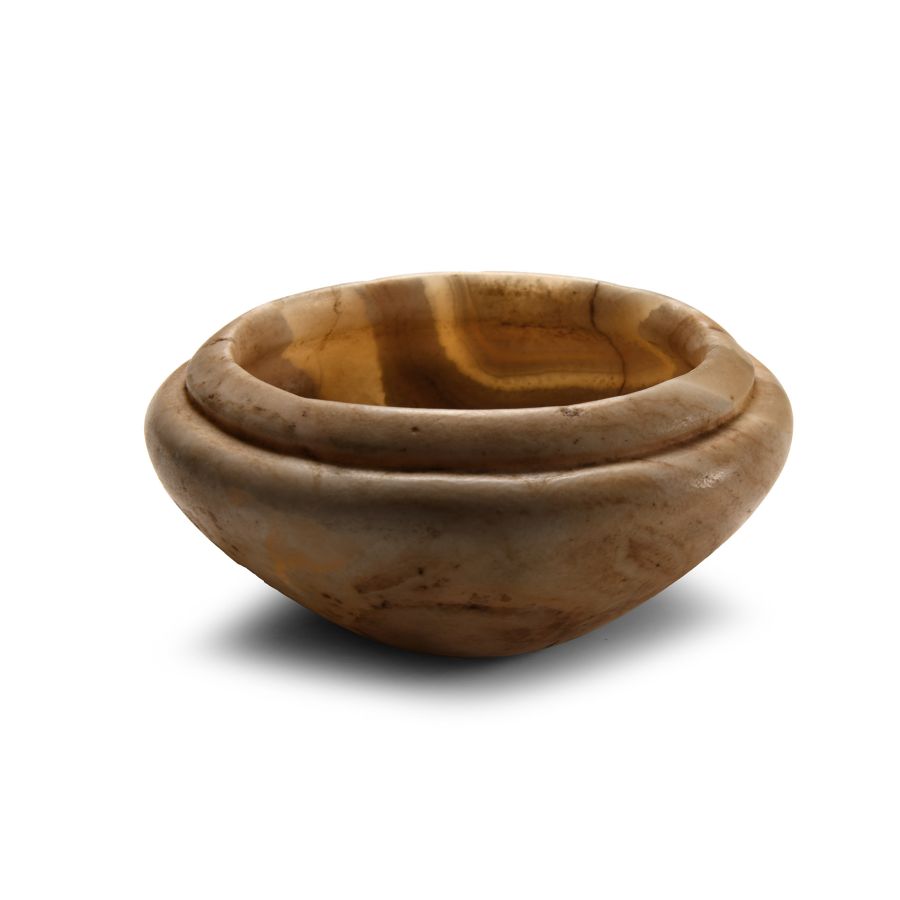
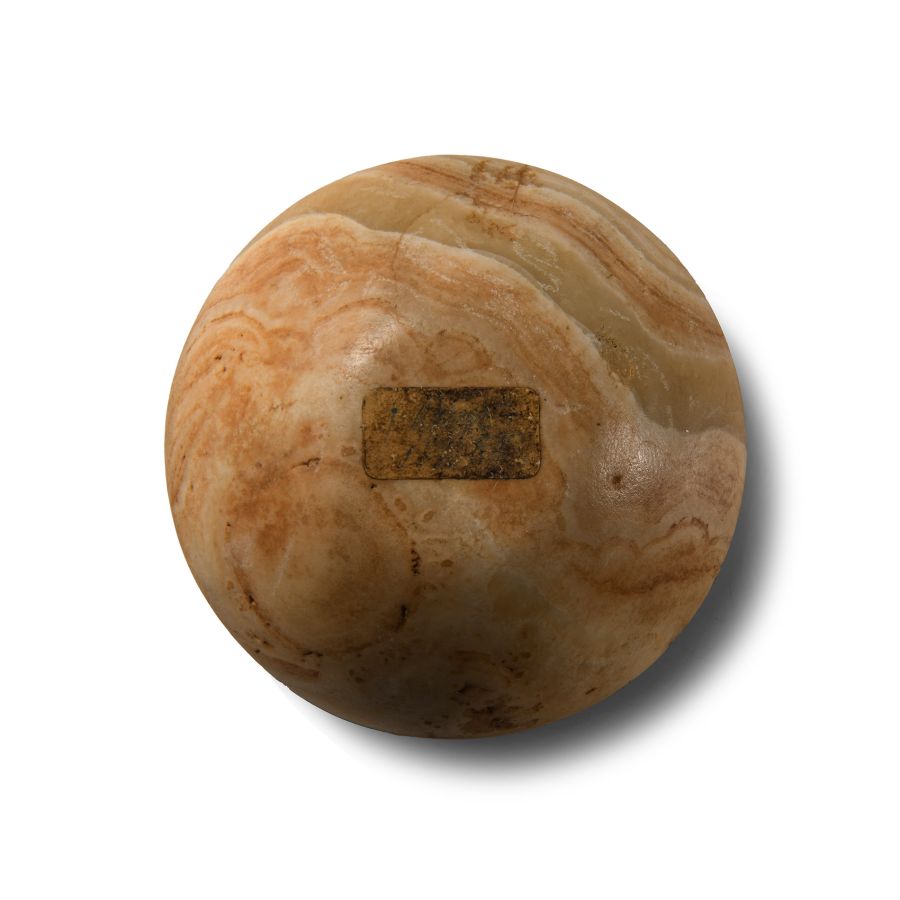
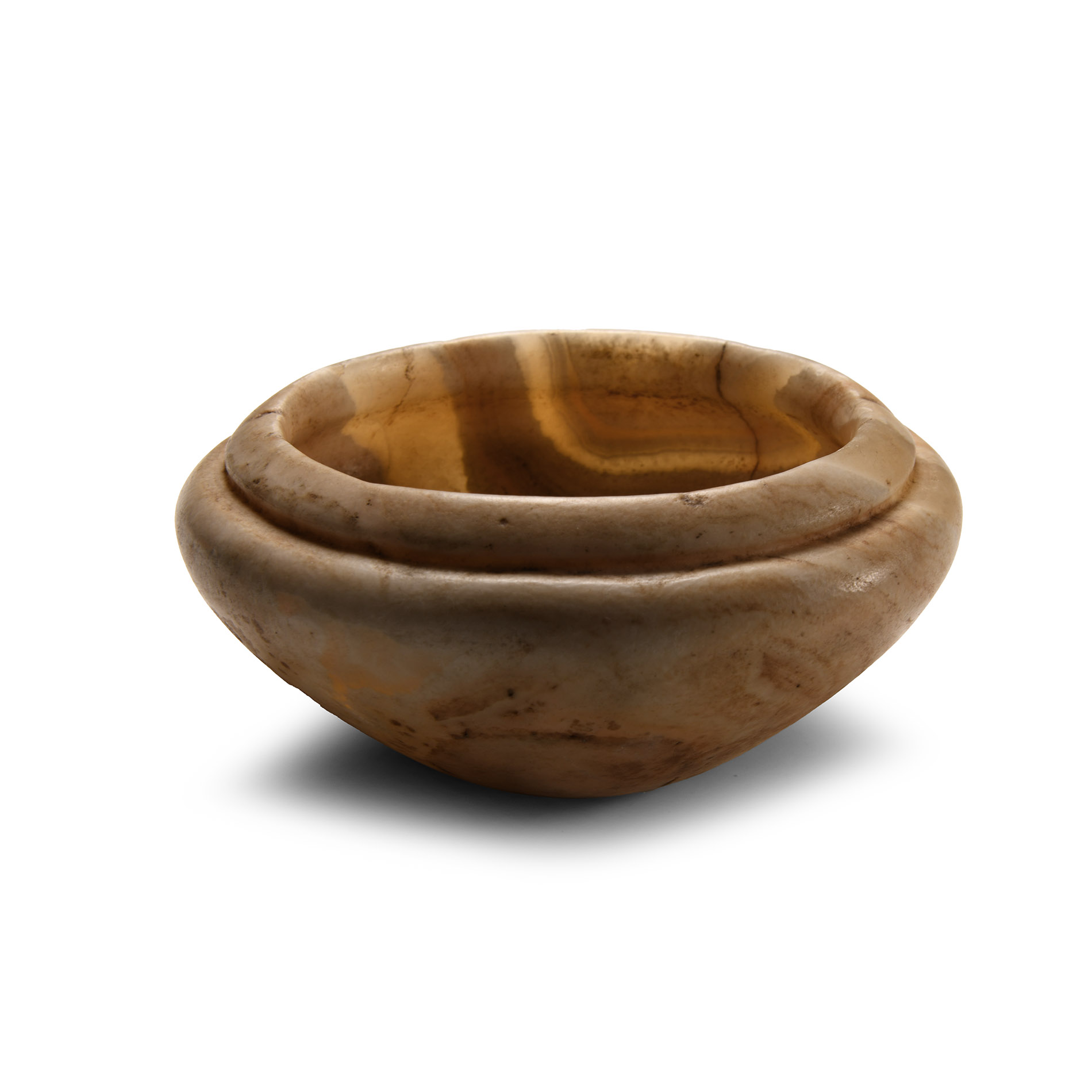
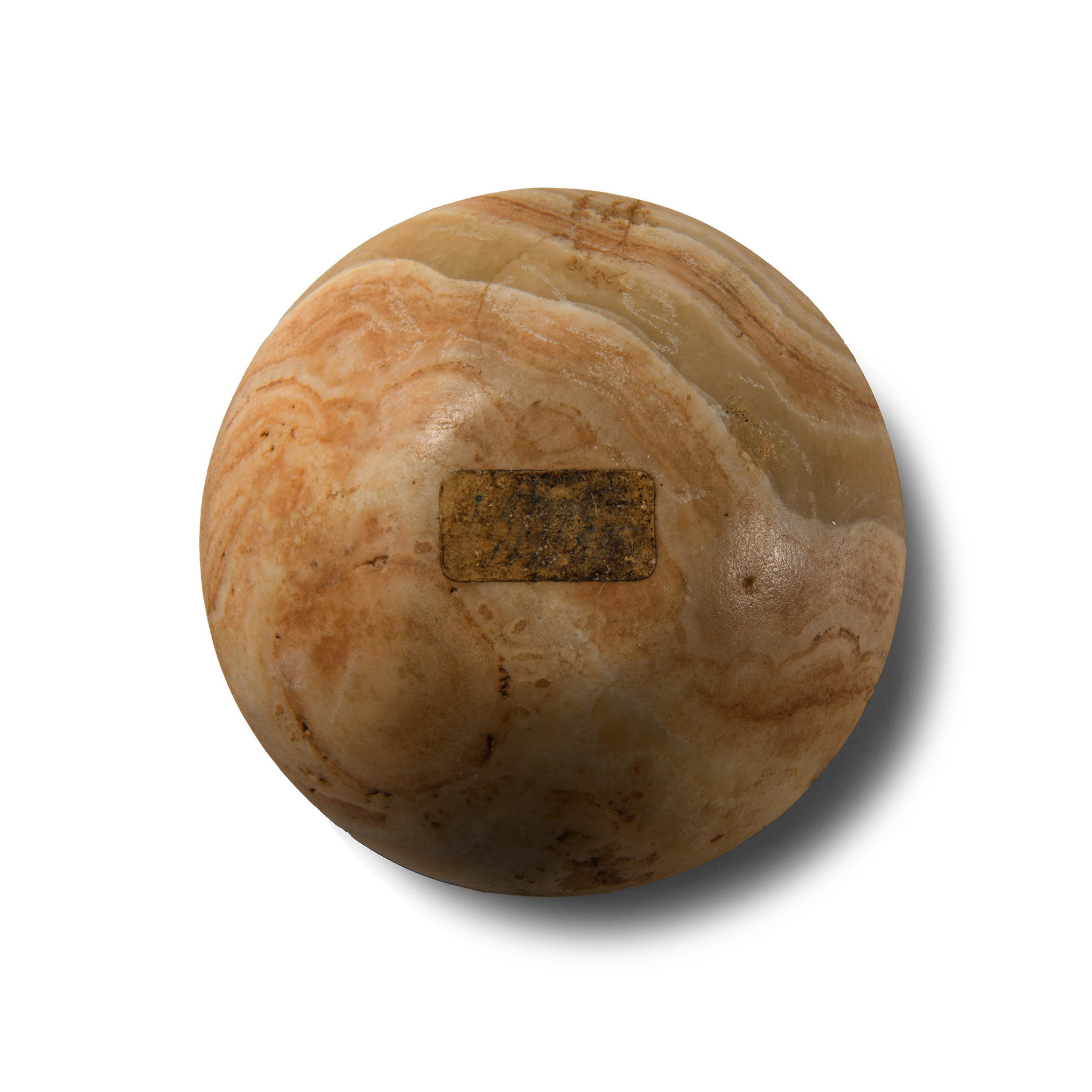
Egyptian Alabaster Bowl
1ST DYNASTY, CIRCA 3000 B.C.
4 1/2 in. (380 grams, 11.6 cm wide).
Of conical profile with flattened base, carinated shoulder and stepped rounded rim, possibly for accepting a lid.
ProvenanceProperty from an American deceased estate, acquired between 19770-1989.
with Bonhams, London, 28 October 2009, no.16 (Part).
Private European collection.
Accompanied by copies of the relevant Bonhams catalogue pages.
This lot has been checked against the Interpol Database of stolen works of art and is accompanied by a search certificate number no.12071-215259.
Cf. Vandier d’Abbadie, J., Les objets de toilette égyptiens au Musée du Louvre, Paris, 1972, pp.108, 110, nos. 433-434, for two examples of this type in the Louvre.
CONDITIONTimeLine Auctions follows a vetting process to ensure the authenticity and legality of all items, reinforcing our commitment to integrity and responsible trading. Each antiquity, antique, and coin lot undergoes thorough examination by a vetting committee of at least ten external specialists, professional trade association members, scientists, and archaeologists: Our Vetting Process
AUCTIONS:
TimeLine is a leading auction house specialising in antiquities, ancient art, collectables, natural history, coins, medals, and books. Our auctions offer museums, collectors, historians, and enthusiasts the opportunity to acquire unique and historically significant pieces.
LOT 0484
Egyptian Alabaster Bowl
Estimate £1,500 - 2,000€1,740 - 2,320 (for guidance only)$2,030 - 2,700 (for guidance only)
-
.jpg)
Egyptian Limestone False Door Relief Panel
Middle Kingdom, circa 1900-1750 B.C.Sold for (Inc. bp): £1,105
Rectangular panel from a false door stela carved in sunk relief with raised vertical borders framing a scene with a male figure wearing a knee-length kilt, collar and short wig, seated on a stool with lion-claw feet, holding a bolt of cloth in his left hand; before him, a pedestal table with splayed feet, the top laden with vertical loaves; traces of pigment to the collar, kilt and table; rear face dressed but plain. 4.12 kg, 28.7 cm
Acquired in the mid 1980s-1990s. Private collection, Switzerland, thence by descent. Private collection, since the late 1990s.
The ancient Egyptians believed the soul of the departed could move in and out of the tomb using a ‘false door.’ This door was identified by a recessed surface with a symbolic entrance at its centre. In the Middle Kingdom, the false door design was combined with other elements or represented by a raised border and cornice above on rectangular stelae. -
Egyptian Canaanite Limestone Scarab Group
Second Intermediate Period-New Kingdom, circa 17th-12th century B.C.Sold for (Inc. bp): £1,040
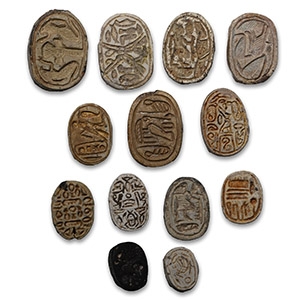
A group of thirteen scarabs with anatomical detailing to the carapace, comprising: 1) two kneeling hawk-headed figures with arms raised praise flank a central Hathoric fetish; 2) two facing falcons adorned with Red Crowns flanked by hieroglyphs, including netjer,hes-jars, and maat feathers; 3) standing human figure holding a staff atop a neb hieroglyph facing a highly stylised crocodile; 4) falcon atop a neb hieroglyph facing a striking cobra with another above; 5) the Re-Horakhty falcon standing before a hes-jar, with cartouche behind containing hieroglyphs and a verticalneb hieroglyph on the left; 6) central motif of a bird atop a neb hieroglyph with a rectangular sign above, a was- sceptre behind, flanked by stylised cobras; 7) falcon wearing the Red Crown atop a shrine with a winged sun disc above, flanked by cobras and Red Crowns; 8) central design consisting of hes-jars, a sun disc, a nub symbol (for gold), nefer signs, a kheper scarab beetle, and lotus flowers, all flanked by a border of en and ro signs; 9) central column of hes-jars, a sun disc, a kha rising sun hieroglyph, and scarab beetle, flanked by lions’ foreparts, Red Crowns, neb and hes-jar signs; 10) standing figure atop a neb hieroglyph holding a flower/branch; 11) hieroglyphs writing ‘Amun beloved of the living Ramesses’; 12) stylised bird with men hieroglyph behind; 13) scarab beetle with sun disc above. 27.1 grams total, 11-20 mm
Acquired in the mid 1980s-1990s. Private collection, Switzerland, thence by descent. Private collection, since the late 1990s.
The popularity of the scarab was so great that many of these scarab designs can be found outside Egypt at sites in the ancient Levant. -
Phoenician Scarab in Gold Swivel Ring
8th-5th century B.C.Estimate: £2,000 - 3,000 (‡+bp*)
Opening Bid: £1,000
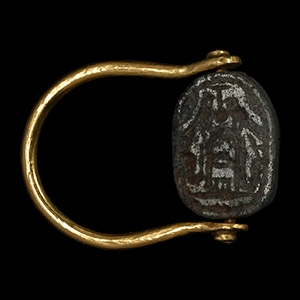
The scarab with lightly incised anatomical detailing, the underside with a central cartouche flanked by two rearing crowned uraei, a pair of falcons standing above the cartouche facing a smꜣ hieroglyph symbolising union (of the two lands, Upper and Lower Egypt); set into a later gold swivel ring. 4.34 grams, 26.44 mm overall, 15.68 mm internal diameter (approximate size British J 1/2, USA 5, Europe 9.32, Japan 9)
with Bonhams, London, 21 October 1999, no.36. Private collection, Europe. This lot has been checked against the Interpol Database of stolen works of art and is accompanied by a search certificate number no.12370-226696.
