
Loading, please wait...
_900x900.jpg "Egyptian Alabaster and Glass Eye Pair")
_200x200.jpg "Egyptian Alabaster and Glass Eye Pair")
.jpg "Egyptian Alabaster and Glass Eye Pair")
LOT 0006
Egyptian Alabaster and Glass Eye Pair
LATE-PTOLEMAIC PERIOD, 664-30 B.C.
1 1/4 in. (15.33 grams, 31mm).
The sclera white alabaster stone and the iris black glass.
ProvenanceFrom a North American gentleman's collection, 1990s.
FootnotesEgyptian coffin eye inlays were both decorative and symbolic, intended to make the coffin appear lifelike and assist the deceased in the afterlife. Typically, they featured a white sclera (glass, travertine, alabaster or quartz), a dark iris (glass or often obsidian), and sometimes red paint at the inner corner. The eyes were often set in bronze or copper frames, occasionally with faience or bronze eyebrows.
CONDITIONTimeLine Auctions follows a vetting process to ensure the authenticity and legality of all items, reinforcing our commitment to integrity and responsible trading. Each antiquity, antique, and coin lot undergoes thorough examination by a vetting committee of at least ten external specialists, professional trade association members, scientists, and archaeologists: Our Vetting Process
AUCTIONS:
TimeLine is a leading auction house specialising in antiquities, ancient art, collectables, natural history, coins, medals, and books. Our auctions offer museums, collectors, historians, and enthusiasts the opportunity to acquire unique and historically significant pieces.
-
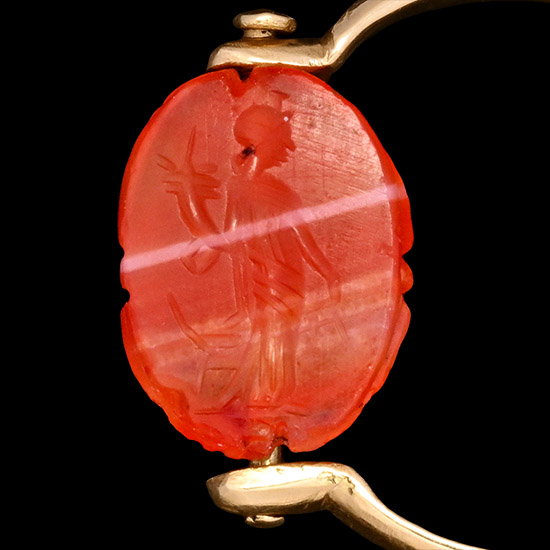
Romano-Egyptian Agate Scarab Engraved with the Goddess Fortuna Mounted in a Gold Ring
1st century B.C.-1st century A.D.Sold for (Inc. bp): £1,170
Scarab with incuse image to the underside of Fortuna with cornucopia and ship's rudder; in later gold swivel ring. 4.34 grams, 22.63 mm overall, 19.34 mm internal diameter (approximate size British N, USA 6 1/2, Europe 13.72, Japan 13)
Private collection, Europe. Acquired on the English art market. -
.jpg)
Egyptian Steatite Heart Scarab
Late Period, 664-332 B.C.Sold for (Inc. bp): £221
With ribbed carapace and suspension loop to underside. 2.89 grams, 22 mm
Acquired on the European art market in the early 2000s. with Galerie Rhéa, Zurich, Switzerland. -
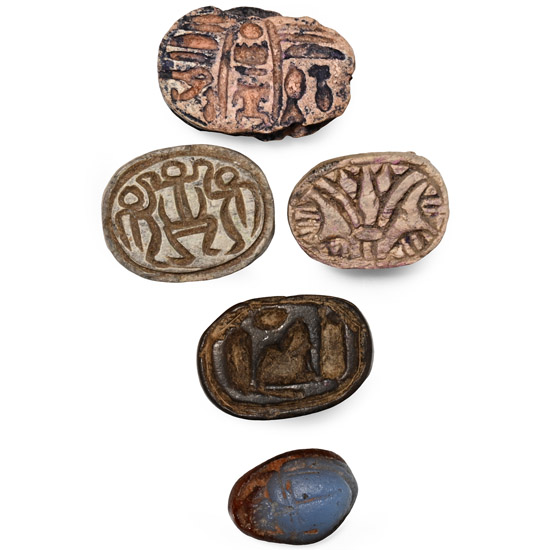
Egyptian Stone and Faience Scarab Group
2nd-1st millennium B.C.Sold for (Inc. bp): £338
Comprising: a blue glazed scarab with the cartouche of Thutmosis III (Men-kheper-Ra) on the underside flanked by other signs; a scarab with three schematic human figures; a scarab with an open lotus flower; another with motifs on the underside; and a blue and black glass scarab with a plain underside. 6.02 grams total, 10-16 mm
From the private collection of a European gentleman (1942-2024), formed since the 1970s.
