
Loading, please wait...
_900x900.jpg "Egyptian Alabaster Alabastron")
_200x200.jpg "Egyptian Alabaster Alabastron")
.jpg "Egyptian Alabaster Alabastron")
LOT 0461
Egyptian Alabaster Alabastron
LATE PERIOD, 664-332 B.C.
5 1/2 in. (332 grams, 14 cm).
Ovoid jar with a rounded base, concave shoulders and flared neck; remains of lug handles, restored.
ProvenanceAcquired in the mid 1980s-1990s.
Private collection, Switzerland, thence by descent.
Private collection, since the late 1990s.
Cf. Aston, B.G., Ancient Egyptian Stone Vessels: Materials and Forms, SAGA 5, Heidelberg, 1994, p.89, fig.18, no.218, for a similar vessel.
CONDITIONTimeLine Auctions follows a vetting process to ensure the authenticity and legality of all items, reinforcing our commitment to integrity and responsible trading. Each antiquity, antique, and coin lot undergoes thorough examination by a vetting committee of at least ten external specialists, professional trade association members, scientists, and archaeologists: Our Vetting Process
AUCTIONS:
TimeLine is a leading auction house specialising in antiquities, ancient art, collectables, natural history, coins, medals, and books. Our auctions offer museums, collectors, historians, and enthusiasts the opportunity to acquire unique and historically significant pieces.
LOT 0461
Egyptian Alabaster Alabastron
Estimate £600 - 800€700 - 930 (for guidance only)$810 - 1,080 (for guidance only)
-
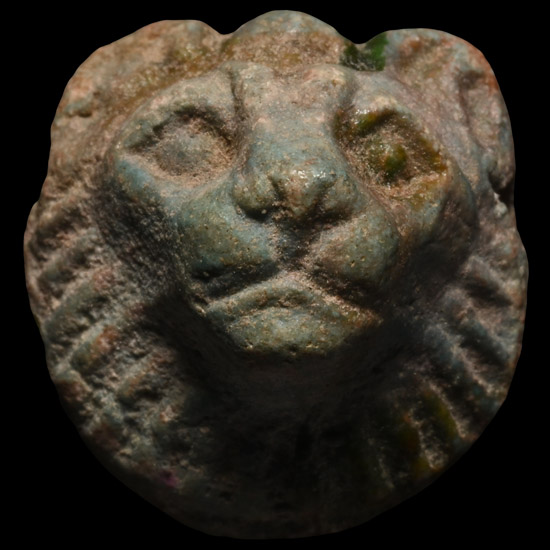
Egyptian Faience Lion's Head Amulet
Roman Period, 30 B.C.-323 A.D.Sold for (Inc. bp): £130
Modelled frontally with a radiating mane framing the face, pierced horizontally. 1.23 grams, 14.8 mm
From the private collection of a European gentleman (1942-2024), formed since the 1970s. -
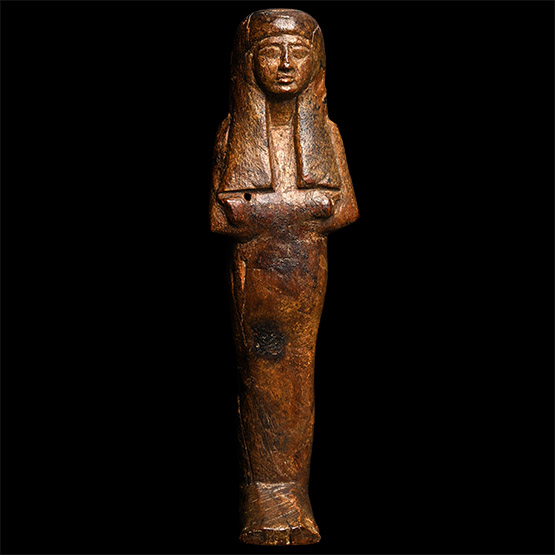
Egyptian Wooden Shabti
New Kingdom, 19th Dynasty, circa 1292-1185 B.C.Estimate: £6,000 - 8,000 (‡+bp*)
Opening Bid: £3,000
Carved in the round in a typical mummiform shape with hands crossed on the chest, wearing a tripartite wig with long, splayed lappets; collector's number to base 'E.803'. 140 grams, 21.5 cm
Private collection, acquired in the late 1980s-early 1990s; thence by descent. This lot has been checked against the Interpol Database of stolen works of art and is accompanied by a search certificate number no.13228-249321.
A shabti (or ushabti) is a small funerary figurine from ancient Egyptian tombs, dating from around 2000 BCE to 30 BCE. Its main purpose was to assist the deceased in the afterlife by performing tasks like farming. Shabtis were often inscribed with a magical formula from the Book of the Dead to ensure they would come to life when needed. -
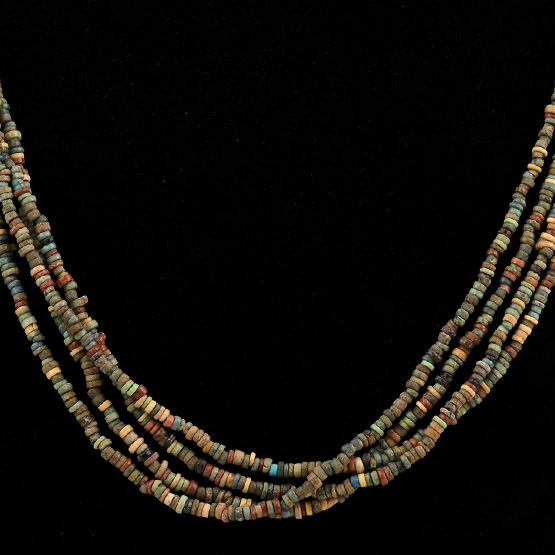
Egyptian Multi-Stranded Mummy Bead Necklace
Late Period, 664-332 B.C.Sold for (Inc. bp): £169
Four-strand designer necklace composed of polychrome beads of mainly disc and cylindrical types. 22.7 grams, 64 cm
Acquired before 1979. From the private collection of Mr F.A., South Kensington, London, UK; thence by descent 2014.
For thousands of years, artisans in Egypt created vibrant ceramics to echo the beauty of rare jewels. These ornaments were created with almost every material, colour, and texture imaginable, and they come from across Egypt and beyond: vibrant blue lapis lazuli from Afghanistan, glossy black obsidian from Turkey, and aqua-green turquoise from the Sinai. They were worn in life and, after death, they served as precious ornamentation for mummies.
