
Loading, please wait...
LOT 1036
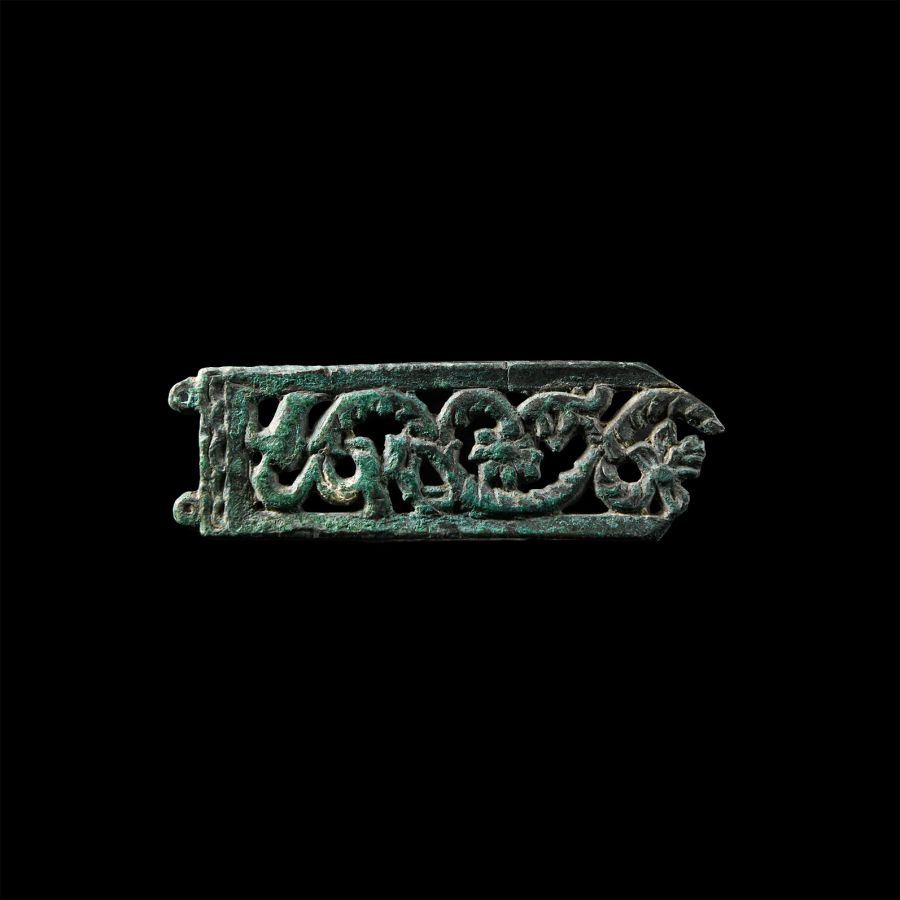
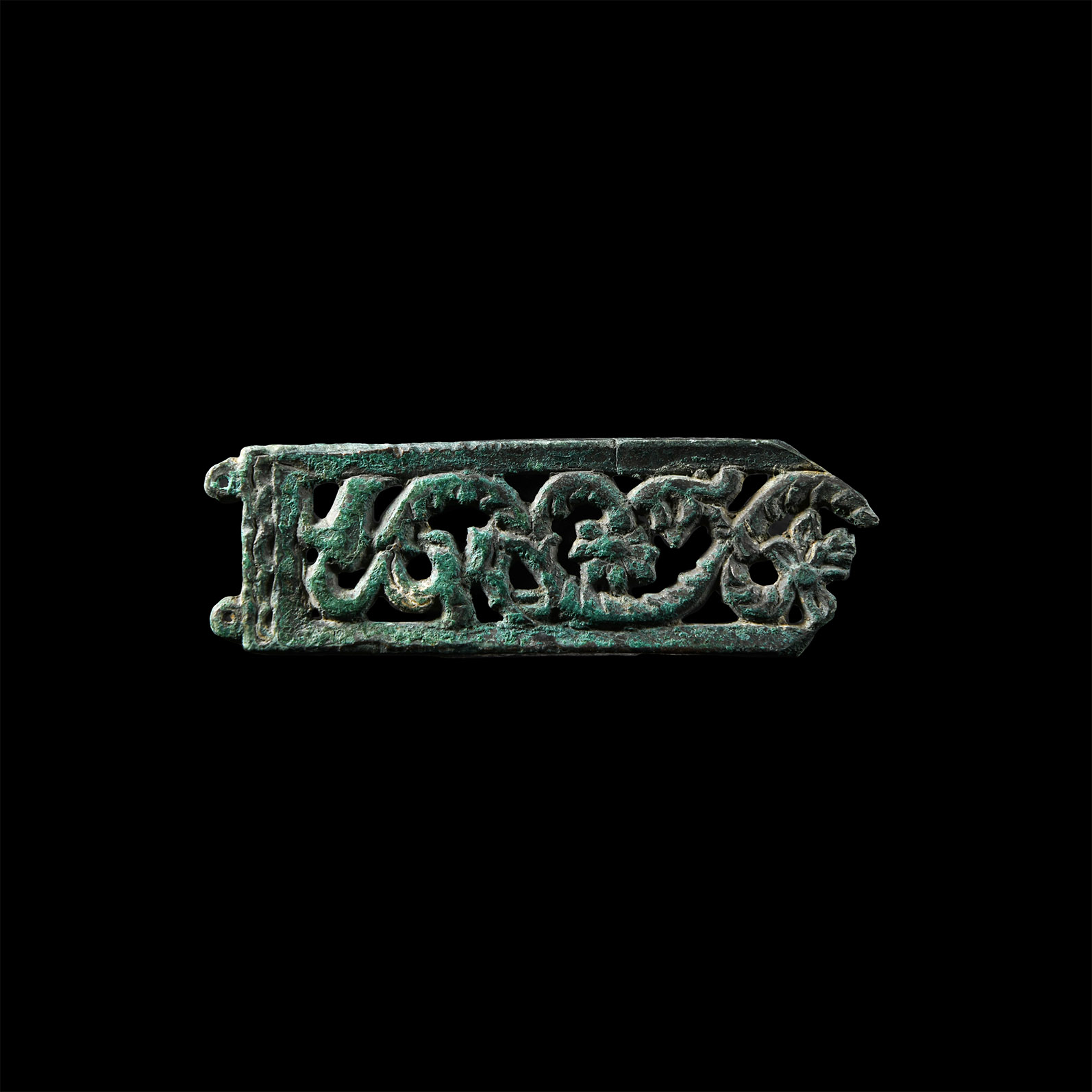
Eastern Roman Tinned Bronze Composite Belt Mount
8TH CENTURY A.D.
3 5/8 in. (27.9 grams, 93 mm).
Displaying openwork floriate decoration within a tongue-shaped frame; two pierced attachment lugs to the rear. [No Reserve]
ProvenanceFrom the collection of a North American gentleman, formed in the 1990s.
LiteratureCf. Daim, F., Die Awaren am Rand der Byzantinischen Welt (The Avars on the Border of the Byzantine World), Bad Vöslau, 2000, figs.1-2,37,112.
FootnotesThe belt is of composite type, decorated with scrollwork in Byzantine style. Many authors discuss the possibility that these belts were produced in the Eastern Roman capital or that they were made in the workshops of the Avar Khaganate, maybe with Roman matrices for producing sheet ornaments.
CONDITIONTimeLine Auctions follows a vetting process to ensure the authenticity and legality of all items, reinforcing our commitment to integrity and responsible trading. Each antiquity, antique, and coin lot undergoes thorough examination by a vetting committee of at least ten external specialists, professional trade association members, scientists, and archaeologists: Our Vetting Process
AUCTIONS:
TimeLine is a leading auction house specialising in antiquities, ancient art, collectables, natural history, coins, medals, and books. Our auctions offer museums, collectors, historians, and enthusiasts the opportunity to acquire unique and historically significant pieces.
LOT 1036
Eastern Roman Tinned Bronze Composite Belt Mount
Estimate £100 - 140€120 - 160 (for guidance only)$140 - 190 (for guidance only)
-
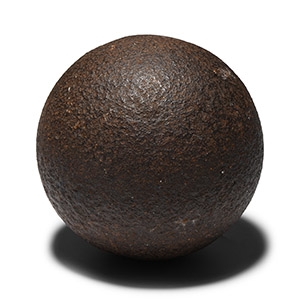
English Civil War Iron Cannon Ball
1642-1651 A.D.Sold for (Inc. bp): £182
Possibly made for a naval long gun, a 'long nine'. 4.3 kg, 98 mm wide
Found in a churchyard in Derbyshire, UK, before 1950. Acquired from the son of the clergyman that found it, in 2004. Property of a Nottinghamshire gentleman. -
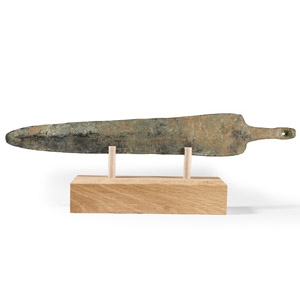
Luristan Short Sword Blade
Circa 13th-6th century B.C.Sold for (Inc. bp): £156
With a broad, lentoid-section blade and wide raised flange down centre, rounded tip, straight sides, well marked shoulders with narrow tang, one hole for rivet to attach an organic hilt; mounted on a custom-made stand. 880 grams total, 38 cm wide including stand
Acquired 1980-1990s. From the private collection of H.N., Milton Keynes, Bedfordshire, UK.
This kind of weapon was used in the early 2nd millennium B.C. in Mesopotamia and in Syria and as late as the mid-first millennium in Luristan. -
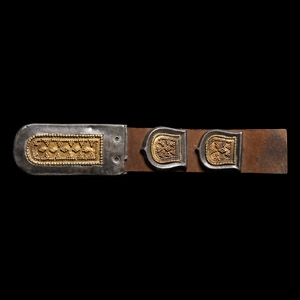
Avar-Byzantine Silver-Gilt Sword Belt Mount Group
7th-9th century A.D.Sold for (Inc. bp): £156
Comprising three belt mounts later remounted onto brown leather comprising: a rectangular strap end with rounded terminal, decorated with granulated borders, lozenges and chevrons; two roughly D-shaped mounts with apex flourish and waisted sides, also decorated with granulated lozenges and chevrons. 26.5 grams, 12.2 cm long
Fine condition.
Acquired in the 1980s-1990s. Ex an important central London gallery, London W1.
This type of belt element, decorated with granulation, is present in the Avar graves of the second half of the 7th century, and was most likely produced in the workshops of the Eastern Roman Empire, from where they reached the Avar lands as imperial gifts (tomb of Kunbàboni) or spoils of war. They were part of multiple belts, to which sabres and knives were attached, commonly used among Avars, Bulgars and Romans during the 7th and 8th centuries A.D.
