
Loading, please wait...
LOT 0322
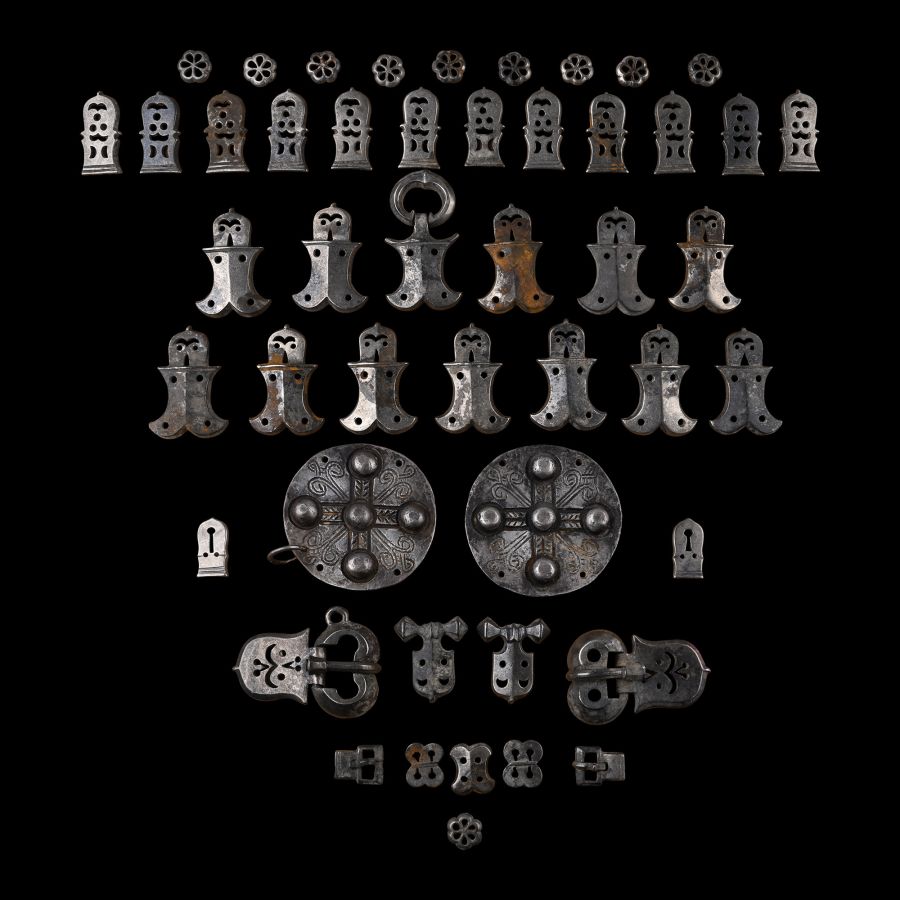
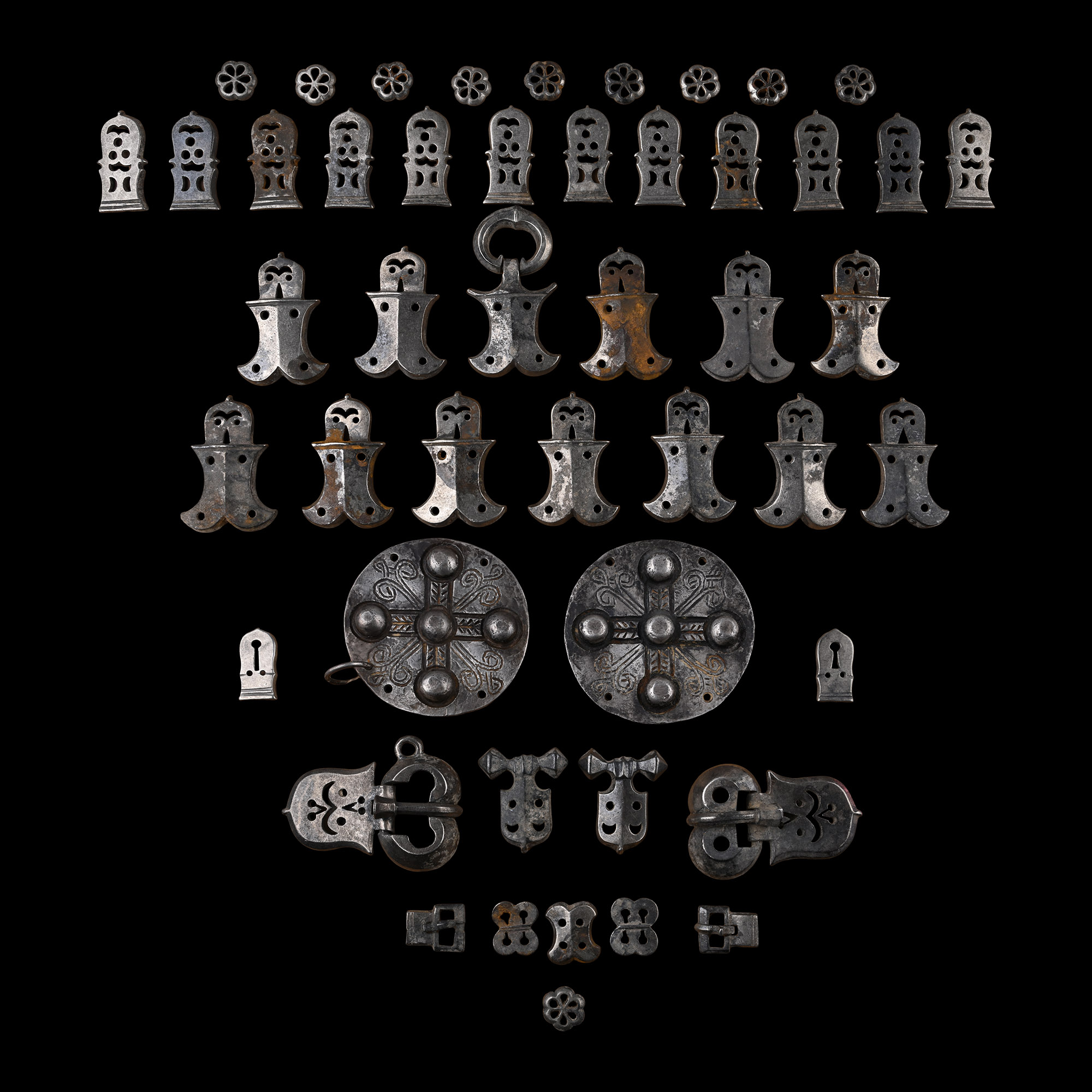
Eastern Roman Military Silver Belt Element Set
6TH-7TH CENTURY A.D.
5/8 - 3 1/8 in. (722 grams total, 16.08-79.52 mm).
A complete set of military belt fittings of Martinovka type, comprising forty-eight elements: two massive shield-shaped buckles, the buckle plate with a central chip-carved mask-shaped decoration, the hinged prong of rectangular form with rounded terminal; twelve shield-shaped belt pendants with wavy edges and the bottom ending in a sharp angle; ten decorative rosettes; twelve belt pendants in the form of a double crescent, with mask-shaped decoration on the oval head, decorated with chip-carved comma and dot ornaments; one pendant of the same typology fitted with a circular massive ring for the suspension; two massive circular phalerae, decorated with a double cross, one ornamented with volutes at the end of the arms, the other with five massive bosses at the sides and centre; two shield-shaped pendants with projections for the fastening of elements; two small rectangular buckles; three trapezoidal openwork pendants and two further small drop-shaped pendants. [48]
ProvenanceFrom the private family collection of a lady, UK; acquired in Germany mid-20th century.
Accompanied by an academic report by Dr Raffaele D’Amato.
This lot has been checked against the Interpol Database of stolen works of art and is accompanied by search certificate number no.13249-253196.
Cf. Kazanski, M., Soupault, V., ‘Les sites archeologiques de l’epoque romaine tardive et du haut Moyen Age en Crimee (III-VII S.): etat des recherches’ in Kazanski, M., Soupault, V., Les Sites Archeologiques en Crimée et au Caucase durant l’Antiquité Tardive et le haut Moyen-Age, Leiden, Boston, Köln, 2000, pp.253-293, fig.11, no.8, for similar belt elements; Miks, C., 'Relikte eines frühmittelalterlichen Oberschichtgrabes?' in Jahrbuch des Römisch-Germanischen Zentralmuseums Mainz 56, 2009, pp. 395-538, figs.48-49, with examples from the British Museum and Kiev Museum.
FootnotesThese belt elements, which form the fittings of at least two belts, are typical of the Roman garrisons of Black Sea and the Balkans, for the late 6th and the 7th century A.D. They were connected especially with Gothic and Alan soldiers militating in the Roman army, and considered part of the Martinovka typology by the academics. Numerous finds of these multi-part belt sets have been found in the area between the Balkans, the north-northeastern Pontus region, the Kama region in the northeast, and the Caspian Sea in the east. The range of the type includes areas controlled by the Avars and the Roman Empire, the south-Danubian region (Moesia II: Beroe, Callatis, Tropaeum Traiani, Ibida, Argamum), the Carpathian area, the northern Black Sea, the Caucasus and up to the Euphrates and other areas of Europe; these elements should therefore be seen as a ‘multi-ethnic’ or ‘international’ element. They were used to hold two types of offensive weapons: a quiver with arrows, and bladed weapons such as the spatha, and the shorter culter venatorius.
CONDITIONTimeLine Auctions follows a vetting process to ensure the authenticity and legality of all items, reinforcing our commitment to integrity and responsible trading. Each antiquity, antique, and coin lot undergoes thorough examination by a vetting committee of at least ten external specialists, professional trade association members, scientists, and archaeologists: Our Vetting Process
AUCTIONS:
TimeLine is a leading auction house specialising in antiquities, ancient art, collectables, natural history, coins, medals, and books. Our auctions offer museums, collectors, historians, and enthusiasts the opportunity to acquire unique and historically significant pieces.
-
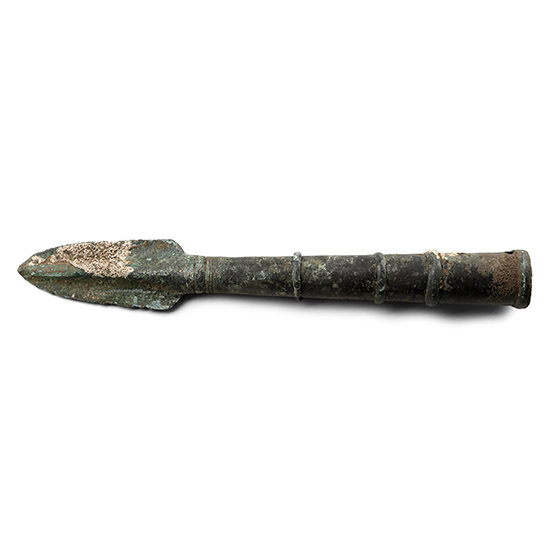
Luristan Bronze Socketted Spearhead
9th-7th century B.C.Sold for (Inc. bp): £117
Comprising a tapering tubular socket with raised ribs, a triangular blade with a raised midrib; ferrel collars to the shaft. 80 grams, 18.6 cm
Ex Abelita family collection, 1980s-2000s.
These kinds of spearheads were realised by casting in a mould. They were of different lengths and used by Luristan, Hamadan, early Median and Achaemenid warriors. The bronze rings were destined to reinforce the structure of the bronze shaft, because the blow, with this spear, was usually delivered by grasping the spear with two hands. -
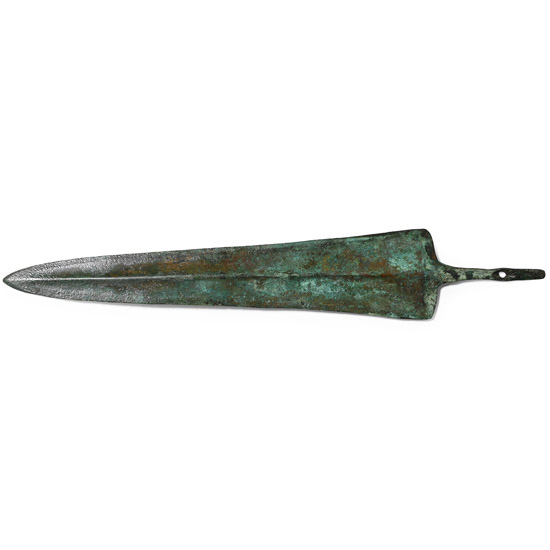
Greek Bronze Tanged Spearhead
1st millennium B.C.Sold for (Inc. bp): £234
With straight shoulders and lozengiform mid-rib running to the blade tip; short tang with fastening hole. 154 grams, 31 cm
Ex Abelita family collection, 1980s-2000s. -
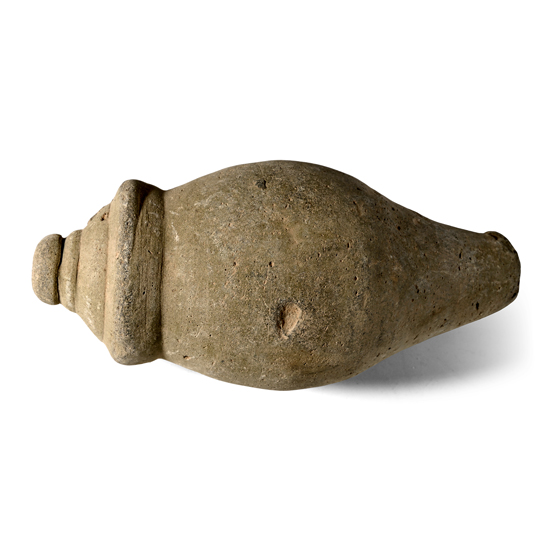
Turco-Mongol 'Greek Fire' Ceramic Fire Bomb or Hand Grenade
14th-15th century A.D.Sold for (Inc. bp): £98
Piriform in profile with a domed mouth and a stepped neck; intended to be filled with explosive liquid and a wick, and used as a hand grenade. 505 grams, 15.7 cm
From an important specialist collection, London, UK, 1990s.
Apart from the use of siphons or manual flame-throwers called cheirosiphona, special corps of Roman soldiers employed terracotta grenades, in the form of small jars, abundantly evidenced in archaeological excavations. They were called μεσαία kακαβιά or κυτροκακάβια, where the former had a bulbous shape and the latter a more cylindrical form.
