
Loading, please wait...
LOT 0522
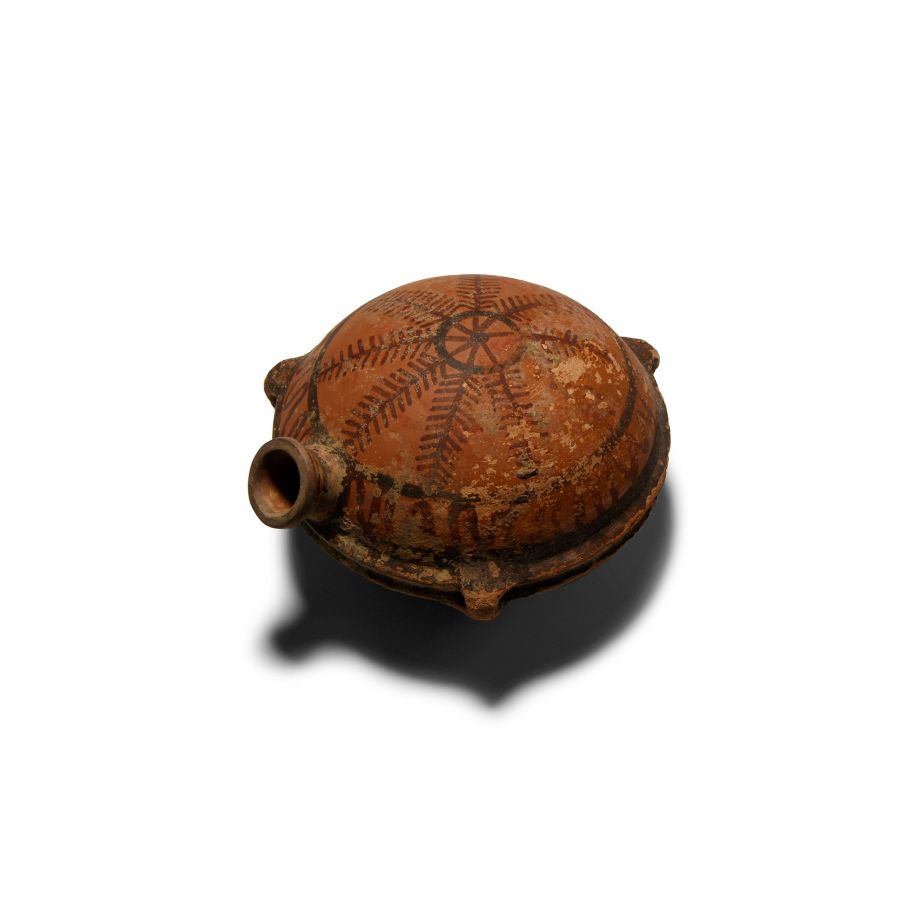
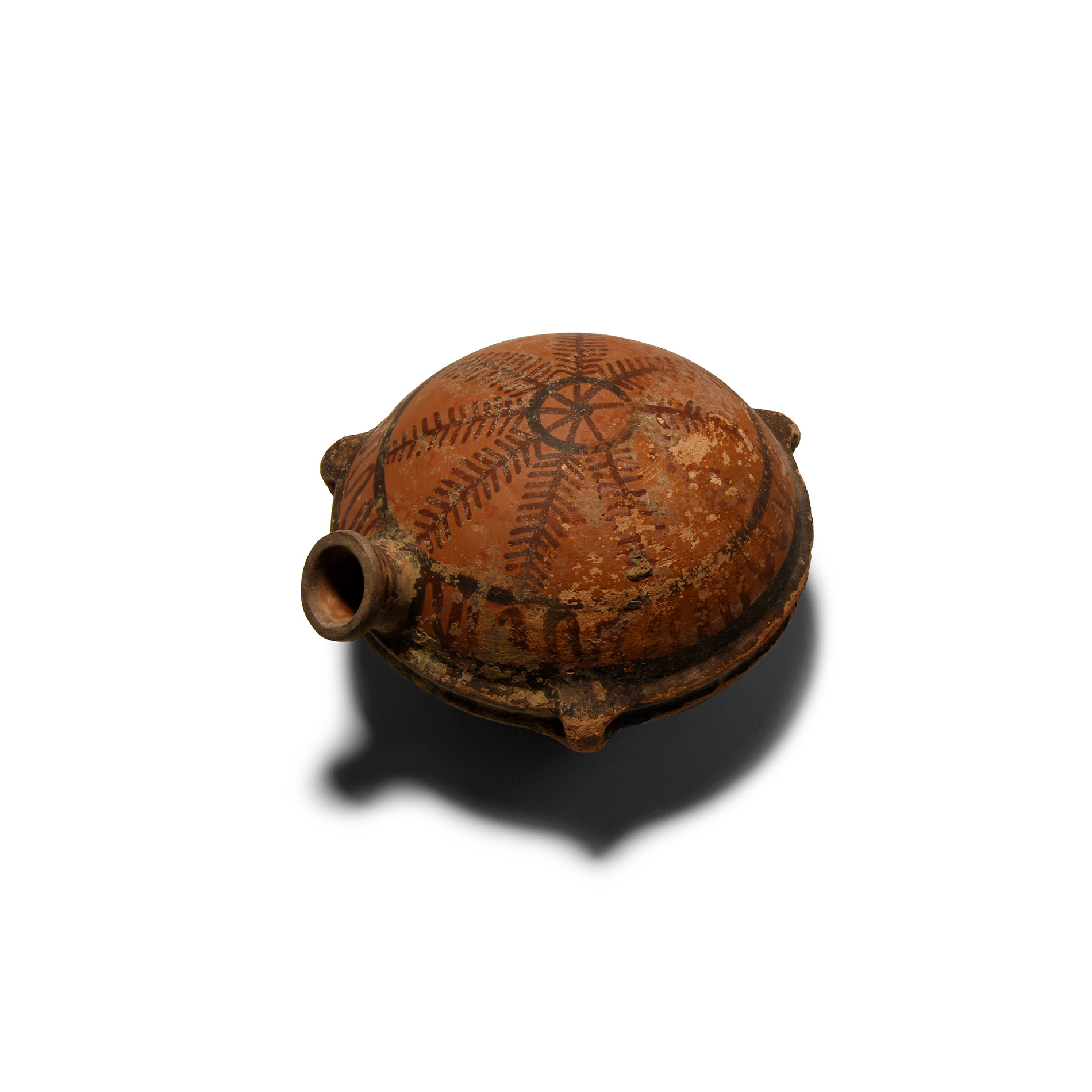
Eastern Mediterranean Flattened Terracotta Vessel with Bichrome Decoration
6TH-4TH CENTURY B.C.
6 3/4 in. (483 grams, 17 cm wide).
Composed of a flask-shaped body with three loop handles to the equator for a carry cord, short spout, the upper or outer body displaying a bichrome painted geometric motif.
ProvenanceEx Rabi gallery, 1990s.
Private collection of Iranian art.
TimeLine Auctions follows a vetting process to ensure the authenticity and legality of all items, reinforcing our commitment to integrity and responsible trading. Each antiquity, antique, and coin lot undergoes thorough examination by a vetting committee of at least ten external specialists, professional trade association members, scientists, and archaeologists: Our Vetting Process
AUCTIONS:
TimeLine is a leading auction house specialising in antiquities, ancient art, collectables, natural history, coins, medals, and books. Our auctions offer museums, collectors, historians, and enthusiasts the opportunity to acquire unique and historically significant pieces.
LOT 0522
Eastern Mediterranean Flattened Terracotta Vessel with Bichrome Decoration
Estimate £300 - 400€350 - 460 (for guidance only)$410 - 540 (for guidance only)
-
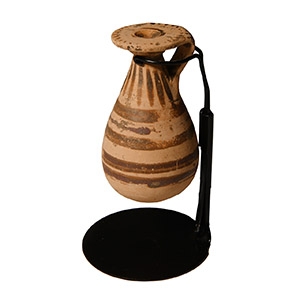
Greek Corinthian Ceramic Alabastron with Geometric Design
Circa 6th century B.C.Sold for (Inc. bp): £221
The piriform bottle with broad everted rim and strap handle, polychrome painted dashes and concentric bands to the upper body and rim; accompanied by a custom-made display stand. 36 grams total, 77 mm high including stand
Acquired 1980s-1990s. From the H.N. collection, Milton Keynes, Bedfordshire, UK.
The alabastron takes its name from the material (alabaster) from which it was originally produced by the people who inhabited Mediterranean Africa from where it spread in the classical world. From an archaeological point of view, our specimen belongs to the first type of alabastrons, a conventional form of Corinthian origin, widespread throughout Greece from the second half of the 7th century BC. to the mid-6th century B.C., characterised by an elongated body with a maximum diameter towards the base, and continuous profile. It seems to be an Etrusco-Corinthian variant. -
.jpg)
Attic Red-Figure Bell Krater with Drunken Male Revellers Attributed to the Kadmos Painter
5th-4th century B.C.Estimate: £40,000 - 60,000 (‡+bp*)
Opening Bid: £16,667
With a high foot, laurel wreath encircling the neck, checkerboard and meander patterns alternating around the lower body, roundels of tongue motif to the handles with palmettes and tendrils below; two red-figure scenes to the body: Side a: a high-quality depiction of a Kōmos composed of five figures, including a young man holding a torch, a double flute player next to three dancers, all possibly followers of Dionysus; side b: three draped figures conversing comprising a central female figure between two opposed male figures, one holding a staff. 3.8 kg, 37 cm wide
Ex Feuardent collection, France, collected in the late 19th century (two old labels: one with 3061-133) on the inner rim and 113/2 (an old lot label from the 1900s/1920s) on the sidewall, further old assession numbers under the base: 321 and 35). Private collection, acquired in Paris, 2004. Accompanied by a copy of a thermoluminescence analysis report no.N111j79 from Oxford Authentication. Accompanied by an academic report by Dr Raffaele D’Amato. This lot has been checked against the Interpol Database of stolen works of art and is accompanied by search certificate number no.11786-206517.
The Kadmos Painter was an Athenian red-figure vase painter, whose real name is unknown. His nickname was bestowed by Beazley, naming him after the subject of a famous hydria in Berlin (Antikensammlungen Berlin/Altes Museum, found in Vulci). He illustrated many mythological scenes, sometimes with figures arranged up and down the field, usually on bell craters, vessels used in symposia for mixing wine and water. A Komos was a ritualistic drunken procession performed by revellers in ancient Greece. It preceded and/or followed the banquet, whether unbridled in nature with music and games, or serious and mythical. -
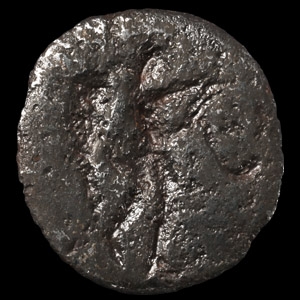
Greek Iron Ring with Figure
3rd-2nd century B.C.Sold for (Inc. bp): £39
Composed of a D-section hoop with slightly splayed arms and a large sub-oval bezel, engraved with a figure advancing right. 7.81 grams, 23.00 mm overall, 17.00 mm internal diameter (approximate size British N 1/2, USA 6 3/4, Europe 14.35, Japan 13)
Ex old English collection. London art market, 1980s.
