
Loading, please wait...


LOT 0537
Eastern Greek Variegated Agate Gemstone with Lion
6TH-4TH CENTURY B.C.
5/8 in. (2.53 grams, 15 mm).
Scaraboid type with incuse design to the underside of a lion advancing beneath a star inside a ropework border; supplied with a museum-quality impression. [No Reserve]
ProvenanceFrom the private collection of a European gentleman (1942-2024), formed since the 1970s.
CONDITIONTimeLine Auctions follows a vetting process to ensure the authenticity and legality of all items, reinforcing our commitment to integrity and responsible trading. Each antiquity, antique, and coin lot undergoes thorough examination by a vetting committee of at least ten external specialists, professional trade association members, scientists, and archaeologists: Our Vetting Process
AUCTIONS:
TimeLine is a leading auction house specialising in antiquities, ancient art, collectables, natural history, coins, medals, and books. Our auctions offer museums, collectors, historians, and enthusiasts the opportunity to acquire unique and historically significant pieces.
-

Eastern Greek Carnelian Scaraboid Gemstone with Nude Hero Holding Lions
6th-5th century B.C. or laterSold for (Inc. bp): £780
Scaraboid type with incuse design to the underside of a nude hero facing, holding one lion by the neck and another by the hind leg; supplied with a museum-quality impression. 4.25 grams, 19 mm
From the private collection of a European gentleman (1942-2024), formed since the 1970s.
The gem could be considered a representation of Heracles, even if the iconography is unusual, and is influenced by the Mesopotamian environment, from where it borrows the frontal image of the hero (Gilgamesh or Enkidu) fighting with two beasts. The hero is beardless and holding an inverted lion. He is acting like a master of the animals, showing eastern traits reminiscent of Graeco-Phoenician art. In the Phoenician tradition, a similar image of the god Bes, holding two lions, as posis theron (‘Master of the Animals’), is common. The type is more frequent in the Eastern Mediterranean than in the West and is found on scarabs in carnelian and chalcedony. -
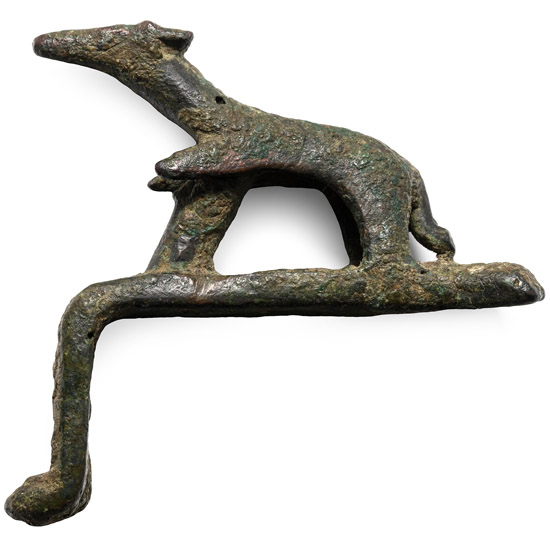
Greek Bronze Fitting with Fox
Circa 5th century B.C.Sold for (Inc. bp): £72
L-shaped bracket with a leaping fox, the beast with an elongated muzzle and swept-back ears. 46.7 grams, 62 mm
From the private coin collection of a West London, UK, gentleman, formed since the mid 1980s. -
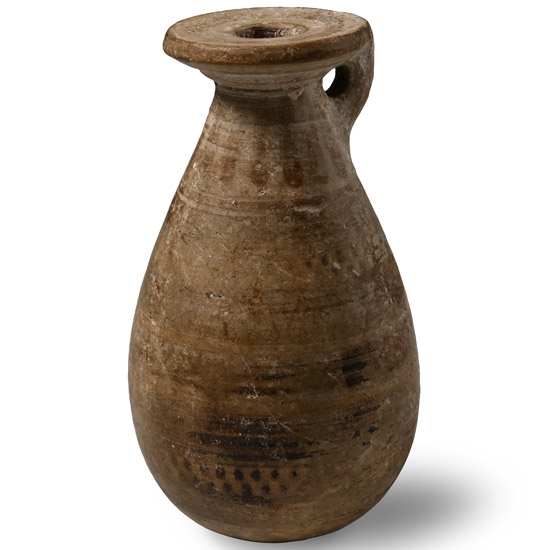
Greek Corinthian Terracotta Alabastron
Archaic Period, circa 600-575 B.B.Sold for (Inc. bp): £130
Ovoid body, short neck, disc-shaped rim, a vestigial handle with suspension hole, decorated with linear motifs such as tongues, lines and dots, all organised in zones. 48.3 grams, 74 mm
From the private collection of a Sussex, UK, gentleman.
