
Loading, please wait...
_900x900.jpg "Eastern Greek Carnelian Scaraboid Gemstone with Nude Hero Holding Lions")
_200x200.jpg "Eastern Greek Carnelian Scaraboid Gemstone with Nude Hero Holding Lions")
_900x900.jpg "Eastern Greek Carnelian Scaraboid Gemstone with Nude Hero Holding Lions")
_200x200.jpg "Eastern Greek Carnelian Scaraboid Gemstone with Nude Hero Holding Lions")
_900x900.jpg "Eastern Greek Carnelian Scaraboid Gemstone with Nude Hero Holding Lions")
_200x200.jpg "Eastern Greek Carnelian Scaraboid Gemstone with Nude Hero Holding Lions")
.jpg "Eastern Greek Carnelian Scaraboid Gemstone with Nude Hero Holding Lions")
.jpg "Eastern Greek Carnelian Scaraboid Gemstone with Nude Hero Holding Lions")
.jpg "Eastern Greek Carnelian Scaraboid Gemstone with Nude Hero Holding Lions")
LOT 0076
Eastern Greek Carnelian Scaraboid Gemstone with Nude Hero Holding Lions
6TH-5TH CENTURY B.C. OR LATER
3/4 in. (4.25 grams, 19 mm).
Scaraboid type with incuse design to the underside of a nude hero facing, holding one lion by the neck and another by the hind leg; supplied with a museum-quality impression. [No Reserve]
ProvenanceFrom the private collection of a European gentleman (1942-2024), formed since the 1970s.
LiteratureCf. a similar (but not identical) gemstone with Herakles fighting a lion and a fox, in Boardman, J., Greeks gems and finger rings, Early Bronze Age to Late Classical, London, 1970, no.343; cf. also Spier, J., Ancient Gems and finger Rings, catalogue of the collections, the J. Paul Getty Museum, Malibu, 1992, no.103.
FootnotesThe gem could be considered a representation of Heracles, even if the iconography is unusual, and is influenced by the Mesopotamian environment, from where it borrows the frontal image of the hero (Gilgamesh or Enkidu) fighting with two beasts. The hero is beardless and holding an inverted lion. He is acting like a master of the animals, showing eastern traits reminiscent of Graeco-Phoenician art. In the Phoenician tradition, a similar image of the god Bes, holding two lions, as posis theron (‘Master of the Animals’), is common. The type is more frequent in the Eastern Mediterranean than in the West and is found on scarabs in carnelian and chalcedony.
CONDITIONTimeLine Auctions follows a vetting process to ensure the authenticity and legality of all items, reinforcing our commitment to integrity and responsible trading. Each antiquity, antique, and coin lot undergoes thorough examination by a vetting committee of at least ten external specialists, professional trade association members, scientists, and archaeologists: Our Vetting Process
AUCTIONS:
TimeLine is a leading auction house specialising in antiquities, ancient art, collectables, natural history, coins, medals, and books. Our auctions offer museums, collectors, historians, and enthusiasts the opportunity to acquire unique and historically significant pieces.
LOT 0076
Eastern Greek Carnelian Scaraboid Gemstone with Nude Hero Holding Lions
Sold for (Inc. bp): £780
-
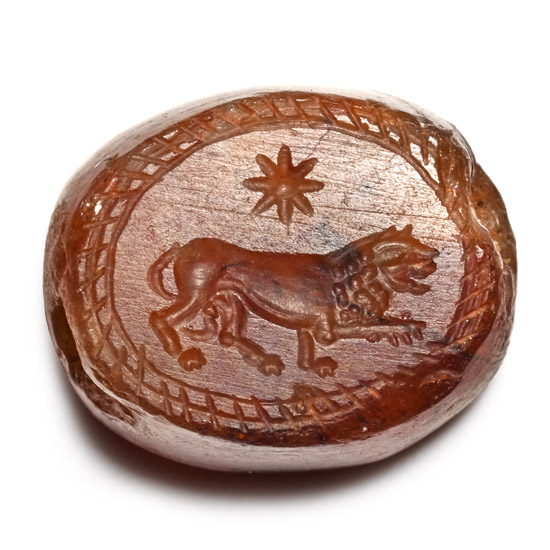
Eastern Greek Variegated Agate Gemstone with Lion
6th-4th century B.C.Sold for (Inc. bp): £312
Scaraboid type with incuse design to the underside of a lion advancing beneath a star inside a ropework border; supplied with a museum-quality impression. 2.53 grams, 15 mm
From the private collection of a European gentleman (1942-2024), formed since the 1970s. -
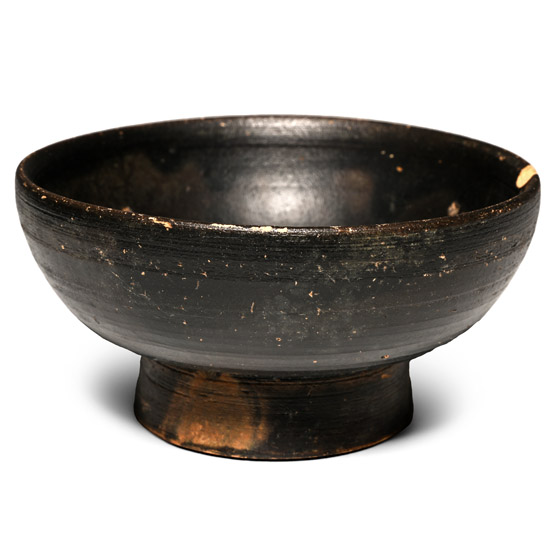
Greek Black Ware Footed Cup with Concentric Circles
South Italian, circa 4th century B.C.Sold for (Inc. bp): £286
With broad bowl and rounded rim, flared foot; old collector's label to the underside 'Z17.91'. 147 grams, 10.4 cm wide
From the collection of the late Bernard C. Pickard, Hampshire, UK, the owner of Bernard C. Pickard Antiquities, which closed in 1987, he had been collecting since the mid 1950s.
Bernard Pickard was a close friend of Richard Hattatt, the renowned author of several books on ancient brooches. Hattatt acknowledges in his first book, Ancient & Romano-British Brooches, published in 1982, that Mr Pickard first aroused his interest in brooches and inspired him in writing his books during his retirement. Mr Pickard also wrote the foreword to the section on Roman animal brooches, op. cit. p.158-160. -
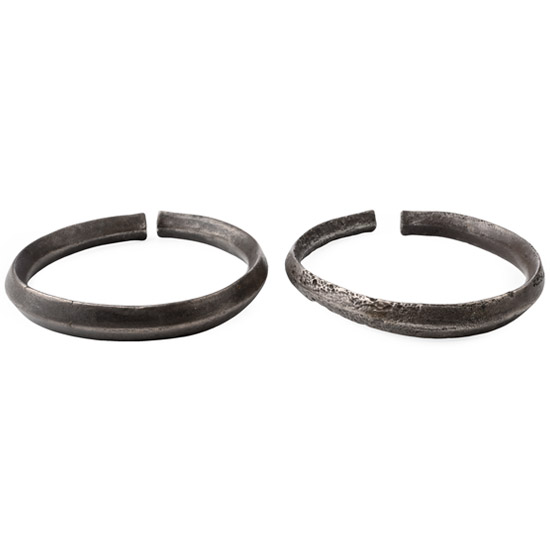
Greek Undecorated Silver Bracelets
Italy, 4th century B.C.Sold for (Inc. bp): £468
Comprising two penannular lozenge-section bracelets. 182 grams total, 84 mm each
Bonhams, Knightsbridge, London, 12 December 1996, no.49. Private collection, Suffolk.
