
Loading, please wait...
LOT 0549
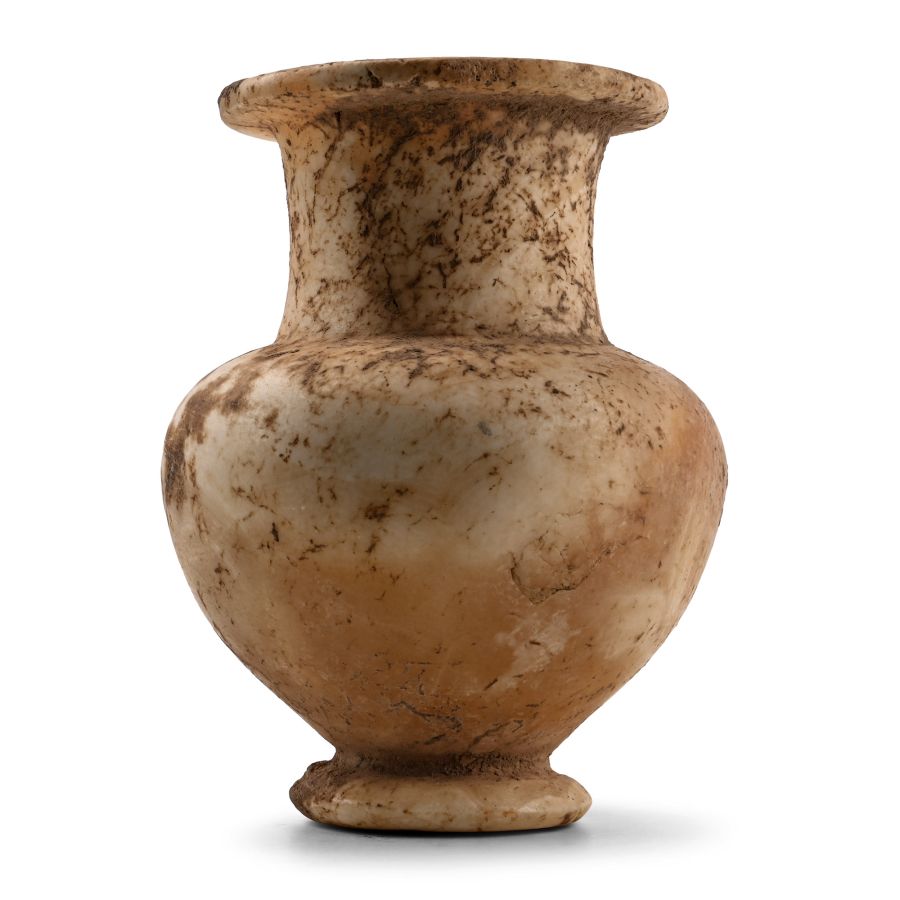
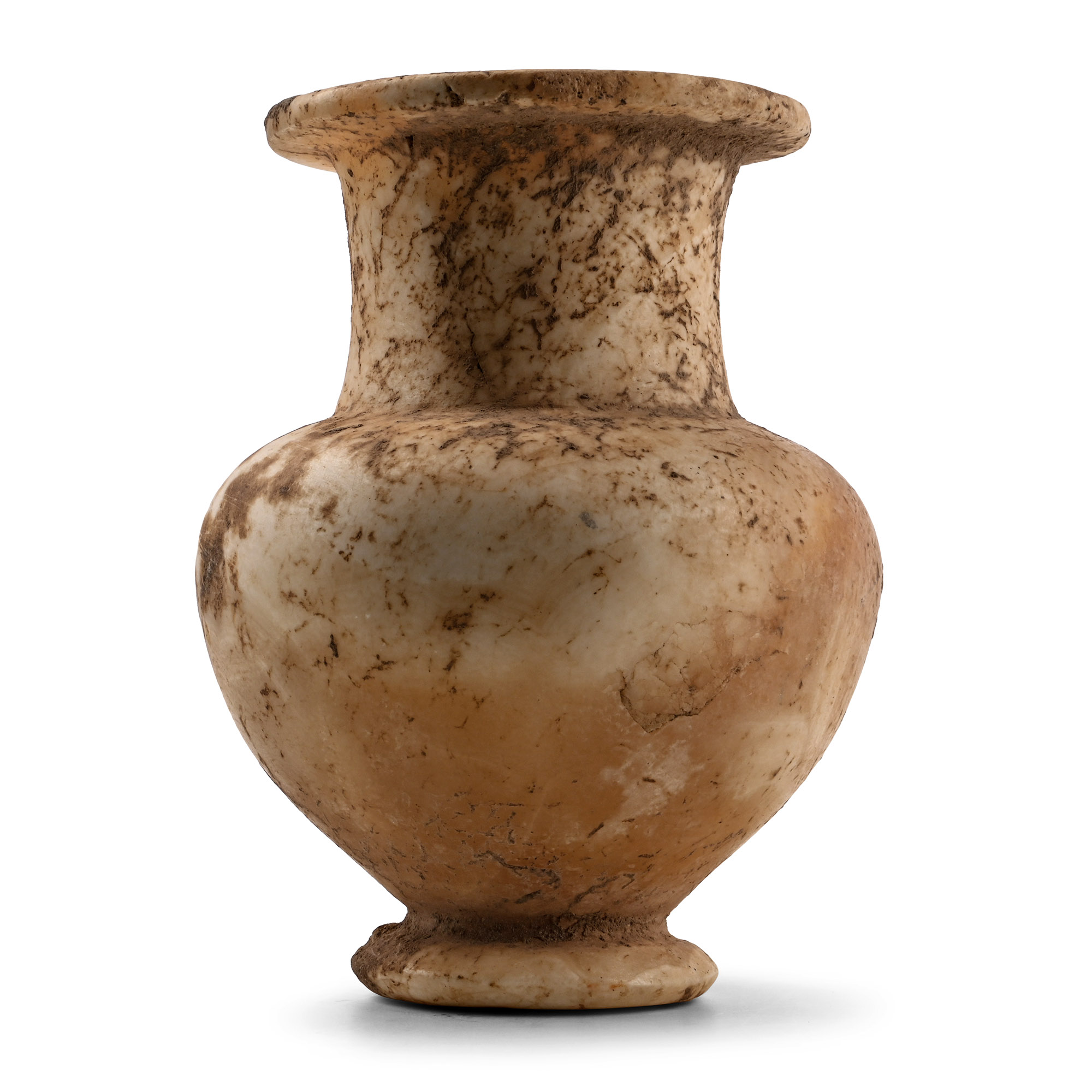
Early Phoenician Alabaster Vase
1ST MILLENNIUM B.C.
5 1/8 in. (769 grams, 13.1 cm).
With bulbous body, broad flared neck, flange rim, dimple to underside of base.
ProvenancePrivate collection, USA and Switzerland, acquired in the late 1980s-early 1990s; by descent to the current owner.
This lot has been checked against the Interpol Database of stolen works of art and is accompanied by search certificate no.13222-249180.
Cf. Auenmüller, J., ‘The “lost” Calcite Alabaster Vessels of Princess Nbw-m-tḫ in Turin (Cat. 3254 and 3255)’ in Rivista del Museo Egizio 7, Torino, 2023, fig.23 cat. 3251.
FootnotesJars like this vase certainly were part of the funerary equipment and destined to contain makeup, unguents and oils. The vase can find a good parallel with a similar specimen in the Egyptian Museum of Turin, belonging to the outfit of the 18th Dynasty princess Nbw-m-tḫ, probably a daughter of Amenhotep III.
CONDITIONTimeLine Auctions follows a vetting process to ensure the authenticity and legality of all items, reinforcing our commitment to integrity and responsible trading. Each antiquity, antique, and coin lot undergoes thorough examination by a vetting committee of at least ten external specialists, professional trade association members, scientists, and archaeologists: Our Vetting Process
AUCTIONS:
TimeLine is a leading auction house specialising in antiquities, ancient art, collectables, natural history, coins, medals, and books. Our auctions offer museums, collectors, historians, and enthusiasts the opportunity to acquire unique and historically significant pieces.
LOT 0549
Early Phoenician Alabaster Vase
Estimate £3,000 - 4,000€3,480 - 4,640 (for guidance only)$4,050 - 5,400 (for guidance only)
Opening Bid
£1,667 (EUR 1,933; USD 2,250) ‡+BP*
-
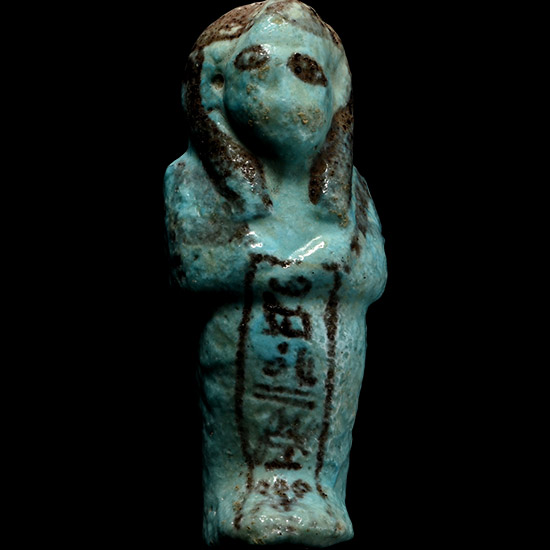
Egyptian Blue Glazed Shabti of Iset-em-khebit
Third Intermediate Period, 21st Dynasty, circa 1077-943 B.C.Estimate: £600 - 800 (‡+bp*)
Opening Bid: £320
Squat mummiform figure wearing a black-painted tripartite wig, arms crossed, holding agricultural implements and a seed bag across the back, painted in black; a hieroglyphic panel on the lower body reading: 'The Osiris, Iset-em-khebit (Ꜣs.t-m-Ꜣḫ-bı͗.t)'. 80 grams, 93 mm
Ex Carl Leonhard Burckhardt-Reinhard (1902-1965), formed since 1922, Egypt. Inherited by his son Christopher Burckhardt in 1966, Switzerland. Since then in the possession of his wife, Switzerland.
Shabtis for Iset-em-khebit were recovered from the second 'Priest's of Amun Cache' at Deir el-Bahari. -
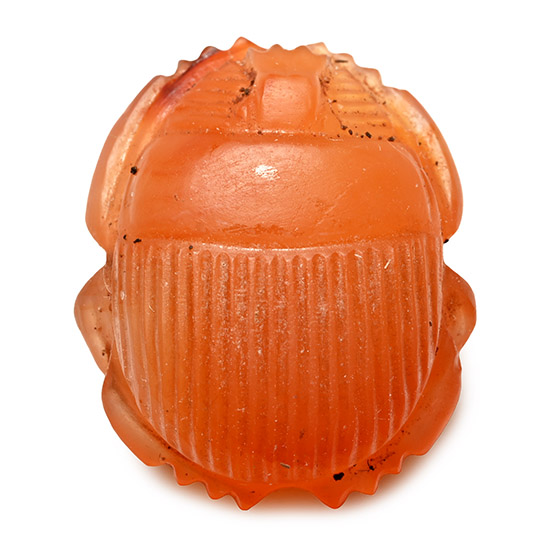
Egyptian Carnelian Heart Scarab
Late Period, 664-332 B.C.Estimate: £800 - 1,000 (+bp*)
Opening Bid: £400
With fine anatomical detailing on the body and striated wingcase, legs folded beneath the body and flanked by a ribbed suspension loop. 2.55 grams, 17 mm
From a mid 20th century collection.
The scarab amulet was one of ancient Egypt’s most widespread symbols, signifying rebirth, transformation, and protection. Modelled on the dung beetle associated with the sun god Khepri—believed to roll the sun across the sky—it embodied the cycle of life and renewal. Widely used from the early Middle Kingdom onwards, scarabs served as funerary amulets, personal charms, and seals, often inscribed with prayers or names. They reflect both spiritual beliefs and daily life in ancient Egypt. Naturalistic scarabs made of semi-precious stones, such as this example, are a characteristic feature of Late Period burials. -
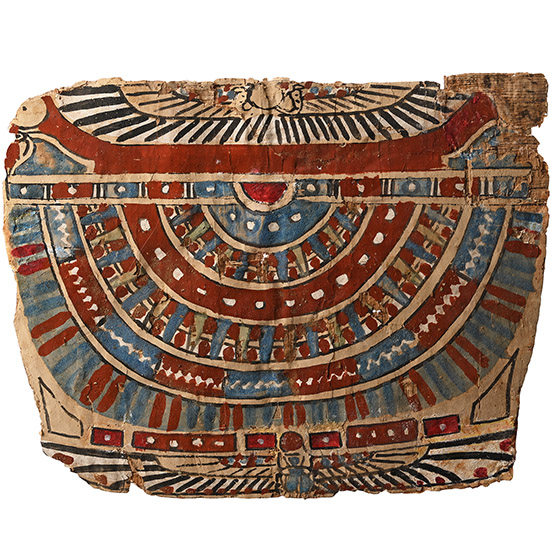
Egyptian Cartonnage Pectoral Panel on Stand
Late Period-Ptolemaic Period, circa 664-30 B.C.Estimate: £1,500 - 2,000 (+bp*)
Opening Bid: £800
Rectangular panel with bands of triangles, teardrops and other motifs in white, red, blue and pale green; winged scarab at the bottom, lower portion of a winged sun disc flanked by uraei to the top; mounted on a custom-made stand. 2.06 kg total, 31.4 cm wide including stand
Ex early 20th century collection, London, UK. Accompanied by a copy of a previous illustrated catalogue page, including provenance. This lot has been checked against the Interpol Database of stolen works of art and is accompanied by search certificate no.13518-263302.
This piece was probably part of a set of cartonnage trappings placed on the mummy.
