
Loading, please wait...
LOT 1349
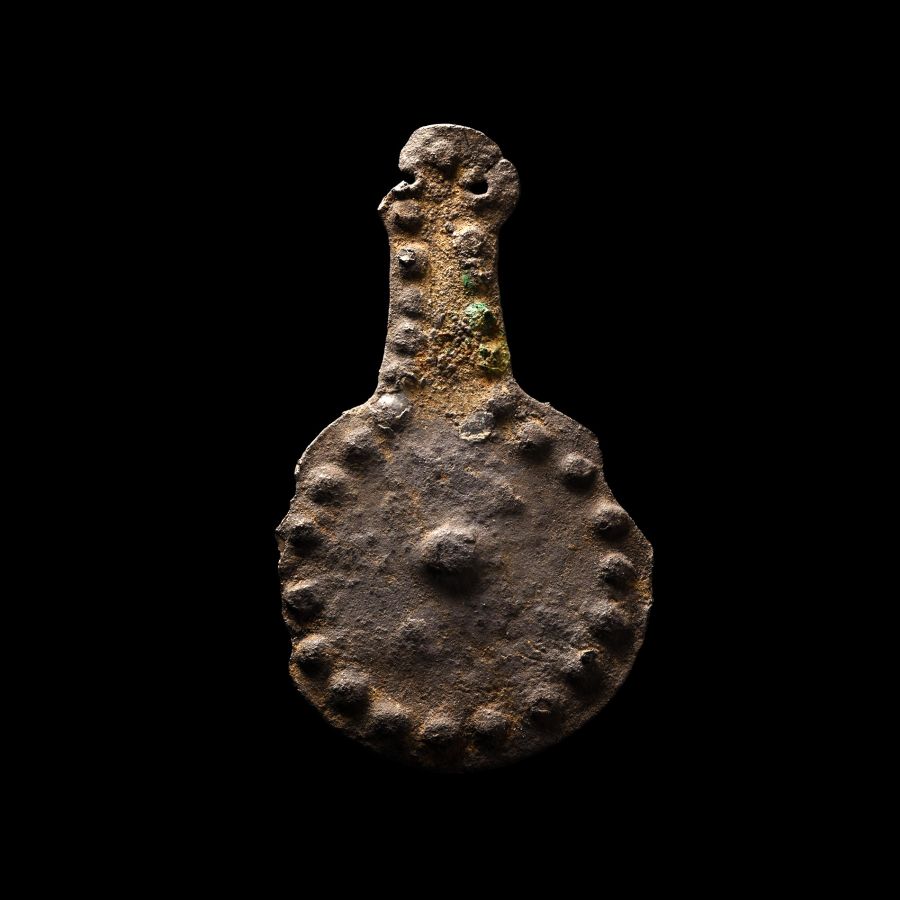
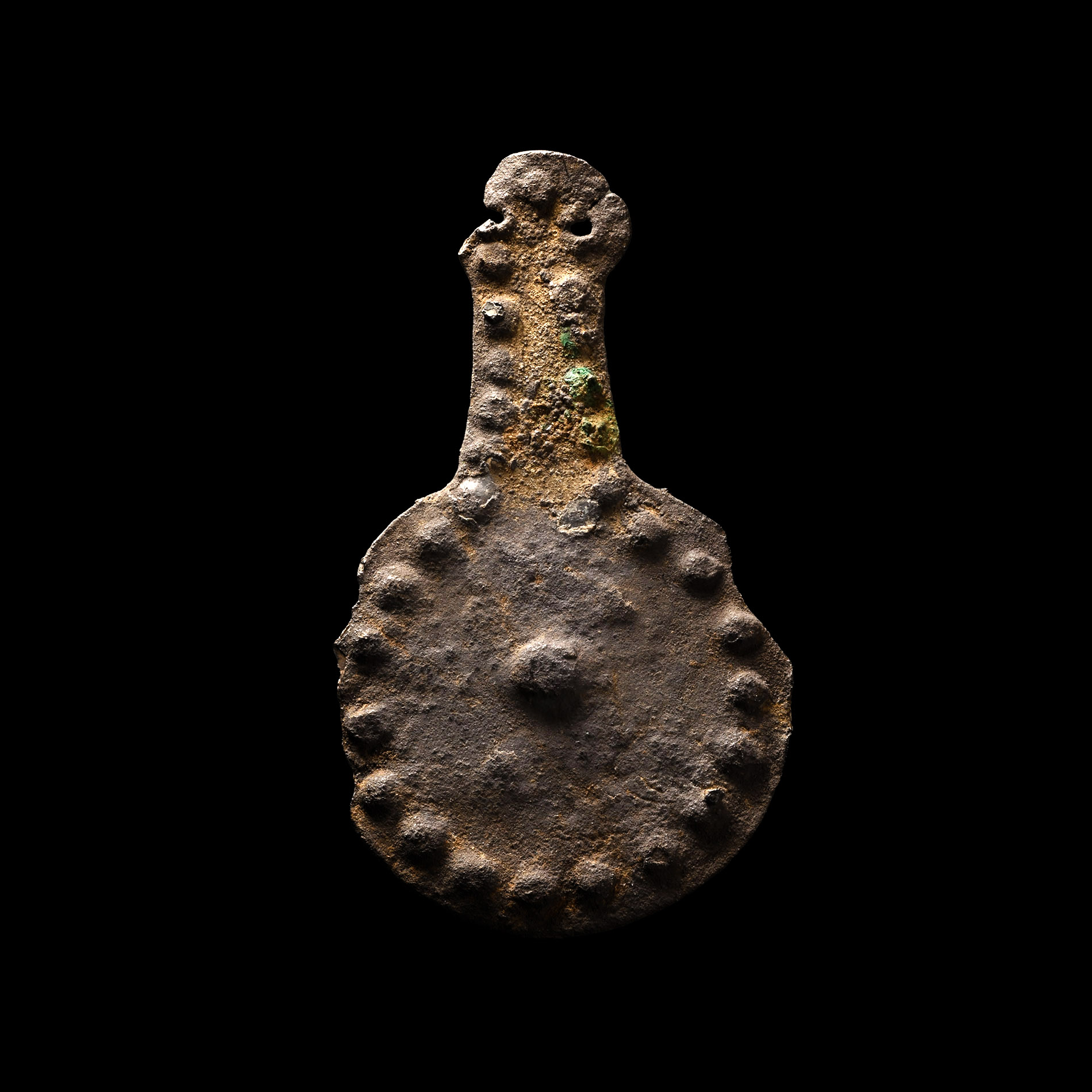
Early Bronze Age Silver Idol
CIRCA 2400-2100 B.C.
2 1/2 in. (5.34 grams, 62 mm).
Violin-shaped with round body, long neck and stylised head, symbolising a female body, perforated with two holes at the top representing the eyes, embossed with dots around the perimeter.
ProvenanceFrom a private family collection formed since the early 19th century, thence by descent.
Property of a New Zealand legal professional.
Accompanied by an academic report by Dr Raffaele D’Amato.
This lot has been checked against the Interpol Database of stolen works of art and is accompanied by search certificate number no.12321-223719.
Cf. for similar idols but in stone and clay, Bilgi, Ö., Anthropomorphic Representations in Anatolia before the Classical Age, Istanbul, 2014, figs. 792-800; for metallic idols of very similar (although not completely identical) shape cf. Zimmermann, T., ‘Anatolia and the Balkans, once again, ring-shaped idols from Western Asia and a critical reassessment of some ‘Early Bronze Age items from Ikiztepe, Turkey’ in Oxford Journal of Archaeology, January, 2007, pp.25-32; Atakuman, Ç., ‘Figurines of the Anatolian Early Bronze Age: the assemblage from Koçumbeli-Ankara’ in Anatolian Studies, 67, 2017, pp.85-108.
CONDITIONTimeLine Auctions follows a vetting process to ensure the authenticity and legality of all items, reinforcing our commitment to integrity and responsible trading. Each antiquity, antique, and coin lot undergoes thorough examination by a vetting committee of at least ten external specialists, professional trade association members, scientists, and archaeologists: Our Vetting Process
AUCTIONS:
TimeLine is a leading auction house specialising in antiquities, ancient art, collectables, natural history, coins, medals, and books. Our auctions offer museums, collectors, historians, and enthusiasts the opportunity to acquire unique and historically significant pieces.
-
.jpg)
Sumerian Ceramic Administrative Cuneiform Tablet
Akkadian, circa 2300-2200 B.C.Sold for (Inc. bp): £624
Square in plan, accompanied by a copy of an old scholarly note, typed by W.G. Lambert, late Professor of Assyriology, University of Birmingham, 1970-1993, which states: 'Clay tablet, 34 x 32 mm., with a total of 8 lines of Sumerian cuneiform on obverse and reverse. Some surface corrosion but much of the script clear. An administrative document with many figures, from Sumer from the Akkadian period, c. 2300-2200 B.C.' 22.22 grams, 35 mm
London, UK, art market, 1980s. Private collection, London, UK. Accompanied by a scholarly note (11.), typed and unsigned by Professor Wilfrid George Lambert, with a copy of the note with notes to verso, including 'offered to JPR (J.P. Rosen) at $190 '(19)86. -
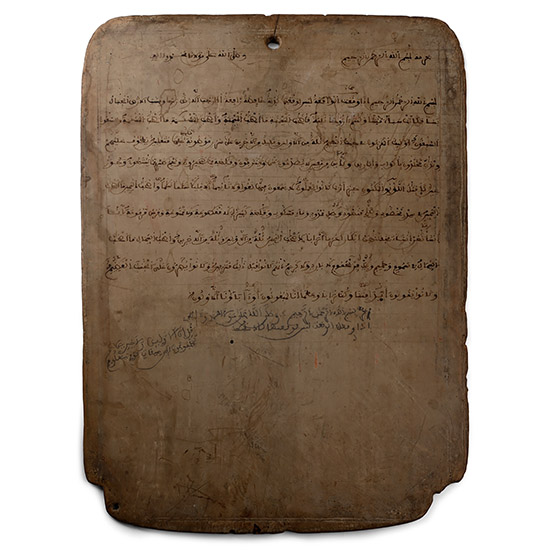
Large Bifacial Wooden Qur'an Board
Morocco, late 19th-early 20th century A.D.Sold for (Inc. bp): £234
Rectangular in plan with flanches to the lower corners and hole to centre-top; Side A with two lines of large calligraphic text above five lines of smaller text and tapering section beneath; Side B with ten lines of text and group of notes below. 716 grams, 39.3 x 28 cm
Private collection, UK. -
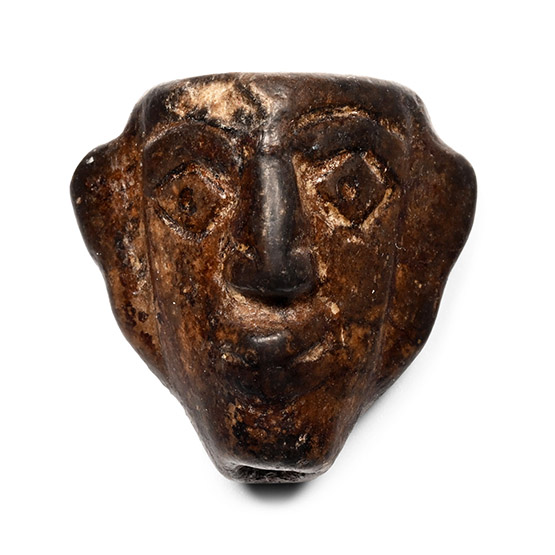
Sumerian Black Stone Face Amulet
Uruk/Jemdet Nasr Period, circa 3500-2900 B.C. or laterSold for (Inc. bp): £390
Carved in the half-round with large eyes and ears; drilled depression above the head and beneath the chin. 4.6 grams, 19 mm
From the 'S' collection, acquired 1970-1990s. Accompanied by a description from Peter Gert Van der Veen, senior lecturer of Levantine Archaeology, Johannes Gutenberg-Universität, Mainz.
