
Loading, please wait...
_900x900.jpg "Early Akkadian Shell Cylinder Seal with Attacking Lions")
_200x200.jpg "Early Akkadian Shell Cylinder Seal with Attacking Lions")
.jpg "Early Akkadian Shell Cylinder Seal with Attacking Lions")
LOT 0206
Early Akkadian Shell Cylinder Seal with Attacking Lions
2400-2200 B.C.
1/4 - 1 1/8 in. (16.1 grams total, 8.1-29.57 mm).
With cord and bead handles; accompanied by a copy of an old scholarly note, typed and signed by W.G. Lambert, late Professor of Assyriology, University of Birmingham, 1970-1993, which states: 'Description of Cylinder Seal of Fossil Shell 30 x 16.5 mm. A god standing in the centre succours a domestic animal on either side which is being attack[ed] in turn by a lion. Terminal: two line[s] below vacant description panel. The seal is of late ED III or early Akkad date, c. 2400-2200 B.C. The cutting is marked by a strong use of the drill. The seal is worn, though the design clear. The meaning of the design is based on real life. Lions were a real threat to the herds and flocks of the community, and it was hoped that the depiction of a god coming to the rescue of the domestic creatures would mean that in real life their animals would be similarly saved by divine help.'; accompanied by a museum-quality impression. [No Reserve]
ProvenanceUK private collection, acquired 1980-1983.
Accompanied by a copy of a scholarly note, typed and signed by Professor Wilfrid George Lambert in August 1990.
This lot has been cleared against the Art Loss Register database, and is accompanied by an illustrated lot declaration signed by the Head of the Antiquities Department, Dr Raffaele D'Amato.
TimeLine Auctions follows a vetting process to ensure the authenticity and legality of all items, reinforcing our commitment to integrity and responsible trading. Each antiquity, antique, and coin lot undergoes thorough examination by a vetting committee of at least ten external specialists, professional trade association members, scientists, and archaeologists: Our Vetting Process
AUCTIONS:
TimeLine is a leading auction house specialising in antiquities, ancient art, collectables, natural history, coins, medals, and books. Our auctions offer museums, collectors, historians, and enthusiasts the opportunity to acquire unique and historically significant pieces.
LOT 0206
Early Akkadian Shell Cylinder Seal with Attacking Lions
Sold for (Inc. bp): £195
-
.jpg)
Early Dynastic Lapis Lazuli Master of Animals Type Cylinder Seal
2600-2340 B.C.Sold for (Inc. bp): £780
With incuse design including an advancing human figure and two rampant stags; old collector's tag. 4.19 grams, 18 mm
Ex 'S' collection, London, UK. Examined by Professor Wilfrid George Lambert FBA (1926-2011), historian, archaeologist, and specialist in Assyriology and Near Eastern archaeology, in the late 1980s and early 1990s. This lot has been cleared against the Art Loss Register database, and is accompanied by an illustrated lot declaration signed by the Head of the Antiquities Department, Dr Raffaele D'Amato. -
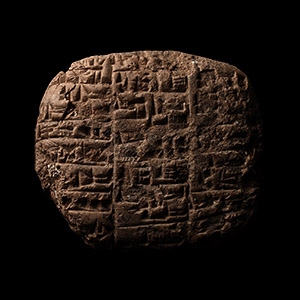
Sumerian Cuneiform Tablet Listing Goods Including 1 Shekel of Refined Silver from Mr Enshaga
Early Dynastic Period, circa 2500 B.C.Sold for (Inc. bp): £1,105
Pillow-shaped with impressed text to both faces; accompanied by an old scholarly note, typed and signed by W.G. Lambert, late Professor of Assyriology, University of Birmingham, 1970-1993, which states: 'Clay tablet 58x64 mm. with 26 Compartments and One Column of Sumerian Cuneiform. This is oblong with rounded sides and edges. each side is divided into 3 columns, and all but the last two are filled with script. This is some kind of legal document from a Sumerian city not so far known for such texts. The first five columns list items, each with a number and followed by a compartment of a different kind. The last column, on the reverse, is different from the others in giving the name and title of an official who in some way presided over the transaction here recorded. Since it is without exact parallel, it is difficult to translate even when the text is clear (there is some surface damage and one corner is broken off). The items given start with "one donkey", and include a quantity of barley (3 gur of barley), "one shekel of refined silver," and "two iku" (acres of agricultural land) is the last item. after which the document concludes: "Mr Enshaga was their seller." Other items are followed by, apparently, personal names, but only once at the end does "was their seller" appears. More study and more similar documents are needed to clear up the problems. The last column begins clearly enough: Ege-anda, Nugig but the final line is not clear. Nugig is a title of a priestess, but only here, it seems, is such a lady a high official giving her blessing to the sale just recorded. This is a most interesting Sumerian document dating to the later early Dynastic periods, c. 2500 B.C.' 95 grams, 64 mm
Ex private collection of Mr S H; thence by descent,1980-1990. Accompanied by an original typed and signed scholarly note by the late W.G. Lambert, Professor of Assyriology at the University of Birmingham, 1970-1993. This lot has been cleared against the Art Loss Register database, and is accompanied by an illustrated lot declaration signed by the Head of the Antiquities Department, Dr Raffaele D'Amato. -
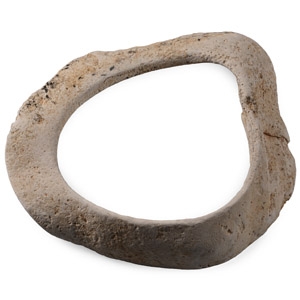
Sumerian Shell Bracelet
Neolithic Period, 4th-3rd millennium B.C.Sold for (Inc. bp): £98
Annular panel cut from a large mollusc shell, domed in section. 126 grams, 13.2 cm
Ex London, UK, collection, 1980-1990s. This lot has been cleared against the Art Loss Register database, and is accompanied by an illustrated lot declaration signed by the Head of the Antiquities Department, Dr Raffaele D'Amato.
