
Loading, please wait...
LOT 2368
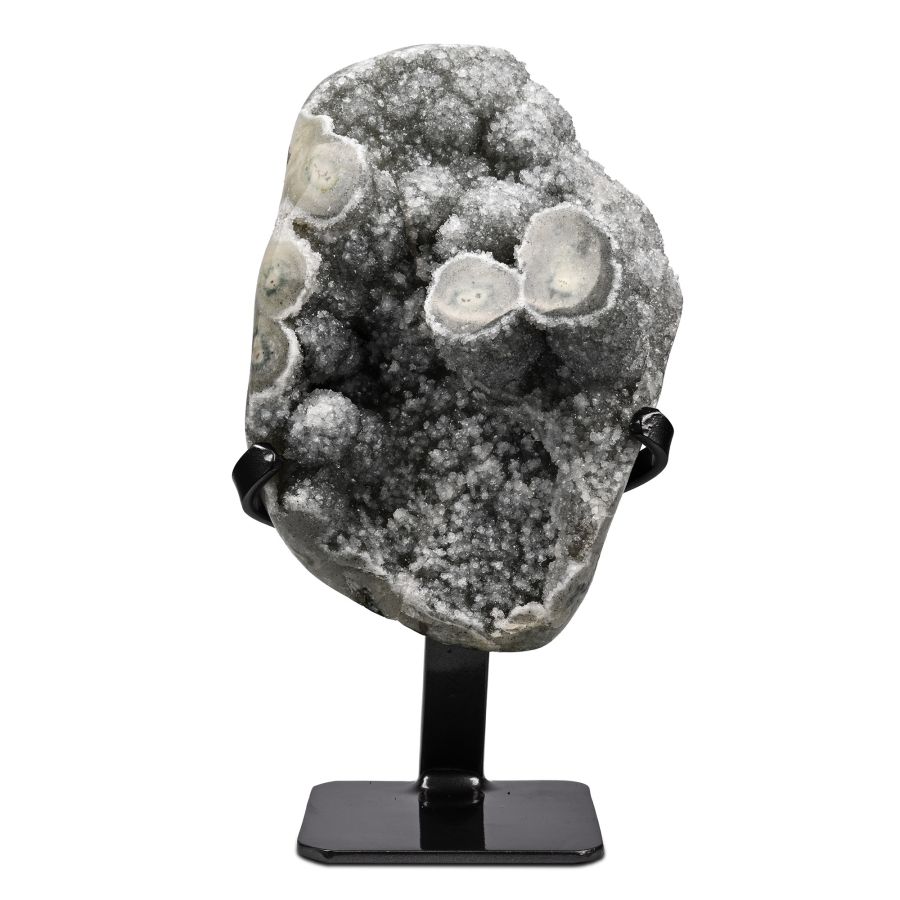
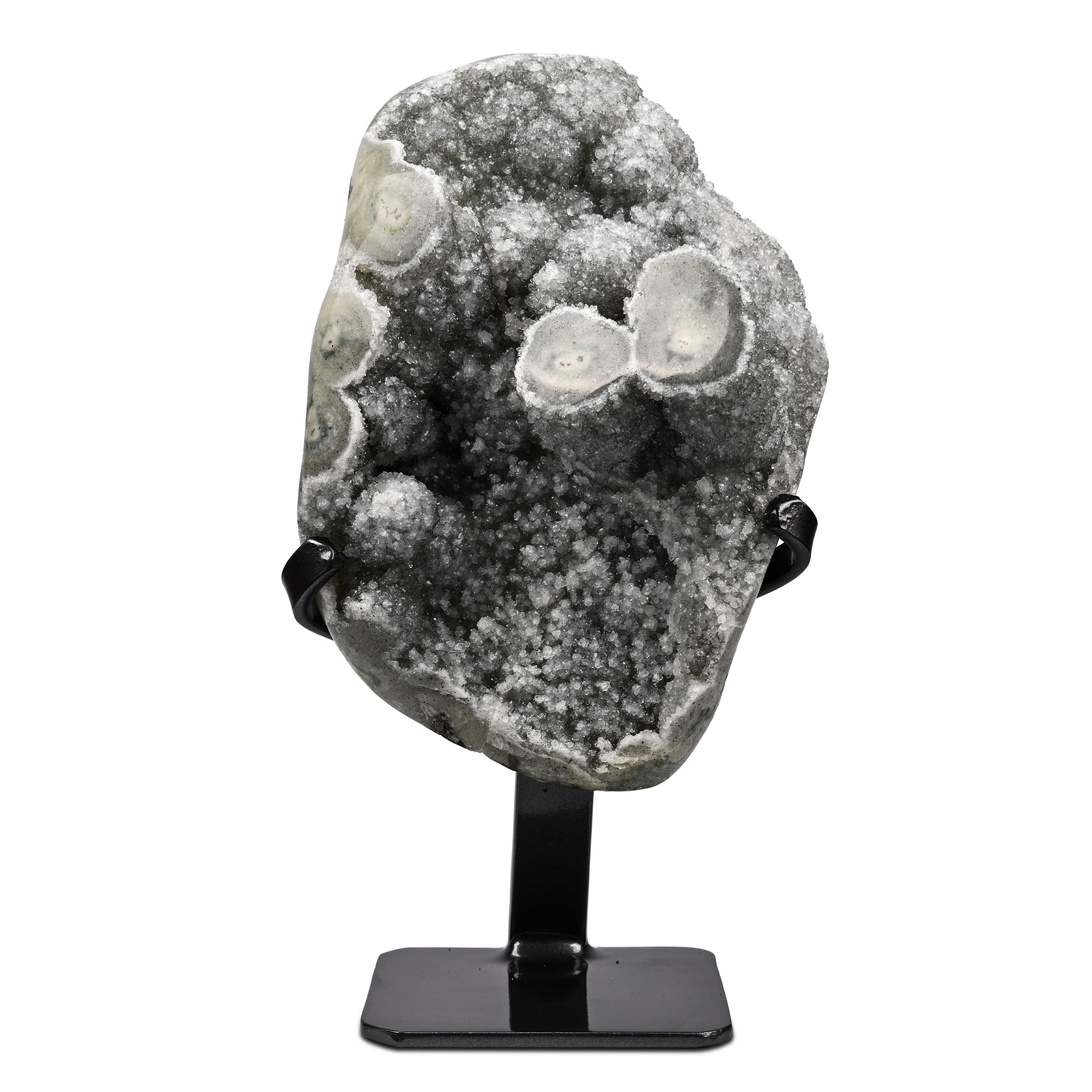
Druzy Quartz Geode Display
CIRCA 140-120 MILLION YEARS B.P.
9 x 7 x 5 7/8, 11 3/8 in. (3.85 kg, 23 x 18 x 15 cm, 29 cm including stand).
An exquisite formation of grey and white druzy quartz on a geode section, a pair of cut stalagmite 'eyes' on one side with polished upper face showing the layered structure; mounted on a custom-made display stand.
ProvenanceFrom Artigas, Uruguay.
Property of a London lady.
TimeLine Auctions follows a vetting process to ensure the authenticity and legality of all items, reinforcing our commitment to integrity and responsible trading. Each antiquity, antique, and coin lot undergoes thorough examination by a vetting committee of at least ten external specialists, professional trade association members, scientists, and archaeologists: Our Vetting Process
AUCTIONS:
TimeLine is a leading auction house specialising in antiquities, ancient art, collectables, natural history, coins, medals, and books. Our auctions offer museums, collectors, historians, and enthusiasts the opportunity to acquire unique and historically significant pieces.
-
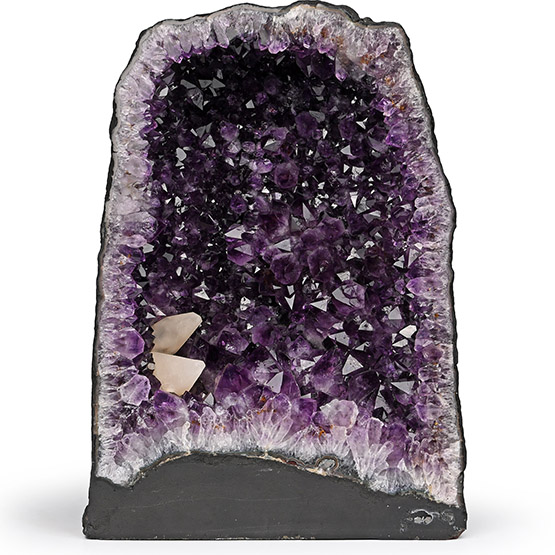
Cathedral Geode Half with Amethyst and Calcite Crystals
Estimate: £1,800 - 2,400 (+bp*)
Opening Bid: £900
The cathedral lined with large deep purple amethyst crystals, white dog tooth calcite crystals emerging from the left corner; mounted on a custom-made display stand. 17.35 kg, 35 cm
From Artigas, Uruguay. Property of a London lady. -
.jpg)
Seymchan Meteorite Cross-Section
Circa 4.5 billion years B.P.Sold for (Inc. bp): £8,450
A magnificent polished cross-section from the Seymchan pallasite meteorite, revealing the honeycomb-like structure characteristic of pallasites, with translucent olivine crystals embedded within iron-nickel crystals; accompanied by a custom-made display stand. 356 grams, 23.2 cm
Discovered in 1967, recovered from the bed of the river Hekandue in the Magadan District, Russia (62° 54’ N, 152° 26’ E).
The main mass of 272.3 kilograms was found during a survey in June 1967 by geologist F. A. Mednikov. The mass was a triangular-shaped thumb-printed meteorite lying among the stones of the brook bed. A second specimen of 51 kilograms was found with a mine detector at a distance of 20 meters from the first in October 1967 by I. H. Markov. During a new expedition in 2004, Dmitri Kachalin recovered about 50 kilograms of new material. Remarkably, about 20% of the new specimens were found to contain olivine crystals, and so revealed the silicate nature of the meteorite. The pallasitic structure was not previously discovered during studies on small metal-only sections of the original mass. The distortion of the Widmanstatten patterns is interpreted as shearing of the superheated meteorite as it broke up in the Earth's atmosphere. -
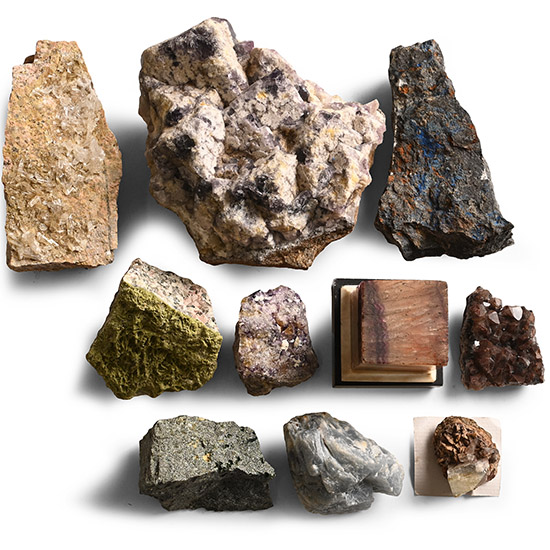
Mixed Ireland, Scotland and English Crystal and Mineral Specimen Group
Sold for (Inc. bp): £39
Comprising: quartz from Cloghmore Quarry, Costelloe, Galway, Ireland; smoky quartz and hematite from Auchinloch Quarry, Dalbeattie, Dumfries, Scotland; baryte from Mowbray Mone, Frizington, Cumbria; pumpellyite from Creag Brimishgan, Isle of Mull, Scotland; fluorite from Mildam Mine, Great Hucklow, Derbyshire; fluorite from Greenlaws Mine, Daddry Sheild, Weardale, Durham; epidote from Cloghmore Quarry, Costelloe, Galway, Ireland; baryte and dolomite from Frizington, Cumbria; azurite from Gortdrum Mine, Monard, Tipperar, Ireland; Blue John on a display stand from Treak Cliff, Castleton, Derbyshire. 3.35 kg total including box, 3.8-12.3 cm
From the property of a Cornwall, UK, gentleman.
