
Loading, please wait...


LOT 0390
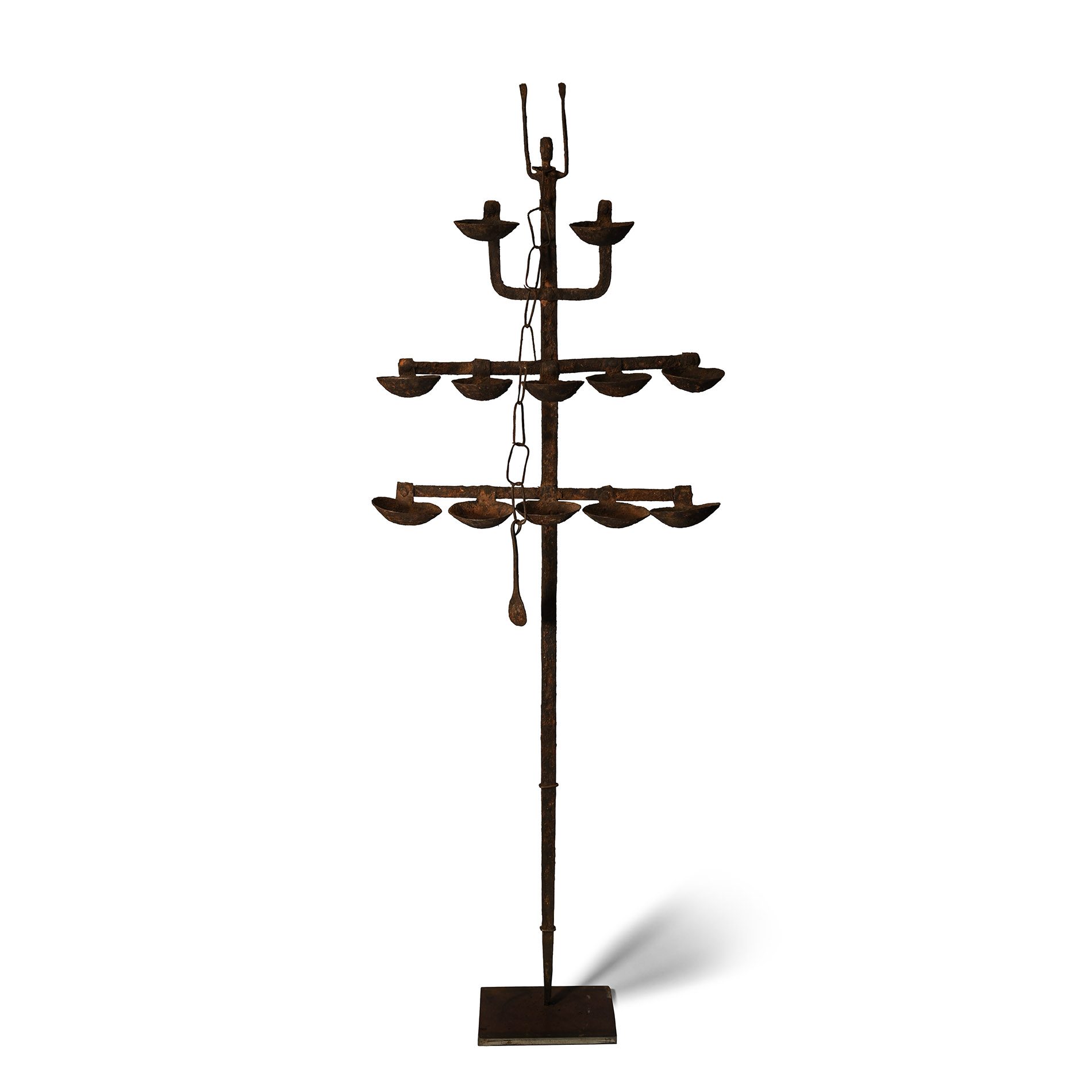
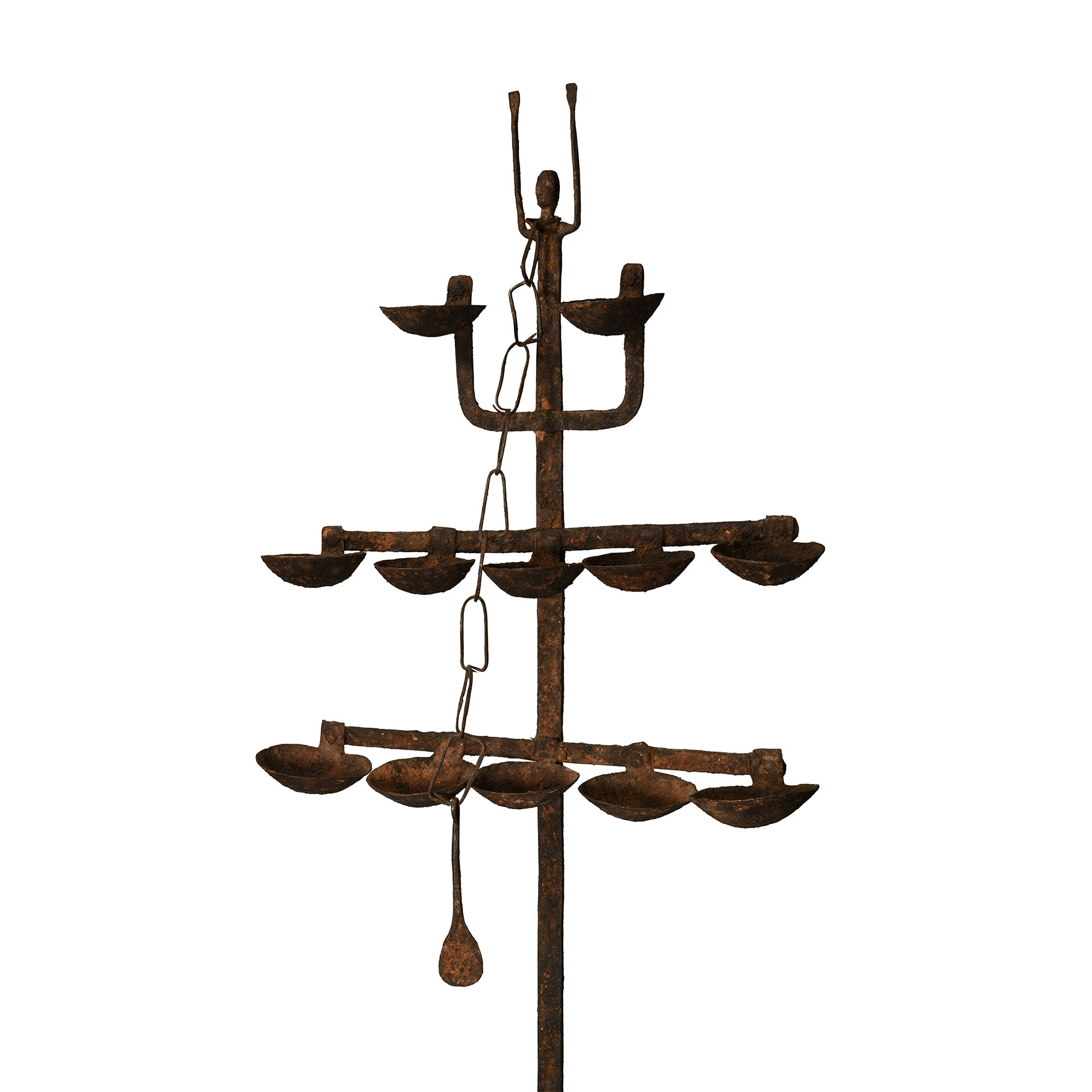
Dogon Iron Multiple Oil Lamp Stand
CIRCA 19TH CENTURY A.D.
52 in. (6.25 kg total, 132 cm including stand).
Iron flat-section shaft with three tiered cross-bars, the two lowest each with five iron lamp-bowls to the forward face; above, a U-shaped bar with a lamp bowl at each upper end; top of the shaft developing to an anthropomorphic torso with ellipsoid head and two narrow arms raised vertically; chain around the neck with hand-forged extinguishing spoon; mounted on a square base; Dogon, Mali, workmanship.
ProvenanceFrom the private collection of Dr Hans-Joachim Koloss, Berlin, Germany, 1975-2002.
Gorny & Mosch, Munich, Germany, auction 279, no.410.
Accompanied by a copy of the Gorny & Mosch invoice and illustrated catalogue listing.
Accompanied by a copy of the German cultural export licence.
This lot is accompanied by an illustrated lot declaration signed by the Head of the Antiquities Department, Dr Raffaele D’Amato.
The figure is probably a Nommo a primordial ancestral spirit in Dogon cosmogony. A Nommo is usually considered to be amphibious, hermaphroditic and fish-like depicted in Dogon art with a humanoid upper torso, and a fish-like lower torso and tail.
CONDITIONTimeLine Auctions follows a vetting process to ensure the authenticity and legality of all items, reinforcing our commitment to integrity and responsible trading. Each antiquity, antique, and coin lot undergoes thorough examination by a vetting committee of at least ten external specialists, professional trade association members, scientists, and archaeologists: Our Vetting Process
AUCTIONS:
TimeLine is a leading auction house specialising in antiquities, ancient art, collectables, natural history, coins, medals, and books. Our auctions offer museums, collectors, historians, and enthusiasts the opportunity to acquire unique and historically significant pieces.
LOT 0390
Dogon Iron Multiple Oil Lamp Stand
Estimate £600 - 800€700 - 930 (for guidance only)$810 - 1,080 (for guidance only)
-
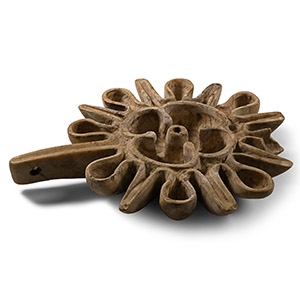
Jewish Stone Menorah Oil Lamp
19th century A.D. or earlierEstimate: £200 - 300 (+bp*)
Opening Bid: £100
Comprising a rectangular handle with hole for suspension supporting a quatrefoil reservoir with central filling tube, outer ring with seven radiating arms and interstitial hollow lobes; basal ring to underside. 1.53 kg, 29 cm
Mr F.D. collection, acquired on the European art market, 1975 to present. This lot is accompanied by an illustrated lot declaration signed by the Head of the Antiquities Department, Dr Raffaele D’Amato. -
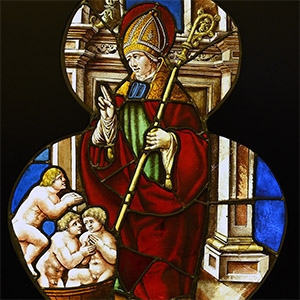
Renaissance Illuminated Souflet Panel with Saint Nicholas
Northern France, Champagne, Troyes, circa 1530 A.D.Sold for (Inc. bp): £2,600
Rectangular framed souflet reveal with inset stained glass depicting St. Nicholas standing wearing episcopal robes and mitre and holding a golden crozier beside a tub with three nude male infants; with integral backlight and 12V DC transformer and three-pin plug. 33.5 kg total, 100.5 x 80.5 cm including frame
Ex Neil Phillips Stained Glass Ltd, 2018. This lot has been checked against the Interpol Database of stolen works of art and is accompanied by a search certificate number no.12550-230648. This lot has been cleared against the Art Loss Register database, and is accompanied by an illustrated lot declaration signed by the Head of the Antiquities Department, Dr Raffaele D’Amato.
The scene depicts St. Nicholas and the three children whom he saved from death. Tradition has it that three boys were playing in a field during the harvest. They wandered into the city and were soon lost, so they stopped at a butcher's premises to ask for food and a place to sleep. The butcher murdered them and kept their remains salted in a barrel. Some time later, Saint Nicholas visited the premises and commanded the butcher to open the large salting tub where the bodies still lay. Saint Nicholas said “Rise up, children!” and thus he miraculously resurrected the boys. -
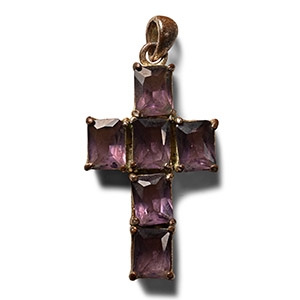
Silvered Cross Pendant with Amethyst Gemstones
Circa 19th century A.D.Sold for (Inc. bp): £85
Cruciform in plan with open reverse to each cell, inset table-cut amethysts, plain bale. 7.68 grams, 43 mm
Acquired on the London art market in the late 1980s-1990s. From the family collection of an East London, UK, gentleman. This lot is accompanied by an illustrated lot declaration signed by the Head of the Antiquities Department, Dr Raffaele D’Amato.
