
Loading, please wait...
LOT 0272
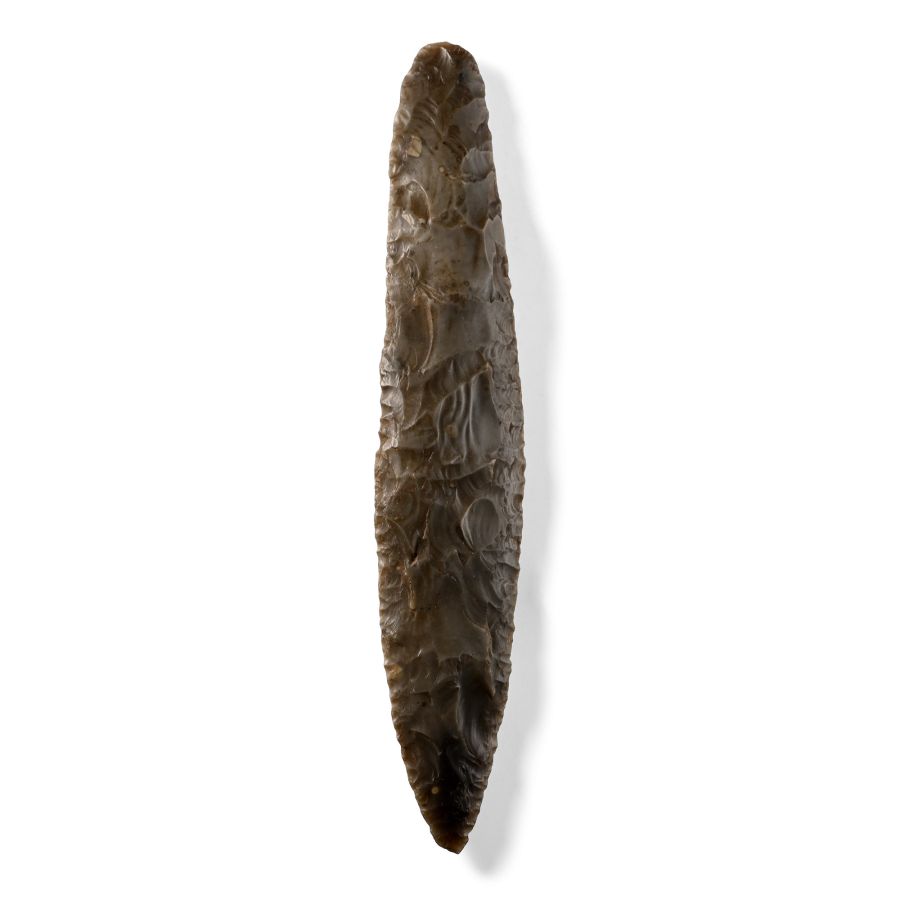
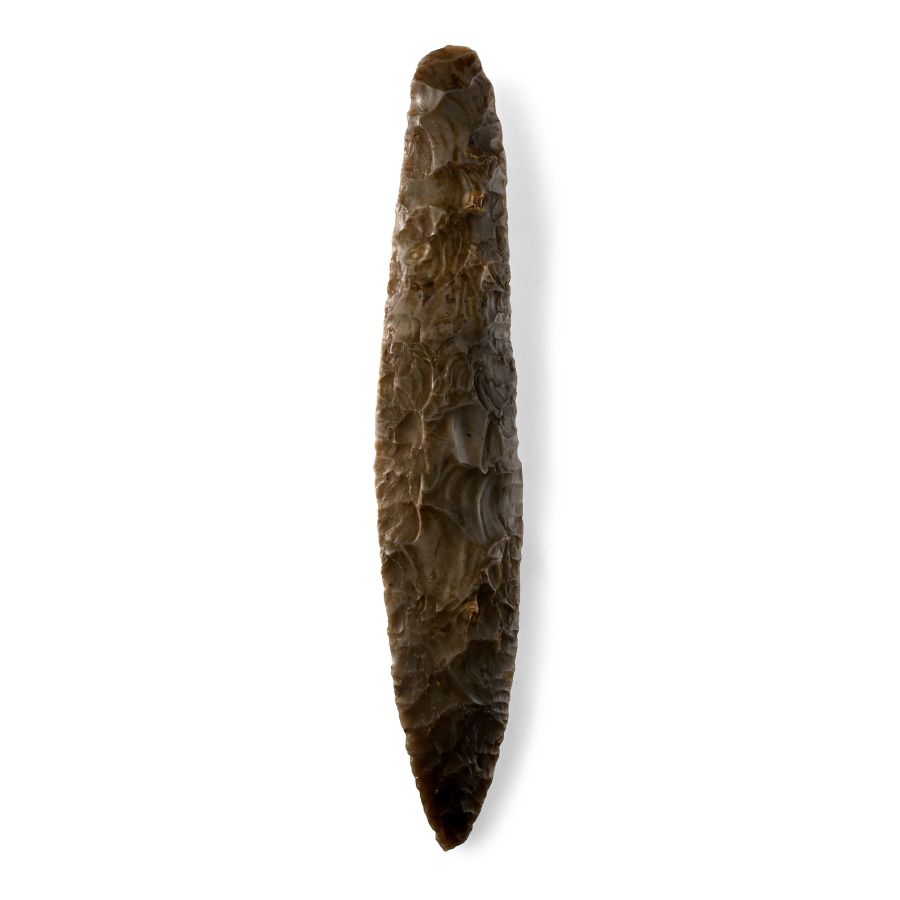
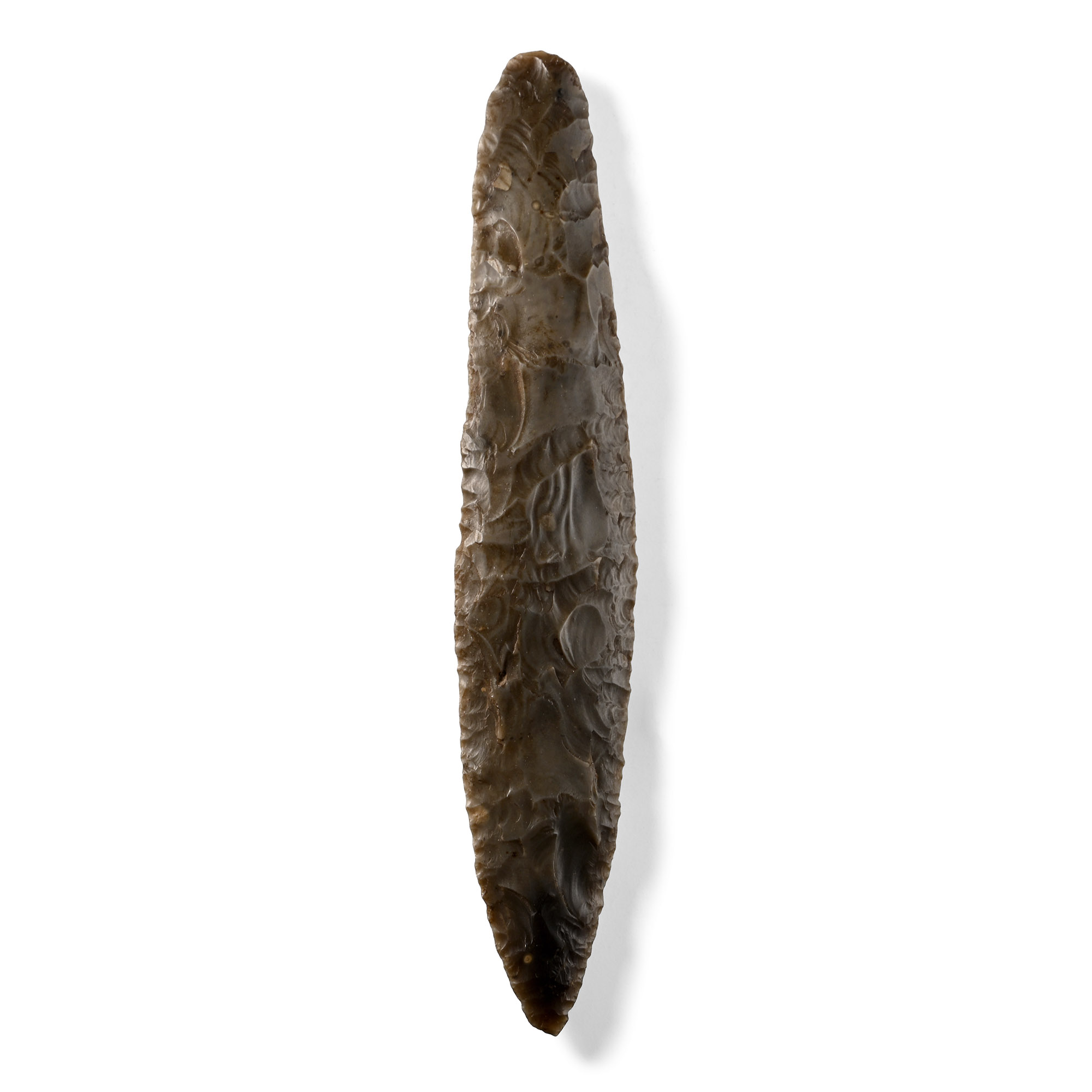
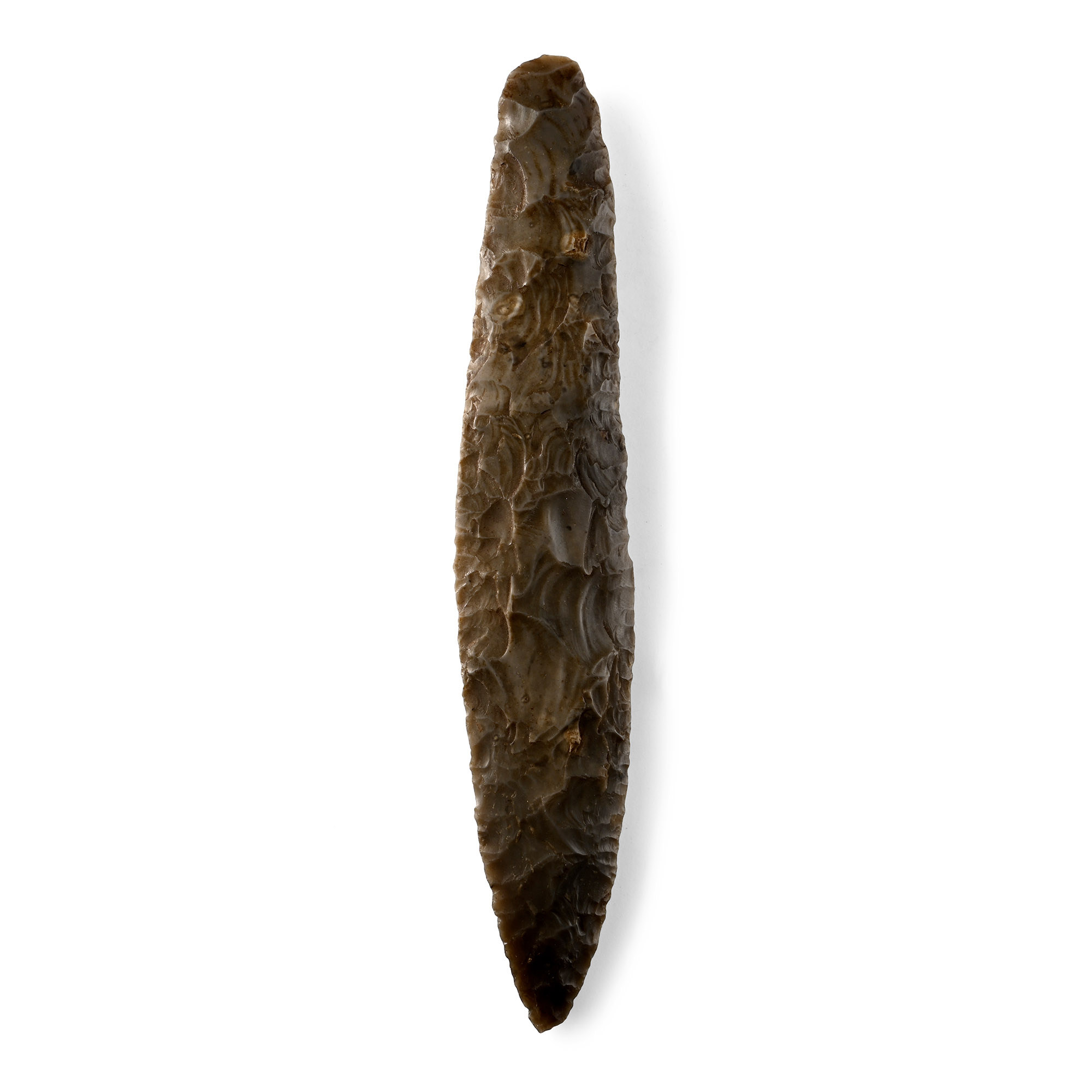
Danish 'Type-1B' Knapped Flint Dagger
NEOLITHIC EARLY DAGGER PERIOD, CIRCA 4400-3800 B.P.
7 1/4 in. (66 grams, 18.3 cm).
A finely made and complete early fine Senonian or Danian flint dagger belonging to the Danish Single Grave Culture (Dolktid), a slender lanceolate outline with near-parallel sides, a discreetly indicated hafting zone, and the maximum width placed at or just ahead of the midsection.
ProvenanceFound Ordrup, Sjaelland Island, Denmark, 1970.
From the private collection of amateur archaeologist Jorgen Faxholm, UK.
Accompanied by a copy of a previous catalogue sheet with reference.
Cf. Lomborg, E., Die Flintdolche Daenemarks, 1973, p.39, clearly worked and sharpened with parallel percussion, perhaps after damage, but illustrating Type 1B (or a post-knapped type II).
FootnotesThis dagger shows the characteristic manufacturing traits of the earliest dagger horizon. There is no polishing or parallel-struck flaking of the later, more elaborate types. The maker relied on careful, even marginal retouch to create a sharp and functional cutting edge. The dagger appears to retain its original proportions with no evidence of later reworking or reduction. By the time Lomborg formalised the typology, approximately 540 examples of Type 1B were recorded from graves or intentional depositions, with a further circa 150 from unprovenanced contexts. This example sits squarely within that early corpus and represents the form at its best.
CONDITIONTimeLine Auctions follows a vetting process to ensure the authenticity and legality of all items, reinforcing our commitment to integrity and responsible trading. Each antiquity, antique, and coin lot undergoes thorough examination by a vetting committee of at least ten external specialists, professional trade association members, scientists, and archaeologists: Our Vetting Process
AUCTIONS:
TimeLine is a leading auction house specialising in antiquities, ancient art, collectables, natural history, coins, medals, and books. Our auctions offer museums, collectors, historians, and enthusiasts the opportunity to acquire unique and historically significant pieces.
-
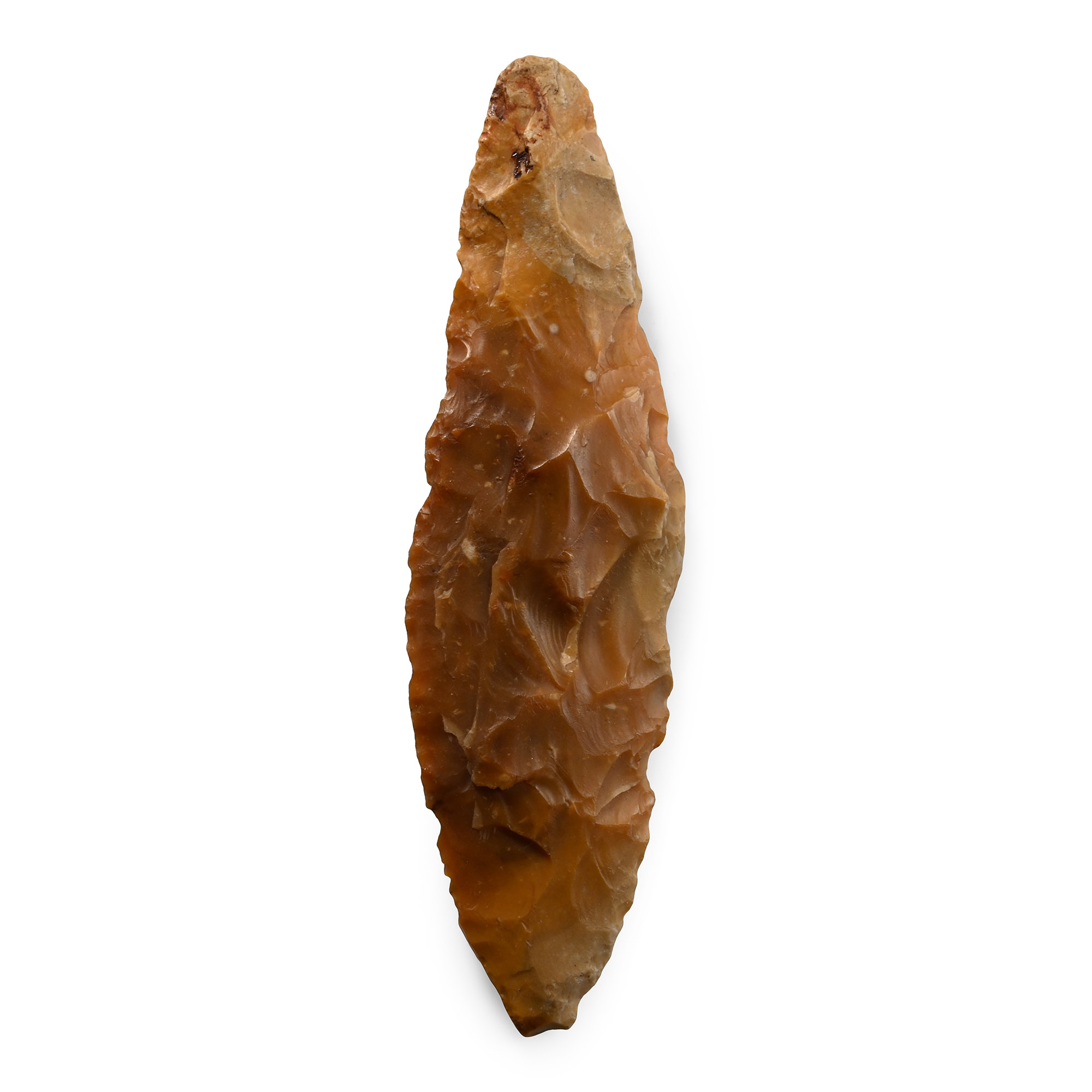
Danish Stone Age Knapped Flint Dagger
Neolithic Period, 3950-3600 B.P.Sold for (Inc. bp): £111
Ovate blade with slightly thickened butt. 40 grams, 11.8 cm
Found Denmark. From the collection of Martin Doyle, Leverstock, UK, 1980s-2000s. -
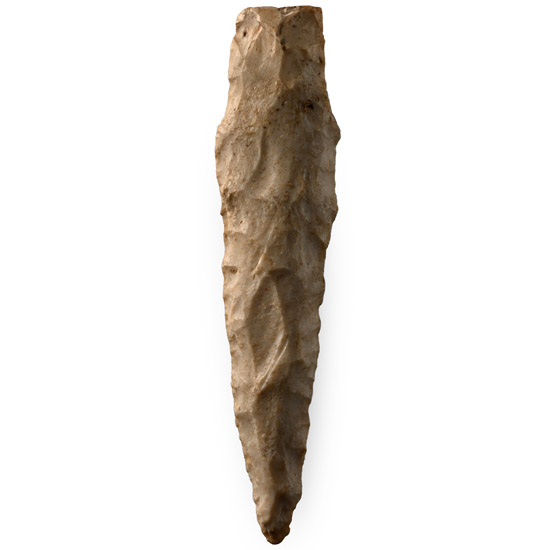
North American Stone Age Knapped Bifacial Dagger
Circa 6000-4000 B.P.Sold for (Inc. bp): £85
Narrow blade made from cream stone, inked Hugh Fawcett collection monogram and notes 'North America, 60-47'. 33.5 grams, 10.8 cm
Ex Dr Hugh Alderson Fawcett (1891-1982), a general practitioner and antiquarian who built up an important collection of ancient implements, weapons and ornaments. From the collection of a West Sussex collector. Acquired from the UK art market in the 2020s.
Dr Hugh Alderson Fawcett (1891-1982) was a general practitioner and antiquarian who built up an important collection of ancient implements, weapons and ornaments. The bulk of his collection is now in the Bristol Museum and Art Gallery, but Fawcett previously sold or traded some examples. His distinctive monogram and careful recording of provenance make his pieces readily identifiable. -
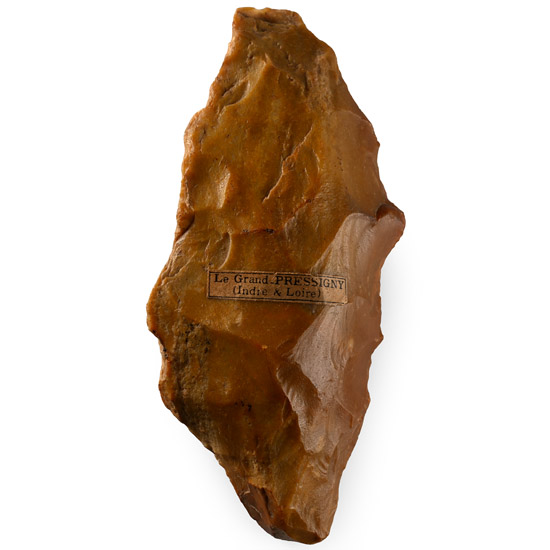
Stone Age Handaxe Rough Out
Neolithic Period, circa 6,000 B.P.Sold for (Inc. bp): £91
In yellow-brown stone, an old collector's label reading 'Le Grand-Pressigny (Indie & Loire)' on one side and an inked note 'N 1 Neol. Le Grand Pressigny' on the other side. 360 grams, 15 cm
From Le Grand-Pressigny, France (according to label and inscription). Collection of Michel C. Vaes, Belgium, formed 1960s-90s. Accompanied by a copy of EU Licence no.2026 DMF 0436.
