
Loading, please wait...
LOT 0515
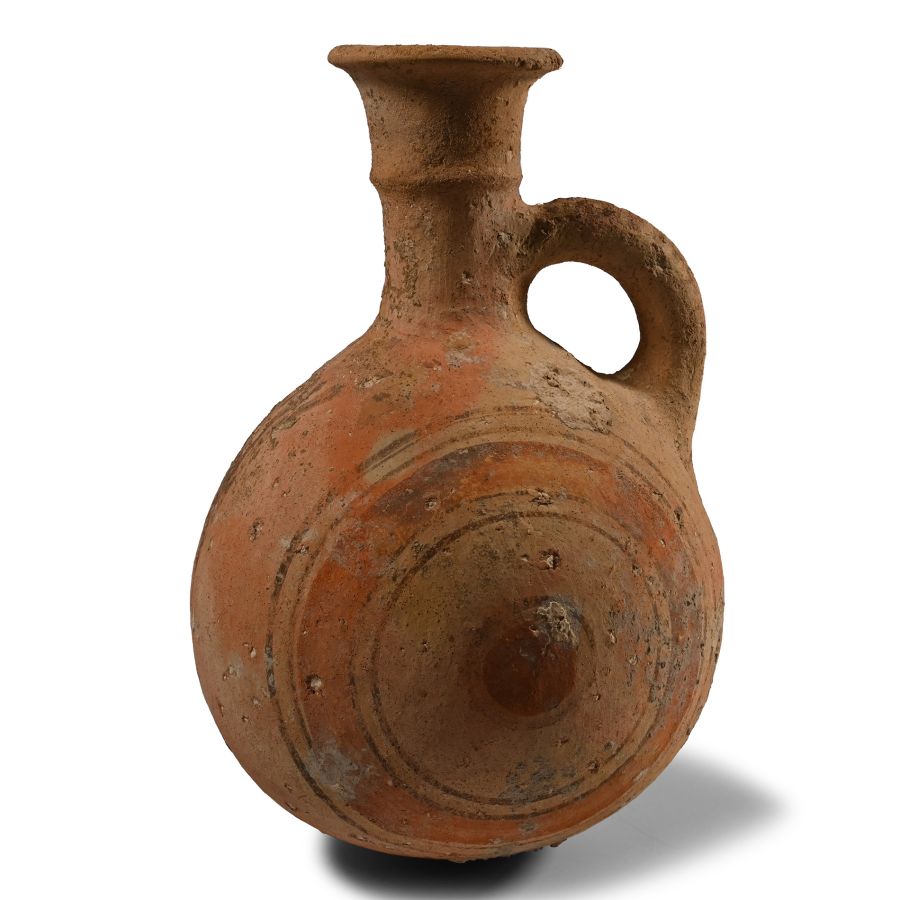
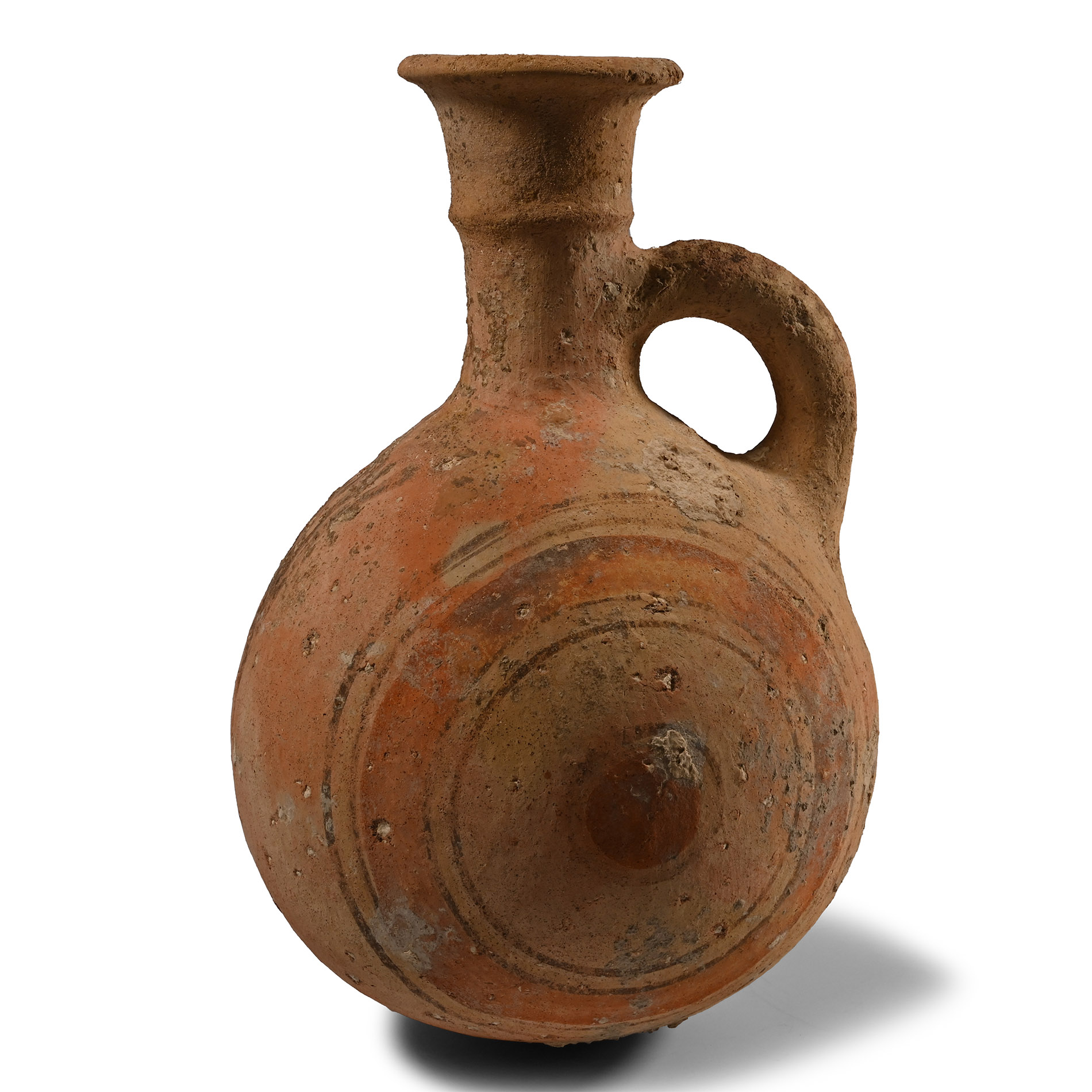
Cypro-Phoenician Terracotta Jug
IRON AGE, CIRCA 8TH-6TH CENTURY B.C.
8 1/2 in. (787 grams, 21.5 cm).
A globular flask with tubular neck and flared rim, loop handle to the shoulder and rib to the neck; concentric rings of red and black to the broad faces, radiating lines below the neck.
ProvenanceEx London art market 1990s.
From a London, UK, collection.
This lot is accompanied by an illustrated lot declaration signed by the Head of the Antiquities Department, Dr Raffaele D’Amato.
TimeLine Auctions follows a vetting process to ensure the authenticity and legality of all items, reinforcing our commitment to integrity and responsible trading. Each antiquity, antique, and coin lot undergoes thorough examination by a vetting committee of at least ten external specialists, professional trade association members, scientists, and archaeologists: Our Vetting Process
AUCTIONS:
TimeLine is a leading auction house specialising in antiquities, ancient art, collectables, natural history, coins, medals, and books. Our auctions offer museums, collectors, historians, and enthusiasts the opportunity to acquire unique and historically significant pieces.
-
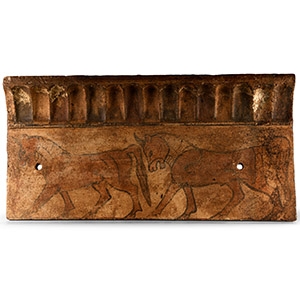
Large Etruscan Cornice Section
6th century B.C.Sold for (Inc. bp): £4,680
For a temple pediment (sima), comprising a curved upper band with polychrome tongue-shaped grooves, a relief depicting a procession of bulls below, the bulls depicted in a dynamic pose with curving necks and raised tails, the horns painted in black; two attachment holes. 4.66 kg, 50 cm
Acquired on the European art market between 1960s-1980s. Property of a gentleman. with Bertolami Fine Arts Ltd, Auction 66, no.1. Accompanied by an academic report by Dr Raffaele D’Amato. This lot has been checked against the Interpol Database of stolen works of art and is accompanied by search certificate number no.12162-218594. This lot has been cleared against the Art Loss Register database, and is accompanied by an illustrated lot declaration signed by the Head of the Antiquities Department, Dr Raffaele D’Amato.
Terracotta plaques like this sima were used in the pediments of temples (Minerva at Veii, Portonaccio Sanctuary, 540-530 BC), or decorated the architecture of tombs. The procession of the bulls recalls the style of painting on a similar slab with a procession of hunting dogs, probably from Caere. -
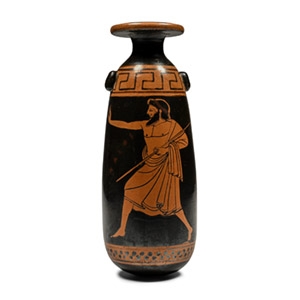
Greek Terracotta Attic Red-Figure Alabastron
Circa 500 B.C.Sold for (Inc. bp): £6,500
Ovoid shape with short neck and expanded flat rim, lugs on the sides; painted with daily life scenes: one side with an older man holding a crozier, dressed in chiton and himation, the other side with a younger bearded man holding a short staff, dressed in a similar way; meander pattern above and a dotted band below; some restoration. 125 grams, 13.6 cm
with Hirsch Auction, 23 September 2006, no.666. Accompanied by an academic report by Dr Raffaele D’Amato. This lot has been checked against the Interpol Database of stolen works of art and is accompanied by search certificate number no.12463-228723. Accompanied by thermoluminescence analysis report no.06280606 by Laboratory Kotalla. This lot has been cleared against the Art Loss Register database, and is accompanied by an illustrated lot declaration signed by the Head of the Antiquities Department, Dr Raffaele D’Amato.
The men depicted on this vessel are each holding an elegant walking stick appropriate to Athenian citizens. They both seem to be in a drunken rage, and seemingly have just left a drinking party: the consequences of immoderate drinking were a favourite subject for vessel decorations. -
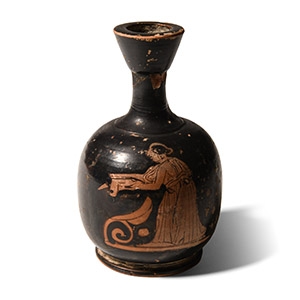
Greek Red-Figure Lekythos
5th century B.C.Sold for (Inc. bp): £1,170
Of ovoid form with trumpet-shaped spout and strap handle, reserved image of a lady wearing a large himation, on a baseline with scrolled foliage. 106 grams, 11 cm
Ex German collection, 1970. with Galerie Chenel, Paris, 22 July 2008. This lot is accompanied by an illustrated lot declaration signed by the Head of the Antiquities Department, Dr Raffaele D’Amato.
The word lekythos had a wide meaning in ancient Greece, probably generally meaning all oil jugs, including the athletes' oil bottle (now called aryballos) as well as the types now given this name by archaeologists. Certain lekythoi resemble certain oenochoe superficially, at a first glance. Oenochoes, however, were wine-pitchers and in most cases were larger than the lekythoi, which were small jugs for oil, perfumes, etc.
