Loading, please wait...
LOT 0544
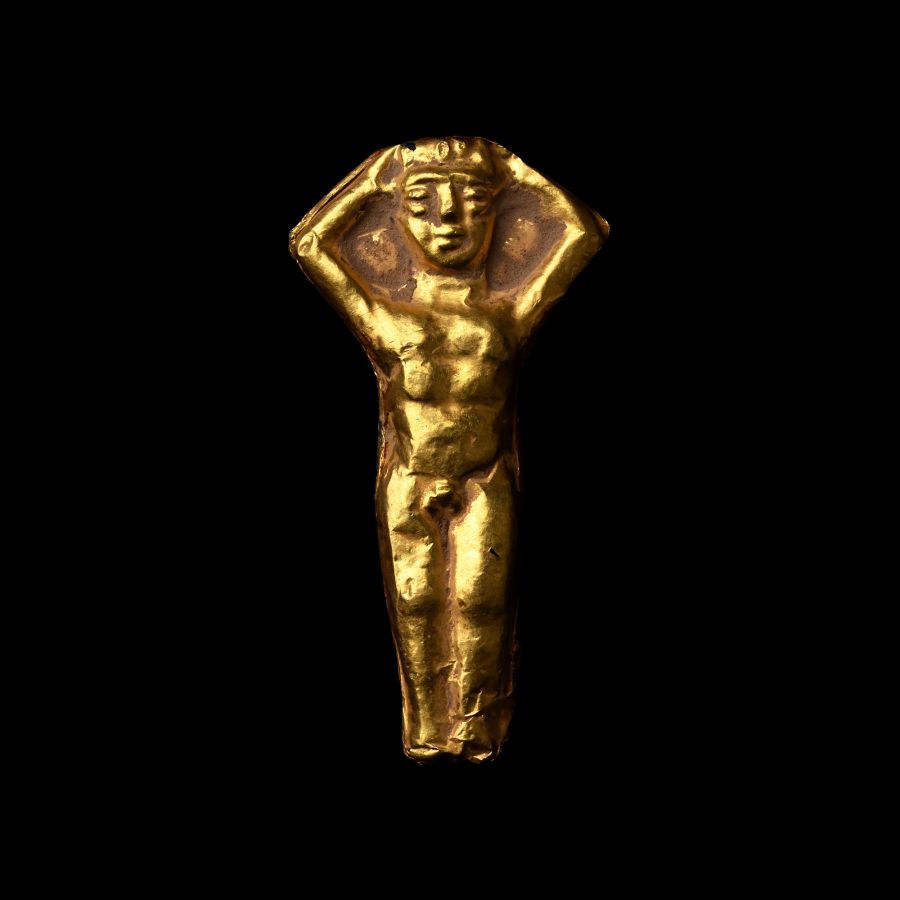
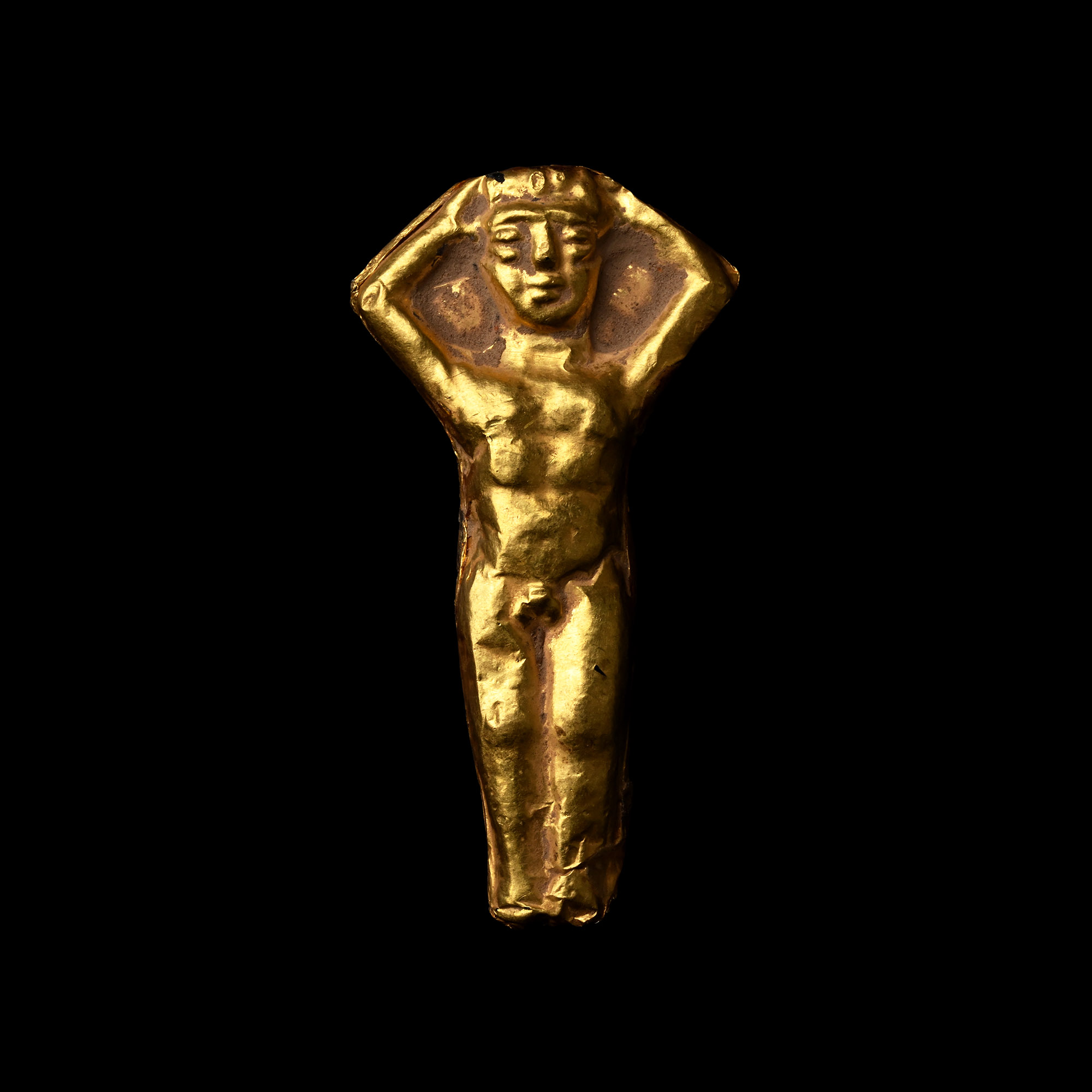
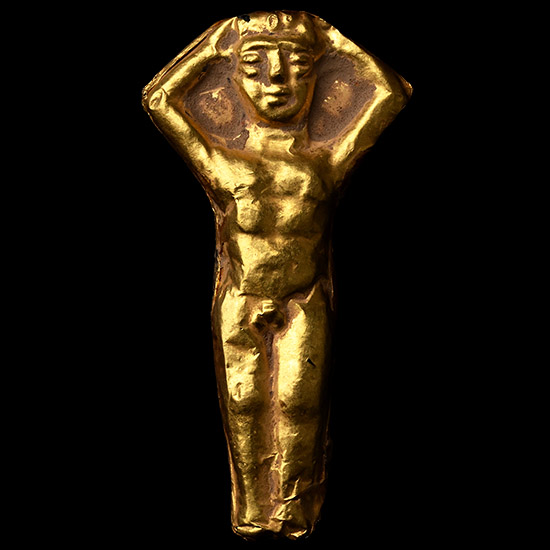
Cypro-Phoenician Gold Bead of a Naked Young Man
MID 1ST MILLENNIUM B.C.
1 1/2 in. (2.08 grams, 38 mm).
Sheet-gold bead modelled in the round as a young nude male with his hands held on top of his head. [No Reserve]
ProvenanceBy repute with Christie's, New York, 1996 and an old European collection.
Private collection, London, UK.
TimeLine Auctions follows a vetting process to ensure the authenticity and legality of all items, reinforcing our commitment to integrity and responsible trading. Each antiquity, antique, and coin lot undergoes thorough examination by a vetting committee of at least ten external specialists, professional trade association members, scientists, and archaeologists: Our Vetting Process
AUCTIONS:
TimeLine is a leading auction house specialising in antiquities, ancient art, collectables, natural history, coins, medals, and books. Our auctions offer museums, collectors, historians, and enthusiasts the opportunity to acquire unique and historically significant pieces.
LOT 0544
Cypro-Phoenician Gold Bead of a Naked Young Man
Estimate £100 - 140€120 - 160 (for guidance only)$140 - 190 (for guidance only)
Opening Bid
£5 (EUR 6; USD 7) +BP*
-
Fragment of an Attic Red-Figure Cup Depicting a Satyr Copulating with a Maenad, Attributed to Epiktetos
Circa 520–490 B.C.Estimate: £4,000 - 6,000 (+bp*)
Opening Bid: £2,000
Dynamic scene featuring a nude, muscular satyr engaged in coitus with a young maenad; the satyr depicted with long curly hair and long dressed beard, a crown of ivy leaves resting on his head, holding the hand of the maenad with his right hand and her waist with the other; the maenad depicted in a half-kneeling position with her right hand grasping the beard of the satyr; partial Greek inscription above 'KTETO' referring to the artist Epiktetos. 31.2 grams, 11.7 cm
Oswald Burchard collection, Zurich, until 1983. M. Hess collection, Hotel Jura, Basel. Private collection, Germany. Private collection, London. One fragment, Antikenmuseum [ACR] Auctions, 17, 30 June 2015, no.14. Two fragments, Bertolami Fine Art, Auction 43, 19 April 2018, no.55. Comprising three fragments, subsequently joined. This lot has been checked against the Interpol Database of stolen works of art and is accompanied by search certificate number no.13326-258216.
Epiktetos is considered a master of the circular image and painted mainly the interiors of cups—specifically "eye-cups," so named because of the two painted eyes on the exterior, which likely served an apotropaic function. His so-called "bilingual" vases feature black-figure painting on the interior, while the exterior of the bowl is decorated in the red-figure style. He painted few mythological scenes (Theseus confronting the Minotaur; a red-figure cup fragment attributed to him depicts Hermes, Apollo, and Artemis or large-scale compositions; instead, he mostly depicted scenes from daily life (an archer, a mounted warrior, figures at a banquet, a sculptor at work as well as erotic scenes featuring men or satyrs. -
Greek Fragmentary Terracotta Red-Figure Hydria
Paestan or Apulian, 4th century B.C.Estimate: £4,000 - 6,000 (‡+bp*)
Opening Bid: £2,200
Comprising the upper two thirds of the vessel; on the shoulder a facing woman's head with diadem and half-veiled face; rosettes to left and right, with suspended ribbons and dots; vine motif around the body with floral ornaments; to the reverse, palmettes and vines; band of laurel with rosettes around the neck and wavy band at the mouth; reassembled from various fragments with three large areas of restoration, only the beginnings of the handles preserved; mounted on a custom-made stand. 1.95 kg, 31 cm (2.6 kg total, 47.5 cm high including stand)
Ex Herbert A. Cahn, Basel, 1990s. This lot has been checked against the Interpol Database of stolen works of art and is accompanied by search certificate number no.12475-228738.
The face-veiling gesture is a known marriage rite; the diadem may suggest that she is intended to represent Persephone. Alternatively, the veiled woman might be a dancer as many terracotta figurines of dancing women are shown with face-coverings. However, the floral ornaments could indicate a funeral or sepulchral context. -
Greek Bronze Ring with Bust of a Philosopher
3rd-2nd century B.C.Estimate: £200 - 300 (+bp*)
Opening Bid: £110
Lentoid-section hoop with integral disc bezel, incuse profile bust of a bearded, balding male. 5.38 grams, 24.33 mm overall, 19.56 mm internal diameter (approximate size British S, USA 9, Europe 20, Japan 19)
Ex German art market, 2000s. Acquired from an EU collector living in London. From the collection of a Surrey, UK, gentleman.