
Loading, please wait...
LOT 0494
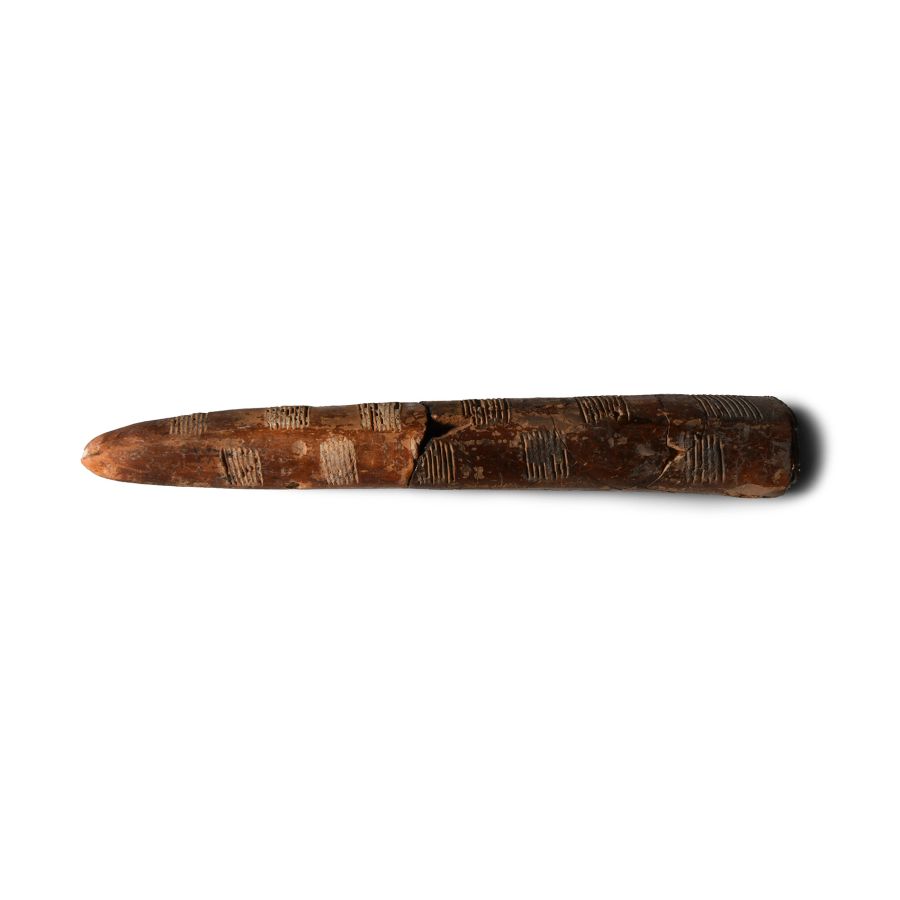
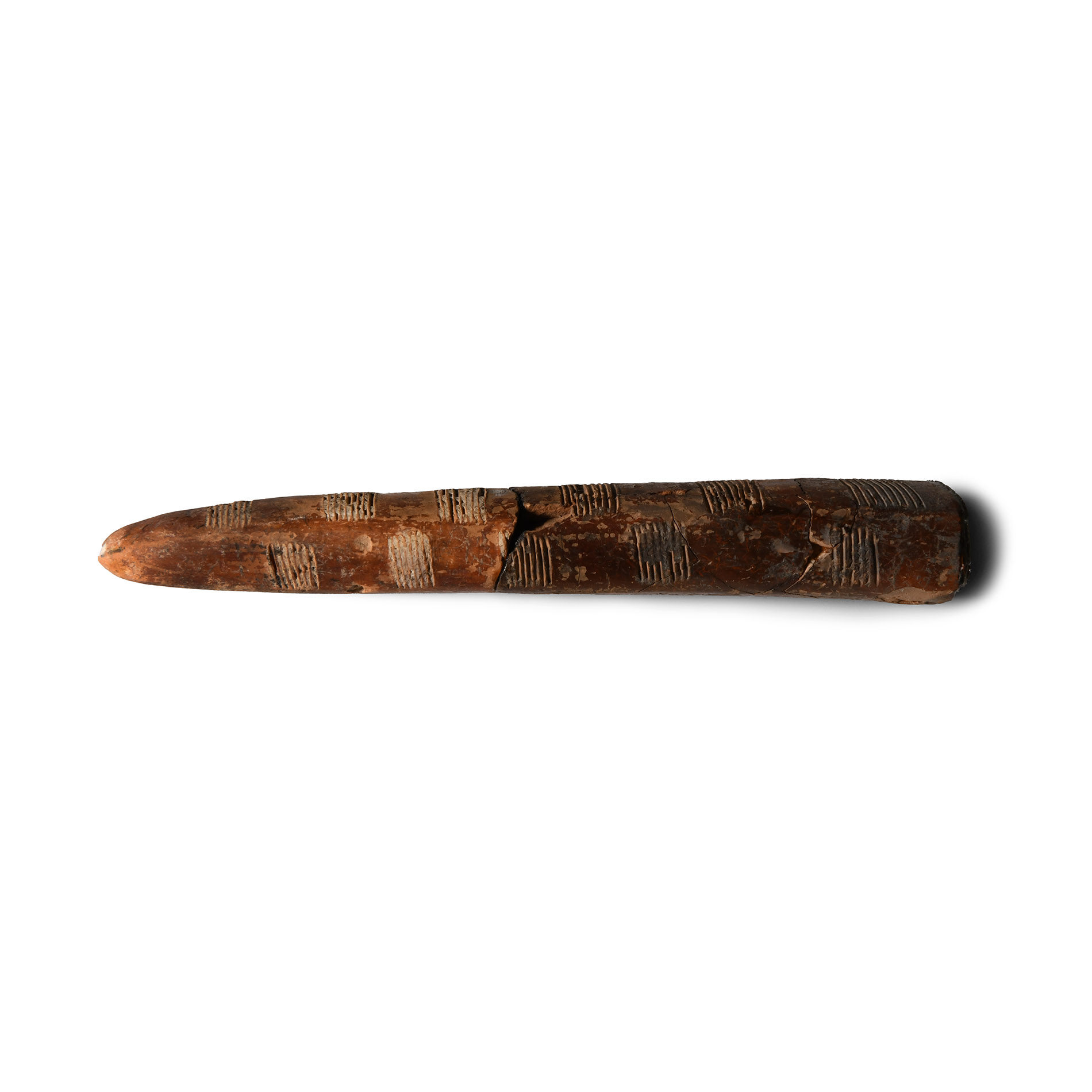
Cypriot Terracotta Votive Horn
2100-1850 B.C.
6 1/2 in. (116 grams, 16.5 cm).
Tapering square-section votive with transverse bands of dense linear hatching; repaired. [No Reserve]
ProvenanceFrom the celebrated personal collection of art formed by the famous anthropologist, artist, and television presenter Desmond Morris.
with Christie’s, South Kensington, 14 May 2002, lot 19 (part).
TimeLine Auctions follows a vetting process to ensure the authenticity and legality of all items, reinforcing our commitment to integrity and responsible trading. Each antiquity, antique, and coin lot undergoes thorough examination by a vetting committee of at least ten external specialists, professional trade association members, scientists, and archaeologists: Our Vetting Process
AUCTIONS:
TimeLine is a leading auction house specialising in antiquities, ancient art, collectables, natural history, coins, medals, and books. Our auctions offer museums, collectors, historians, and enthusiasts the opportunity to acquire unique and historically significant pieces.
-
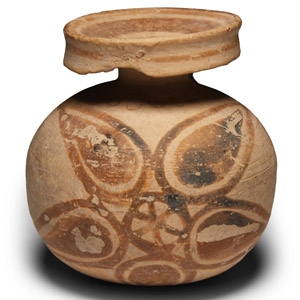
Greek Corinthian Terracotta Aryballos
Circa 6th century B.C.Sold for (Inc. bp): £416
Bulbous-bodied with a short neck, deep rim and strap handle; polychrome roundels to the mouth, orange line to the rim, dots around the shoulder and a five-petalled lotus flower blossoming on the main body, a five-rayed wheel at the centre of the flower and on the opposite side. 96 grams, 77 mm high
Ex P. A., Hertfordshire, UK, specialist collection of Greek art, 1980-1990s.
Corinthian aryballoi with floral quatrefoils or lotus flowers were produced in great numbers throughout the 6th century B.C. and probably into the 5th, and were also widely exported. The simple but distinctive decoration suggests that these vases may have had a specific contents, possibly used as an oil flask. -
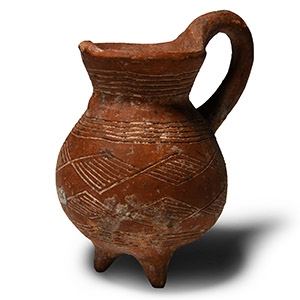
Cypriot Terracotta Juglet with Handle
650-600 B.C.Sold for (Inc. bp): £234
With globular body, three stub legs, flared mouth with spur to the lip; loop handle to the rear; bands of incised geometric ornament. 119 grams, 10.6 cm
Collection of Louis-Gabriel Bellon (1819-1899), Saint-Nicolas-lez-Arras and Rouen, thence by descent. with Millon & Associes Auctions, Paris, 6th December 2021, lot 1. -
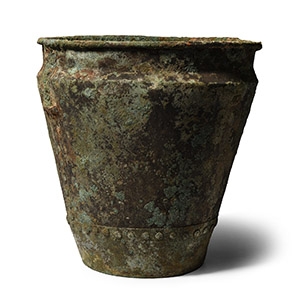
Greek Bronze Situla
5th-4th century B.C.Sold for (Inc. bp): £520
Tall vessel with dished underside, elegant carination at the shoulder, rolled rim; lateral vertical seams each covered by an applied rivetted strip, with remains of handle below the shoulder. 1.56 kg, 26 cm high
Ex Axel Guttmann Collection of Ancient Arms and Armour, Germany [1944-2001], AG 490. This lot has been checked against the Interpol Database of stolen works of art and is accompanied by search certificate no.11953-210857.
